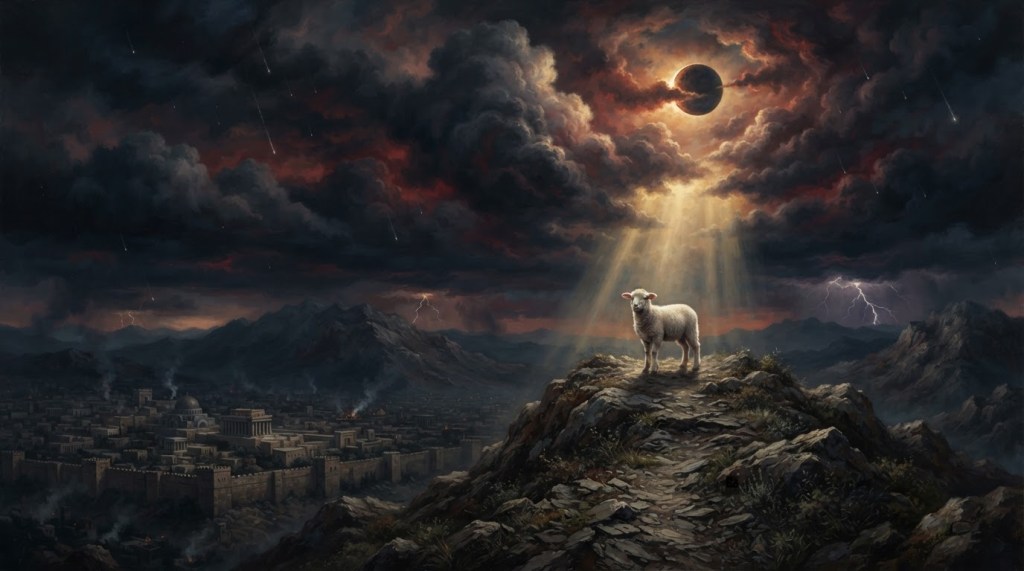
Understanding Revelation and Apocalyptic Literature
Notes and slides from a class I taught on the book of Revelation. Main text: Revelation 1:1–3; 22:6–10.
Introduction: A Book of Blessing, Not a Book of Fear (Revelation 1:3)
Revelation in one hour? We all grin, because it is a little ridiculous.
- To do it, we have to back away from the details and get the big picture.
- Most people either avoid Revelation completely or obsess over every beast and number.
(Revelation 1:3) It is the only book in the Bible that promises a blessing just for reading it.
- Blessed is he who reads, those who hear, and those who keep it.
- God did not write this book to confuse His people. He wrote it to strengthen them.
The details can be hard. The message is simple.
- The mistake is stopping at the first question mark, running to a commentary, and losing the story.
- We get the whole story first. Then we ask when, then we ask what it means for us.
OUR GOAL: SEE THE STORY, HEAR THE MESSAGE, AND KEEP IT.
1. What Is Apocalyptic Literature? (Revelation 1:1)
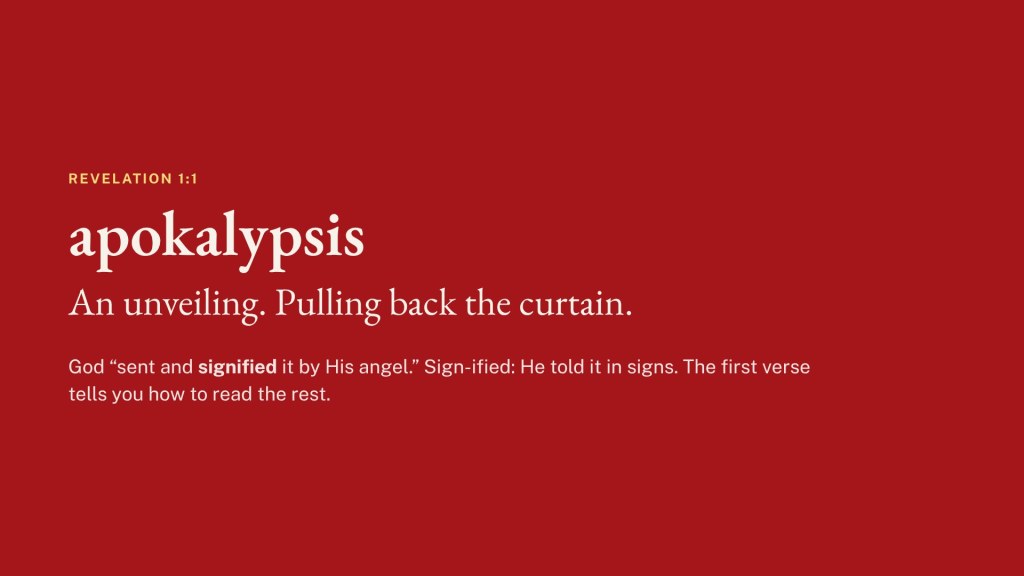
(Revelation 1:1) “The Revelation” is the Greek word apokalypsis: an unveiling, a disclosure.
- It means pulling back the curtain to show what could not otherwise be known.
- Revelation is not a hidden book. It is an uncovered book.
- The NKJV says God “signified” it by His angel. Sign-ified: He told it in signs. The first verse tells you how to read the rest.
Revelation is not the only book written this way.
- Ezekiel, Daniel, Zechariah, and Jesus in Matthew 24 all use the same kind of language.
- Also parts of Isaiah (24–27) and Joel.
- Beasts, horns, numbers, earthquakes, darkened sun, falling stars, people hiding in caves.
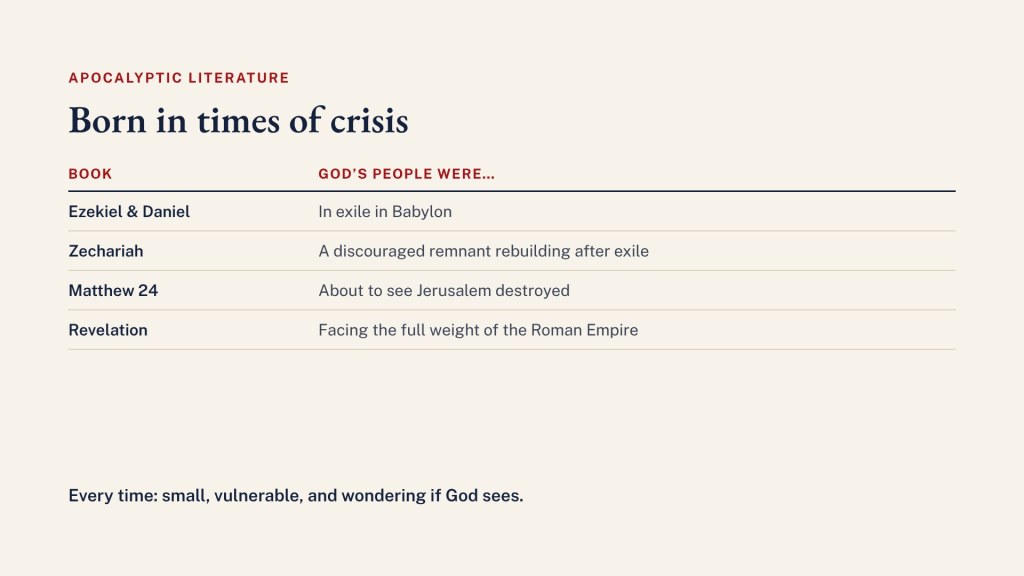
Apocalyptic literature is born in times of crisis.
- Ezekiel and Daniel: God’s people in exile in Babylon.
- Zechariah: a discouraged remnant rebuilding after exile.
- Matthew 24: Jesus preparing disciples for the destruction of Jerusalem.
- Revelation: churches facing the full weight of the Roman Empire.
- Every time, God’s people are small, vulnerable, and wondering if God sees.
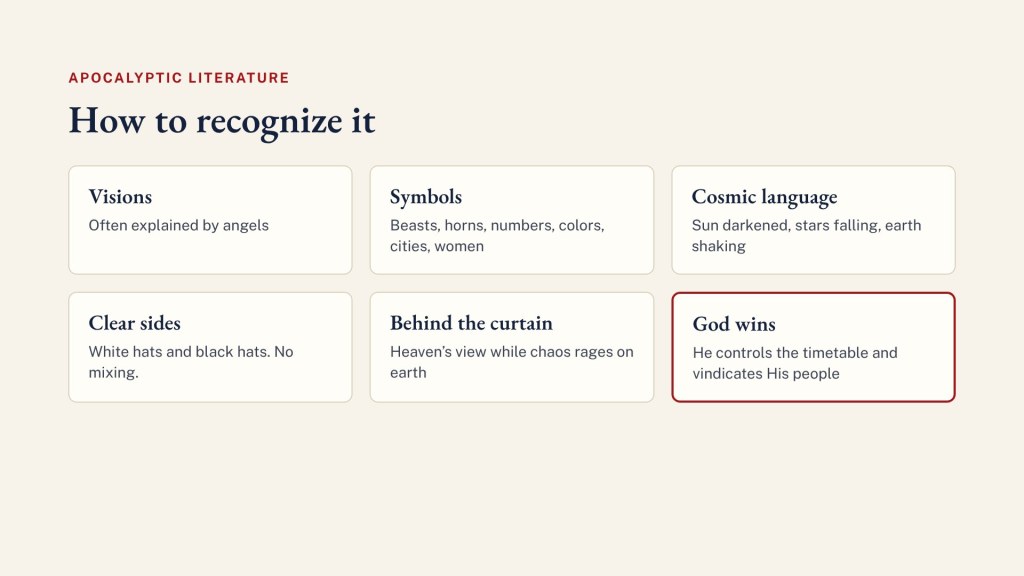
Its marks are easy to spot once you know them.
- Visions, often explained by angels.
- Vivid symbols: animals, colors, numbers, cities, women.
- Cosmic, earth shaking language: sun, moon, and stars thrown into chaos.
- A clear line between good and evil. White hats and black hats. No mixing.
- A look behind the curtain: what is happening in heaven while chaos rages on earth.
- God controls the timetable, and God wins.
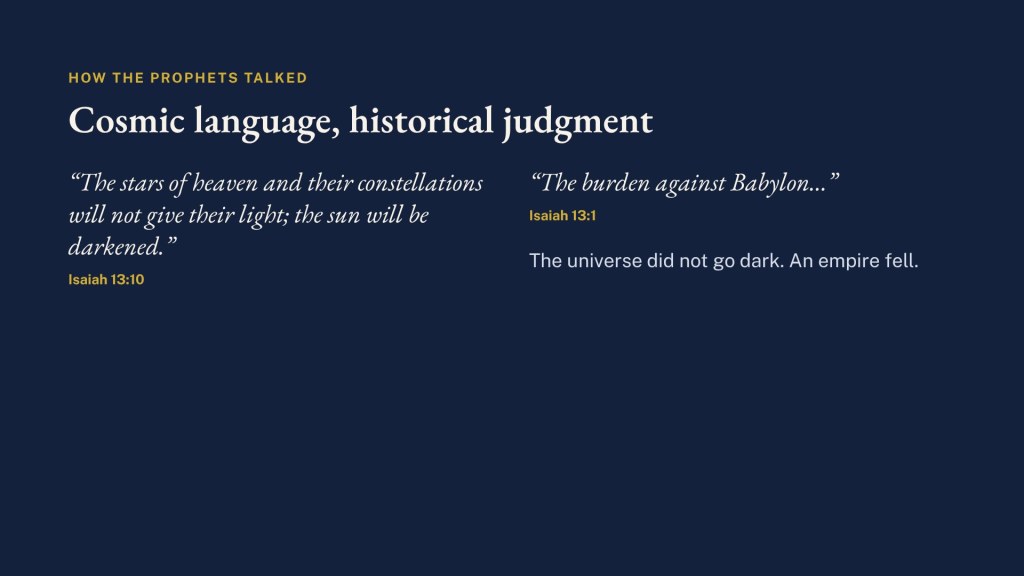
Bible Nugget: (Isaiah 13:1, 10) Cosmic language describes real judgments in history.
- Isaiah says the stars, sun, and moon will go dark.
- Verse 1 tells us the subject: the burden against Babylon.
- The universe did not go dark. An empire fell. That is how the prophets talked.
- So when Revelation darkens the sun, ask what kingdom is falling, not what the weatherman will say.
The sports page.
- Someone from a country with no baseball picks up a Boston paper.
- Bunt, stolen base, walk off home run. He has no idea what any of it means.
- A baseball fan reads it instantly. It is code, but a code every fan knows.
- He picks up another paper with the same words. Same game? No. Same language, different game, maybe a different season.
Lesson: similar language does not mean the same event.
- The Jewish believer knew this “sports page” language for times of distress.
- The flood, the Exodus, Babylon, Jerusalem in AD 70, Rome: different games, same language.
- Each time, God says, “Enough is enough,” brings down the oppressor, and delivers His people.
Apocalyptic is written to stir the heart more than to inform the head.
- You do not go to the Psalms for the plan of salvation. You go to be stirred to trust God.
- Revelation is the same. It is built to give suffering saints courage.
- Not much dialogue. Lots of action. It is a movie, not a lecture.
APOCALYPTIC IS NOT A CALENDAR FOR THE CURIOUS. IT IS COURAGE FOR THE CRUSHED.
2. How to Read It: Rules of the Road (Revelation 1:10–20)
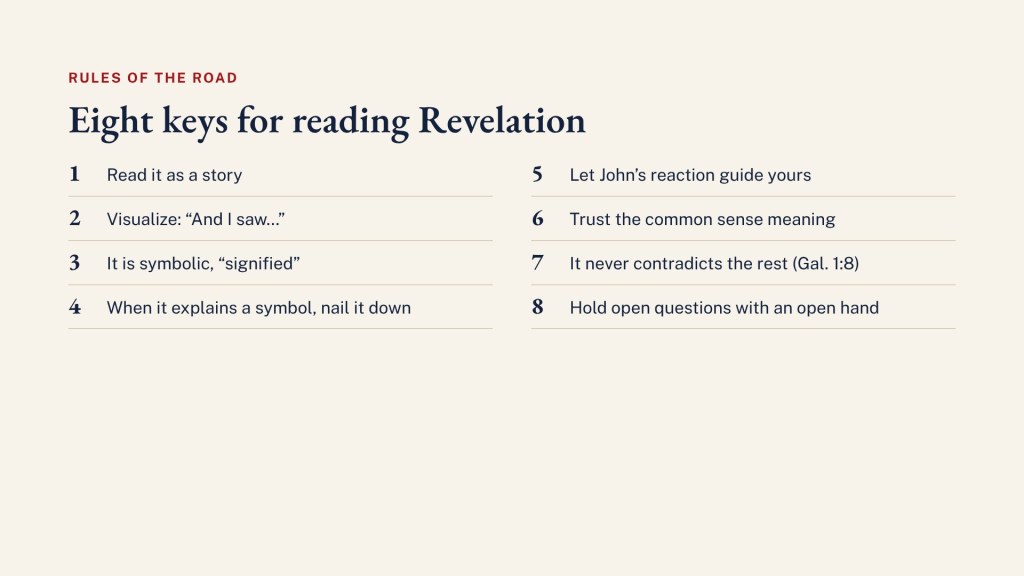
Rule 1: Read it as a story.
- Who are the characters? Good guys and bad guys.
- What is the problem? How is it resolved?
- You do not watch a movie in 15 minute pieces, and you do not want the guy next to you asking, “Who’s that?” every scene.
Rule 2: Visualize. “And I saw… and I saw… and I saw.”
- John tells us what he saw. Our job is to see what he saw before we try to figure it out.
- (1:12–16) Seven golden lampstands. One like the Son of Man. Robe to the floor, gold sash.
- Hair white as wool, eyes like fire, feet like burnished bronze, voice like Niagara Falls.
- Seven stars in His hand. A sharp two edged sword from His mouth. Face like the sun.
Rule 3: It is symbolic, and that is not a dodge.
- Jesus said, “I am the door.” He is not made of wood.
- The dragon is a figure for Satan. Satan is not literally a dragon. What do you do with dragons? Fear them and hope for a dragon slayer.
- (7:4–8) 144,000 is 12 x 12,000. The tribes were never the same size, and the list is not a normal list of tribes.
- It is a picture of order, balance, and the completeness of God’s people.
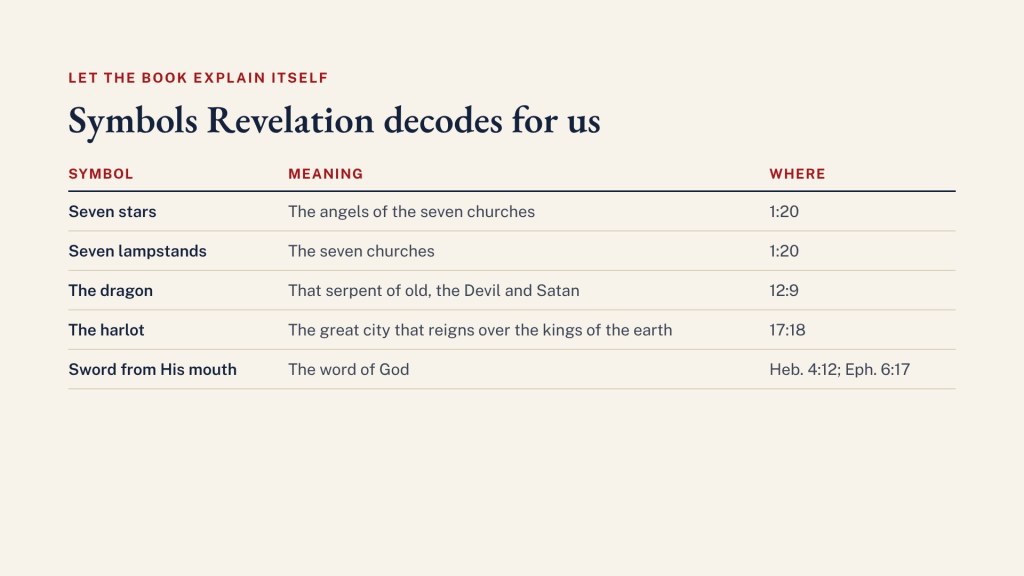
Rule 4: When the book explains a symbol, nail it down.
- (1:20) Stars are the angels of the churches; lampstands are the churches.
- (12:9) The dragon is that serpent of old, the Devil and Satan.
- (17:18) The woman is the great city that reigns over the kings of the earth.
Rule 5: Let John’s reaction guide yours.
- (1:17) John walked with Jesus for three years and never fell down as dead. Now he sees His glory.
- (5:4) When no one can open the scroll, John weeps. That is serious. Feel it.
Rule 6: Trust the natural, common sense meaning.
- Sword from His mouth: the word of God (Hebrews 4:12; Ephesians 6:17), not a third weapon because His hands are full.
- White hair: Jesus is the Ancient of Days. He was 33 in the flesh; He is eternal as the Son.
(Galatians 1:8) Rule 7: Revelation will never contradict the rest of the Bible.
- If an angel preaches another gospel, let him be accursed. Revelation is full of angels.
- Our heritage: interpret the unclear by the clear. Never build doctrine on a beast’s horn.
- Do not go to Revelation for the plan of salvation. Go to Acts. Revelation is about endurance.
Rule 8: Hold your conclusions with an open hand where the text is not clear.
- Some things we can be dogmatic about. The child of the woman is Jesus. Not Paul, not Moses.
- Other things go in the question mark column for a while. Why three and a half days? I don’t know.
- If a commentary helps, good, but only if it sends you back to the text.
3. The Whole Story in One Sweep (Revelation 1–22)
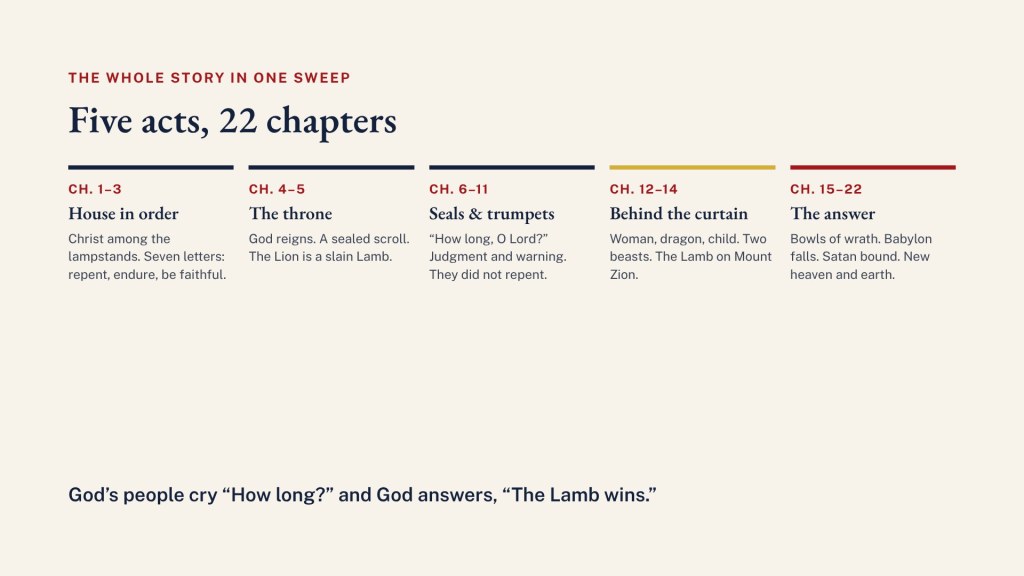
Act One: Get Your House in Order (Chapters 1–3)
(1:9) John is on Patmos, a Roman prison island, “for the word of God and the testimony of Jesus.”
- He calls himself their companion in the tribulation. He is writing from inside the fire.
(2–3) Seven letters to seven real churches in Asia.
- Ephesus and Laodicea are named elsewhere in the New Testament. These are real congregations.
- (Acts 19:10) All Asia heard the word in two years. These churches came from that harvest.
- Seven is completeness. The message is for all of them, and for all churches who will listen.
Before Jesus deals with the enemy outside, He deals with the church inside.
- (2:4) Ephesus: you left your first love. Commitment without love will not survive what is coming.
- (2:10) Smyrna: be faithful until death.
- (3:16) Laodicea: lukewarm. Jesus says it makes Him want to vomit.
- Not only can an individual fall away. A whole church can.
From Church History: (around AD 155) Polycarp, bishop of Smyrna, before the proconsul.
- Told to curse Christ, he answered: “Eighty six years I have served Him, and He has done me no wrong. How can I blaspheme my King?”
- He was faithful to the end. That is Smyrna’s letter lived out.
Act Two: The Throne and the Problem (Chapters 4–5)
(4:1–11) A door opens in heaven, and the first thing John sees is a throne.
- Jewels, a rainbow, 24 elders with crowns, four living creatures full of eyes.
- The elders are like bridesmaids: their glory only makes the One on the throne look greater.
- Before any chaos, the book shows us who is in charge. GOD IS ON THE THRONE.
(5:1–4) The problem of the story: a scroll sealed with seven seals that no one can open.
- John weeps. If God’s people cannot know what is coming, they cannot endure it.
(5:5–6) “Behold the Lion of the tribe of Judah.” John turns and sees a Lamb that was slain.
- The Lion wins by being the Lamb. There is only one character in the Bible who fits this.
- (5:9) He is worthy because He redeemed us by His blood from every tribe and tongue.
- Chapter 1 shows His power. Chapter 5 shows His sacrifice.
Act Three: Seals, Trumpets, and the Cry “How Long?” (Chapters 6–11)
(6:1–8) The first four seals: four horsemen.
- White horse: conquest. Red horse: peace taken, people killing each other.
- Black horse: scales, a day’s wage for a quart of wheat. Famine and shortage.
- Pale horse: Death and Hades over a fourth of the earth.
- These come from the throne. Judgment is in God’s hand, not out of His control.
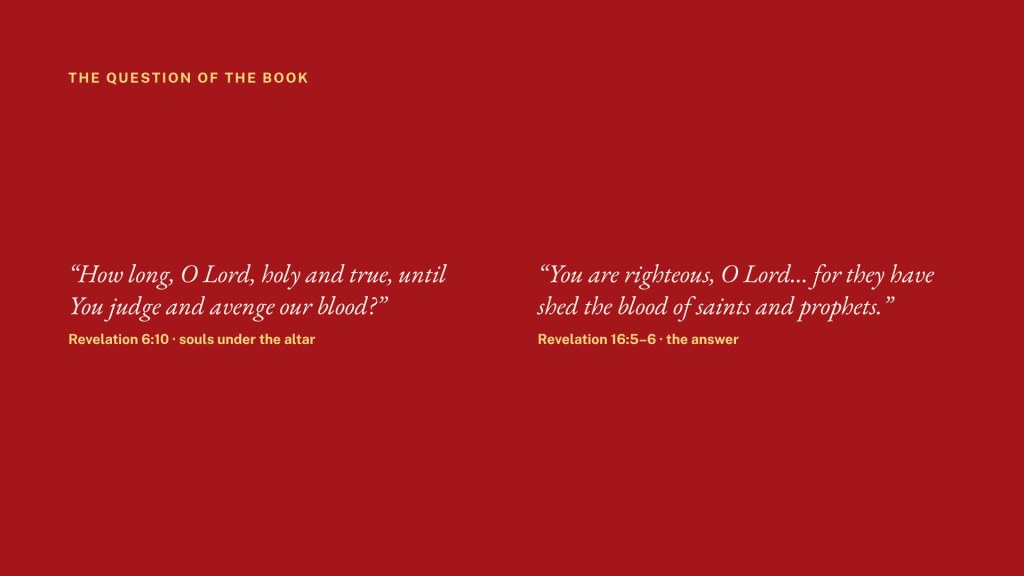
(6:9–11) The fifth seal is the key to the whole book.
- Souls under the altar, slain for the word of God, like sacrifices whose blood runs to the base.
- “How long, O Lord, until You judge and avenge our blood?”
- God gives them white robes and says, “Rest a little while longer.” More will die.
- THE REST OF THE BOOK IS GOD’S ANSWER TO “HOW LONG?”
(6:12–17) The sixth seal: earthquake, black sun, kings hiding in caves from the wrath of the Lamb.
(8:1) The seventh seal: silence in heaven for half an hour.
- Could you take thirty minutes of silence in that room? It is the hush before the storm.
(8:3–5) The prayers of the saints go up with incense, and fire comes back down.
- These are not “bless the food” prayers. These are desperate saints in trying times.
- The angel fills the censer from the altar and throws it to the earth. Thunder, lightning, earthquake.
- God is answering His people’s prayers.
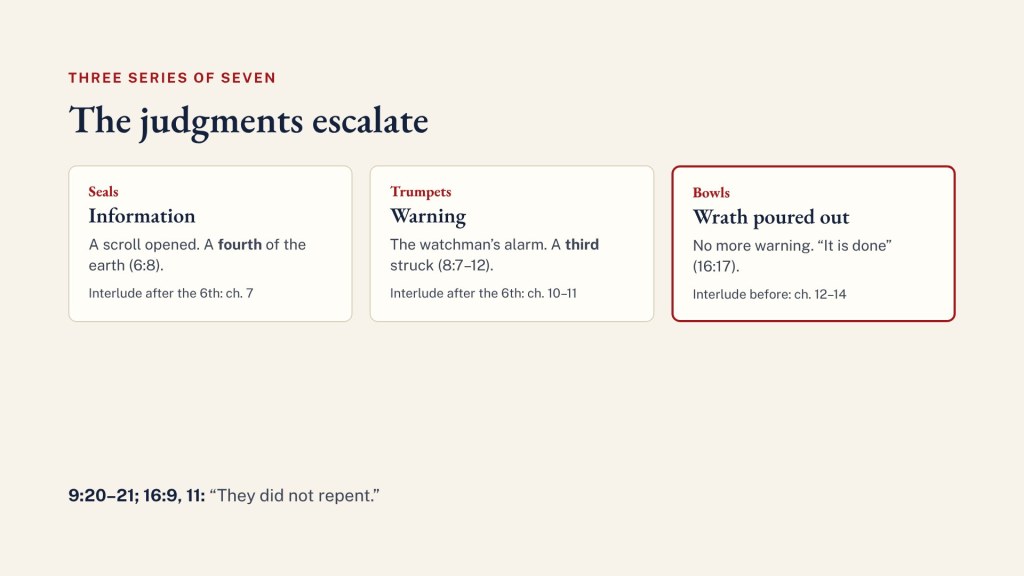
(8:6–9:21) Seven trumpets: seven warnings.
- Trumpets sound the alarm. Watchman on the wall: warning, warning, warning.
- The seals touched a fourth. The trumpets hit a third. The judgments escalate.
- Hail and fire, a burning mountain in the sea, bitter water, darkness: it sounds like Egypt and the Exodus plagues.
- (9:4) The locusts harm only those without the seal of God on their foreheads.
(9:20–21) “They did not repent.”
- The warnings are meant to wake people up. Like a tragedy that fills the churches for a few weeks, and then everyone forgets.
(11:15) The seventh trumpet is simply an announcement.
- “The kingdoms of this world have become the kingdoms of our Lord and of His Christ.”
- For the faithful, that is the best news in the book. For the rebellious, it is the worst.
Act Four: Behind the Curtain (Chapters 12–14)
(12:1–5) A woman clothed with the sun, a great red dragon, and a child.
- The dragon’s tail sweeps a third of the stars from the sky. Picture the size of this monster.
- He waits to devour the child, but the child is caught up to God’s throne, to rule the nations with a rod of iron.
- The child is Jesus. The woman may be Mary, or more broadly the faithful of Israel who brought the Messiah into the world.
(12:7–12) War in heaven, and the dragon loses.
- He tried to wreck God’s plan at the manger, in the wilderness, at the cross. He failed every time.
- (12:10) The accuser of our brethren is thrown down. Forgiven people cannot be accused.
- (12:12) He is furious, “knowing that he has a short time.”
(12:17) Having lost the war against the plan, he goes to war against the people.
- The rest of her offspring: those who keep God’s commandments and hold the testimony of Jesus. Christians.
(13:1–10) The sea beast: a political power over every tribe, tongue, and nation.
- Gets his throne from the dragon, is worshiped, blasphemes, and makes war on the saints for 42 months.
(13:11–18) The land beast, later called the false prophet: a religious power.
- Signs and wonders, images to worship, death for those who refuse.
- No mark, no buying or selling. Refuse and you are an outcast, or dead.
- Satan, the beast, and the false prophet: an unholy trinity copying the real one.
(14:1–5) Then I looked, and behold, a Lamb standing on Mount Zion with the 144,000.
- War has been declared on them, and they are singing a new song.
- (14:6–7) An angel with the everlasting gospel: “Fear God and give Him glory.”
- (14:8) “Babylon is fallen, is fallen.”
- Do not put a chapter break between 13 and 14. The beast is never the last word.
Act Five: The Answer Comes (Chapters 15–22)
(15:1; 16:1–21) Seven bowls: the wrath of God is complete.
- A seal is information. A trumpet is a warning. A bowl is wrath poured out. No more warning.
- (16:5–6) “You are righteous, O Lord… for they have shed the blood of saints and prophets.”
- That is the answer to the souls under the altar. “How long?” Not one day longer.
- (16:9, 11) Still they did not repent. There comes a time when the door closes.
- (16:16–17) Armies gather at Armageddon, and God simply says, “It is done.”
(17–18) Babylon the great harlot falls.
- Wealthy, immoral, drunk with the blood of the saints, riding the beast.
- Merchants weep because their business dies with her.
- When the regime collapsed, the whole economy stopped.
- Even people who hated the regime grieved their lost livelihood. That is chapter 18.
- But one group rejoices: the people of God on earth and in heaven (18:20; 19:1–3).
(19:11–21) Jesus rides out on a white horse, King of kings and Lord of lords.
- The beast and false prophet are thrown into the lake of fire. The saints never lift a sword.
(20:1–15) Satan bound for 1,000 years, the martyrs reign, then the final judgment.
- All the dead stand before the great white throne and are judged according to their works.
(21–22) A new heaven and a new earth.
- God dwells with His people. No more tears, death, sorrow, or pain.
- The story that began with a crying apostle ends with God wiping every tear away.
THE WHOLE STORY: GOD’S PEOPLE CRY “HOW LONG?” AND GOD ANSWERS, “THE LAMB WINS.”
4. When Do These Things Happen? (Revelation 1:1, 3; 22:6, 10)
Most teachers today say Revelation is about to happen in our headlines.
- Every generation finds hurricanes, wars, and dictators that seem to fit. Five hundred years from now people will do it again.
- That starts with me and my newspaper. What were my great grandparents supposed to do with the book?
- Instead, start where the book starts: with the original readers.
(1:4, 11; 22:16) It was addressed to seven real churches.
- “I know your works.” Jesus says it to every church. He knew their street and their struggle.
- The letters in chapters 2 and 3 cannot be separated from the rest of the book. The whole revelation was for them.
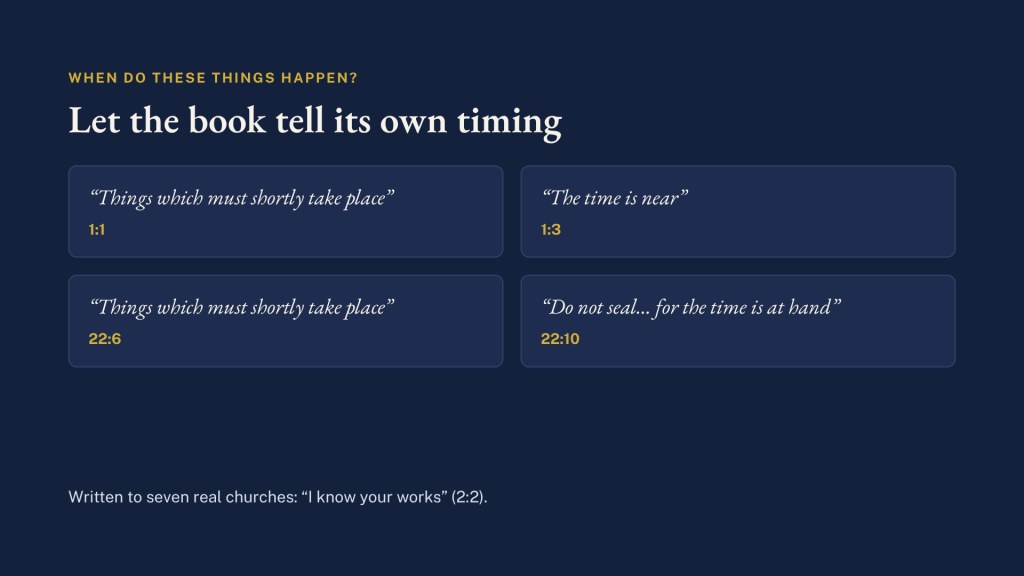
Let the book tell us its own timing.
- (1:1) “Things which must shortly take place.”
- (1:3) “The time is near.”
- (22:6) “Things which must shortly take place.”
- (22:10) “Do not seal the words… for the time is at hand.”
- It says it at the beginning and says it again at the end.
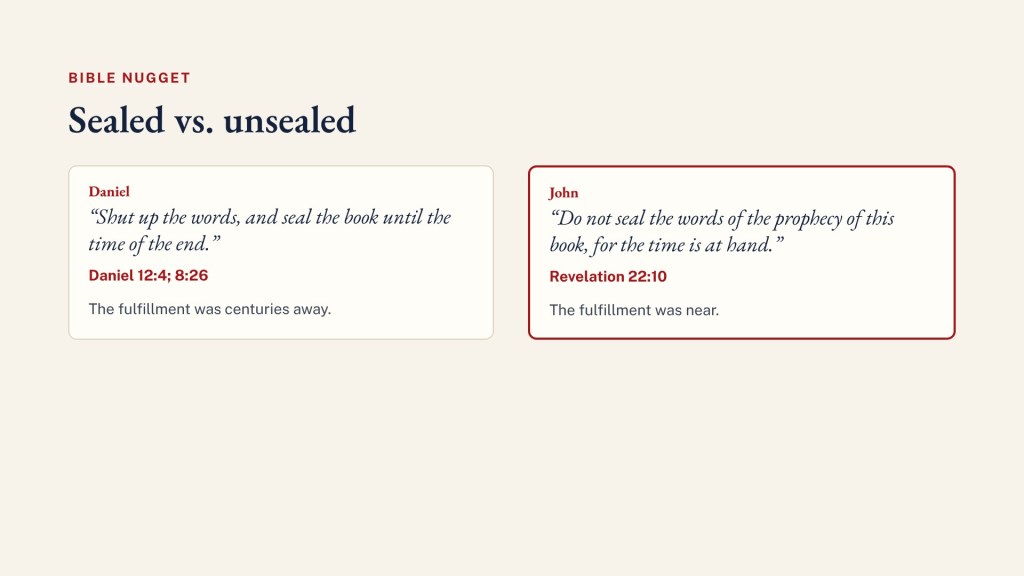
Bible Nugget: (Daniel 8:26; 12:4) Daniel was told to seal up his vision.
- Daniel’s vision reached centuries ahead, so it was sealed.
- John is told the opposite: do not seal it. The time is close.
- Like a time capsule: you seal it for a generation far away. You do not seal a letter meant for this week.
“Near” and “soon” are relative, but they are not 2,000 years.
- (Matthew 3:2) John the Baptist said the kingdom was “at hand.” It came within a few years in Acts 2.
- High school feels long as a freshman and short at graduation. But it is four years, not forty generations.
- If it does not happen in my lifetime, it is irrelevant to me. That would make these promises almost insulting to the first readers.
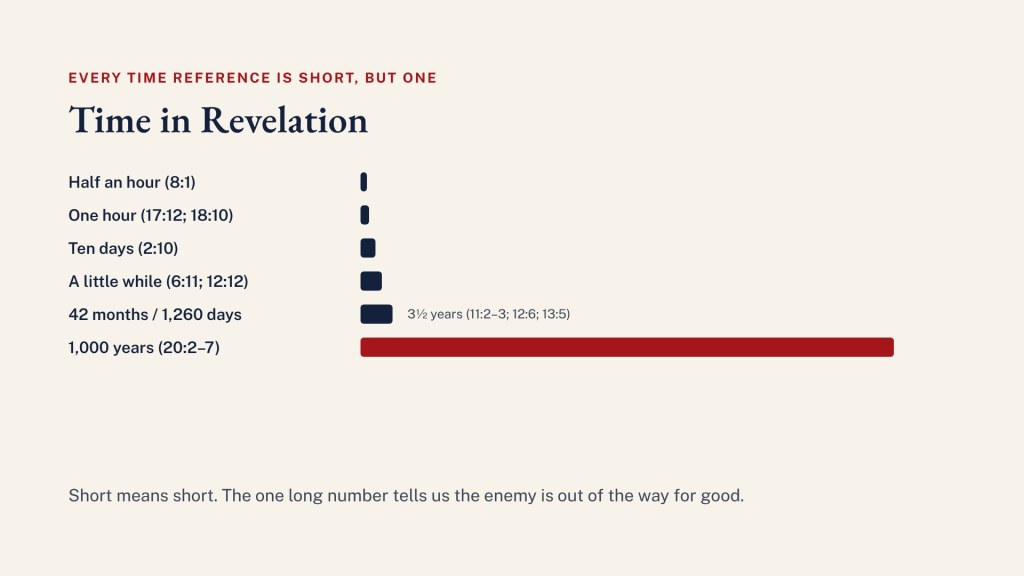
Every time reference in the book is short, with one exception.
- Ten days (2:10). Half an hour (8:1). No more delay (10:6).
- 42 months, 1,260 days, time, times, and half a time (11:2–3; 12:6, 14; 13:5): all three and a half years.
- A little while (6:11). A short time (12:12; 17:10). One hour (17:12; 18:10).
- The only long number is the 1,000 years in chapter 20.
(Jeremiah 25:11; 29:10) When a prophet gives a time, the time is part of the prophecy.
- Seventy years in Babylon. It happened in seventy years.
- If a prophet gets the timing wrong, why trust anything else he says?
(2 Peter 3:8–9) “A day is as a thousand years” is not a decoder ring.
- Peter is answering scoffers who say, “He is not coming back.”
- His point: with the Lord, time passing does not weaken a promise. And He waits because He wants all to repent.
The thirty dollars.
- I borrow thirty bucks for gas and promise to pay you tomorrow.
- A week passes. A month. Every day, your confidence goes down.
- Then you read my obituary. That is human promises.
- God promised Abraham the land, then the Messiah thousands of years later. Every one came true. Time does not wear down God’s word.
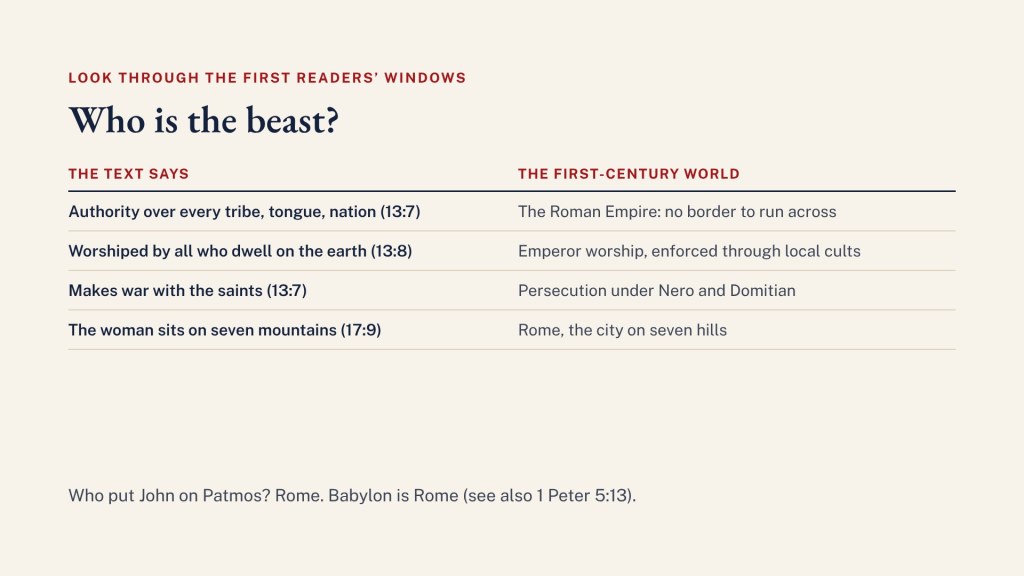
So Who Is the Beast?
If it is near for the first readers, look at their world.
- A power over every tribe, tongue, and nation. Worshiped as a god. At war with Christians.
- That is the Roman Empire and its emperors, especially Nero and Domitian.
- Emperor worship was enforced through local temples and cults: the land beast.
- Who put John on Patmos? Rome.
Early or late date? Either way, the answer is Rome.
- Some date the book around AD 68–69 under Nero. Many date it around AD 95 under Domitian.
- Do not get lost in that fight. Get the big picture.
(17:9) The woman sits on seven mountains.
- Rome was known in the ancient world as the city on seven hills. Babylon is Rome.
- (1 Peter 5:13) Peter seems to use “Babylon” for Rome too.
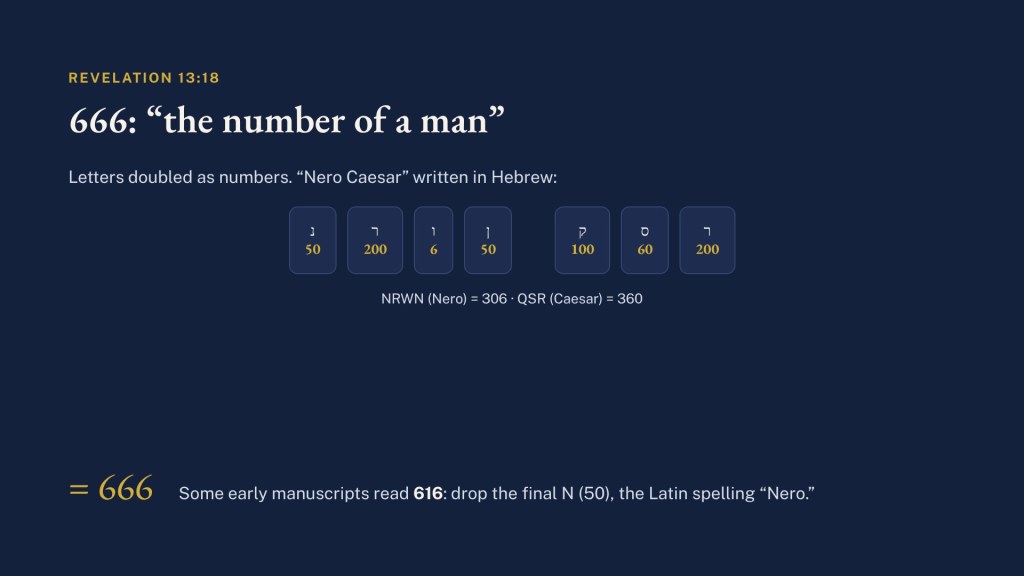
Bible Nugget: (13:18) 666, “the number of a man.”
- In Hebrew and Greek, letters doubled as numbers. Gematria. Graffiti in Pompeii says, “I love her whose number is 545.”
- “Nero Caesar” written in Hebrew letters adds up to 666.
- Some early manuscripts read 616, which matches the other common spelling of his name.
- But do not miss the bigger point: it is the number of a man. Men live and die. The beast is mortal. God is not.
Handling the question, “Hasn’t there been an empire as bad since?”
- Yes, many brutal ones. The point is not size or cruelty.
- In the first century, there was no border to run across. Rome was the whole known world, and it declared war on the saints.
- And the book says it would happen soon. Rome fits the time and the picture.
And the Thousand Years?
(20:1–3) Satan is bound “so that he should deceive the nations no more.”
- Not gone. Peter still says he prowls like a roaring lion (1 Peter 5:8).
- Limited: never again a single world empire turning every nation against the church at once.
(20:4–6) The martyrs live and reign with Christ for 1,000 years.
- Those who were beheaded are not losers. They are reigning.
- 1,000 is symbolic: a time so long it is beyond our lives and our grandchildren’s lives. In the story, it means the enemy is out of the way.
- We are living in that long age now.
(20:7–15) At the end, Satan is released a little while, then fire falls, he is thrown into the lake of fire, and the final judgment comes.
- Chapters 21 and 22 are the promise for every generation, theirs and ours: heaven with God.
5. What Happens to God’s People? (Revelation 7, 11, 14)
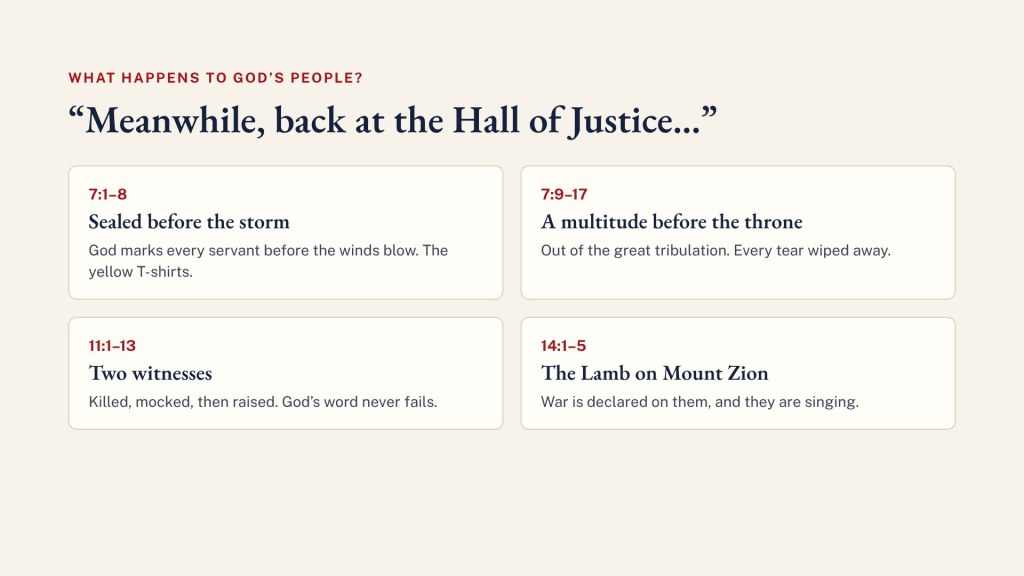
“Meanwhile, back at the Hall of Justice.”
- Remember the old Super Friends cartoons? Right when the action peaked, the narrator cut away: “Meanwhile, back at the Hall of Justice…”
- Between the sixth and seventh of each series, the camera cuts away to God’s people.
- These interludes answer the question every reader asks: what about us?
(7:1–8) The 144,000 are sealed before the winds blow.
- God tells the angels to hold back the destruction until every servant is marked.
The yellow T-shirts at the zoo.
- A preschool teacher puts every child in a bright yellow shirt with the school name in big red letters.
- One little guy stares at the lions too long and looks up. Everyone is gone.
- He is scared, but he remembers: “If you wear your shirt, we will find you.”
- God does not need the shirt to see us. We need to know He sees us.
(7:9–17) A great multitude no one could number, before the throne.
- “These are the ones who come out of the great tribulation.”
- No hunger, no thirst, no scorching sun. God wipes away every tear.
- On earth God counts His people. In heaven He does not need to. Back in the classroom, no one wears the yellow shirt.
- Death is getting on the train and going home. The ride can be scary. But you get off at home.
(11:1–13) The two witnesses: God’s word always finishes its work.
- Fire from their mouths, power like Elijah and Moses. No one can stop the message.
- When they finish, the beast kills them. Their bodies lie in the street while the world throws a party.
- After three and a half days, God breathes life into them and calls them up.
- God does not promise a force field. He promises His purpose will never fail.
(Daniel 1–6) Daniel and his three friends suffered the captivity with everyone else.
- Fiery furnace. Lions’ den. But God never lost track of them.
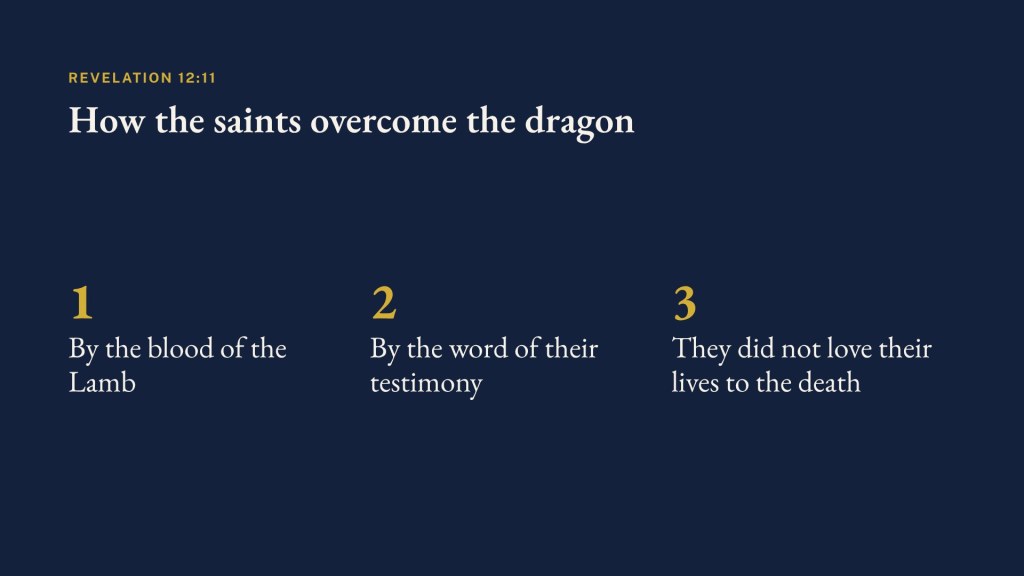
(12:11) How the saints overcome the dragon.
- By the blood of the Lamb.
- By the word of their testimony.
- They did not love their lives to the death.
(13:16; 14:1) Two marks, one forehead.
- The beast’s mark or the Father’s name. There is not room for both.
- No one thinks Christians wear a literal tattoo. So why hunt for a literal mark of the beast? It is the evil twin of God’s mark.
- It is about allegiance: whom you worship and whom you obey.
Seven times the book says “Blessed” (1:3; 14:13; 16:15; 19:9; 20:6; 22:7, 14).
- From chapter 1 to chapter 22, this is a book of comfort.
- GOD’S PEOPLE ARE GOING TO BE ALL RIGHT. ONE DAY THEY WILL BE ALL THE WAY ALL RIGHT.
6. What Do We Do With It? (Revelation 2:10; 22:7)
Read Revelation the way we read Corinthians and Galatians.
- Galatians was written to their problem, not a problem that would only show up in 2026.
- When we face what they faced, God’s answer to them is God’s answer to us.
- Revelation was not written so people 2,000 years later could predict next year.
Its message: whatever it costs, do not let go of Jesus.
- Do not give in to the government. Do not give in to culture. Do not give in to temptation.
- You do not need to start a political revolution. God will handle Rome. You live and preach the gospel.
Christians who live under persecution today need this book more than we do.
- It is not hypothetical to them. Pray for them, and let their faith shame our complaining.
(13:17) Ask: will I let money decide my loyalty?
- The mark was about buying and selling. Am I willing to go through financial hardship for Jesus?
(14:4) Keep yourself pure.
- The 144,000 are “virgins,” undefiled. Impurity is one of Satan’s favorite attacks.
(2:4; 3:16) Check your heart for the warning signs.
- Have I left my first love? Am I lukewarm? Am I tolerating sin in me or in my church?
(14:6) Keep reaping.
- Revelation is not an evangelism manual. But the everlasting gospel still goes to every nation, tribe, tongue, and people.
- Strengthened people go back out. Discouraged people come to this book; encouraged people leave it ready to fight.
(22:20) “Surely I am coming quickly.” “Amen. Even so, come, Lord Jesus.”
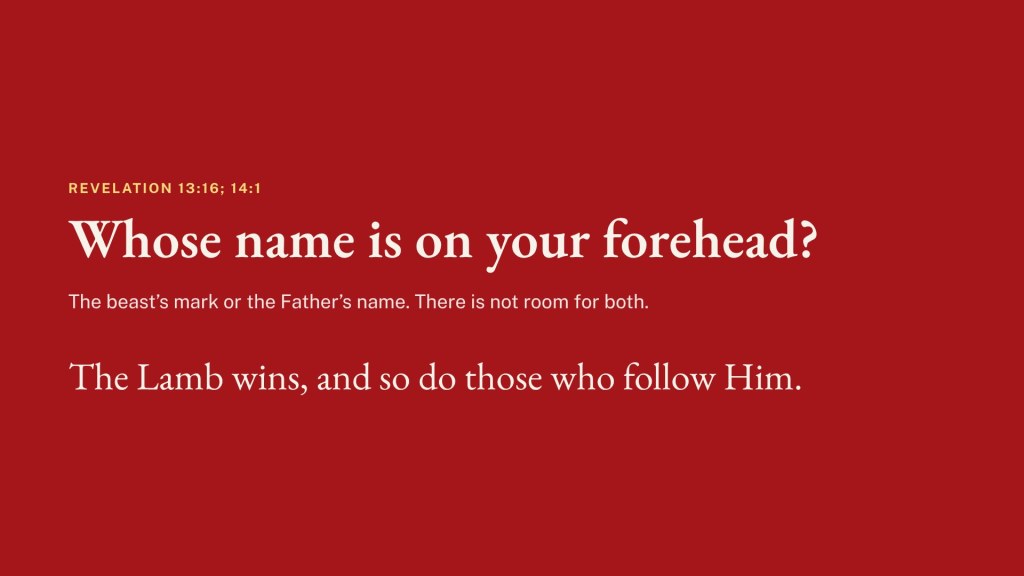
Call: Whose name is on your forehead? Decide today that no beast, no Babylon, no bank account, and no threat will pull you away from the Lamb. Read Revelation this week straight through like a movie, and let it give you courage. THE LAMB WINS, AND SO DO THOSE WHO FOLLOW HIM.


Leave a Reply