Category: Uncategorized

  • Cutting It Straight

    Biblical Interpretation, Hermeneutics, Authority, and Leadership

    Notes from a class I taught recently to our Ministry Training Academy (MTA)
    Slide 1: Cutting It Straight

    Introduction (2 Timothy 2:15)

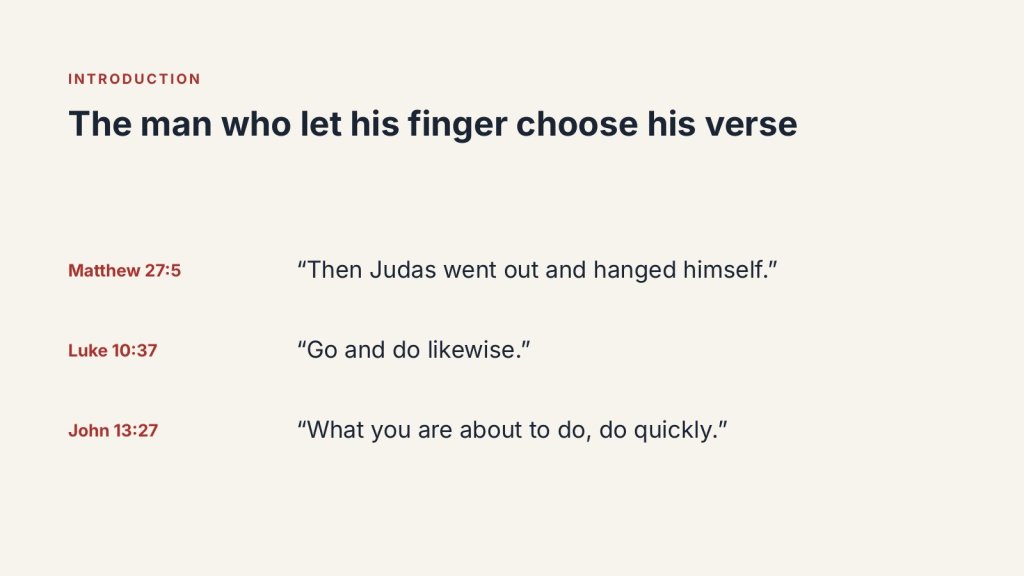
    Slide 2: The man who let his finger choose his verse

    There was a man who sought God’s will by opening his Bible at random and obeying the first verse his finger landed on. He was going through a hard season with his family, so he prayed, opened, and pointed.

    • (Matthew 27:5) “Then Judas went out and hanged himself.”
    • Puzzled, he called a do-over and flipped again. (Luke 10:37) “Go and do likewise.”
    • Flustered, he gave it one last try. (John 13:27) “What you are about to do, do quickly.”

    Every verse he read was true. Every conclusion he drew was deadly.

    Everybody interprets the Bible. The only question is whether we interpret it well. The man in the story believed every word. His problem was not faith; it was method. Sincerity does not protect you from misreading God. Training does.
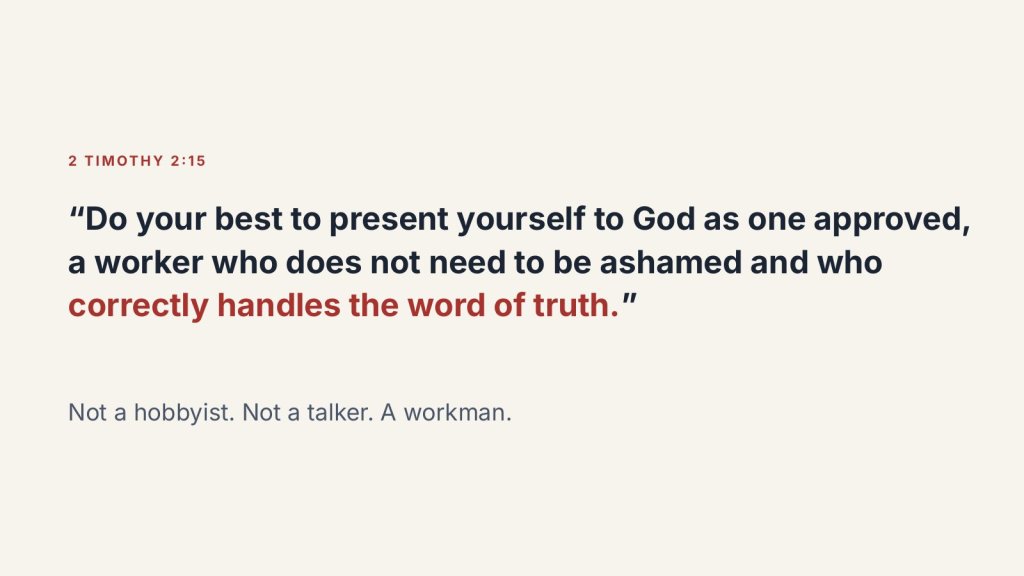
    Slide 3: 2 Timothy 2:15

    In 2 Timothy 2:15, Paul charges a young evangelist to handle the word like a craftsman: “Do your best to present yourself to God as one approved, a worker who does not need to be ashamed and who correctly handles the word of truth.” Not a hobbyist. Not a talker. A workman.
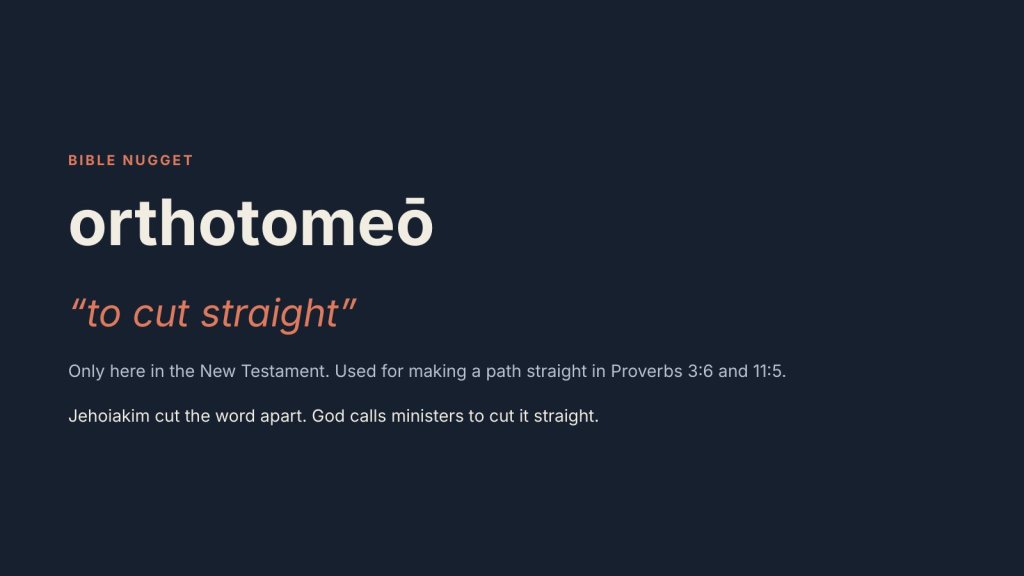
    Slide 4: orthotomeō

    Bible Nugget: “Correctly handles” is one Greek word: orthotomeō, “to cut straight.”

    • It appears only here in the New Testament.
    • The Greek Old Testament uses it in Proverbs 3:6 and 11:5 for God making a path straight.
    • Picture a road crew cutting a straight road through rough country, so others can travel it safely.
    • Some older commentators (Pulpit Commentary) suggest Paul the tentmaker had his own trade in mind: cut the pieces straight or nothing fits together.
    • Remember Jehoiakim? He took a knife to the word and cut it apart. God calls ministers to take the word and cut it straight.
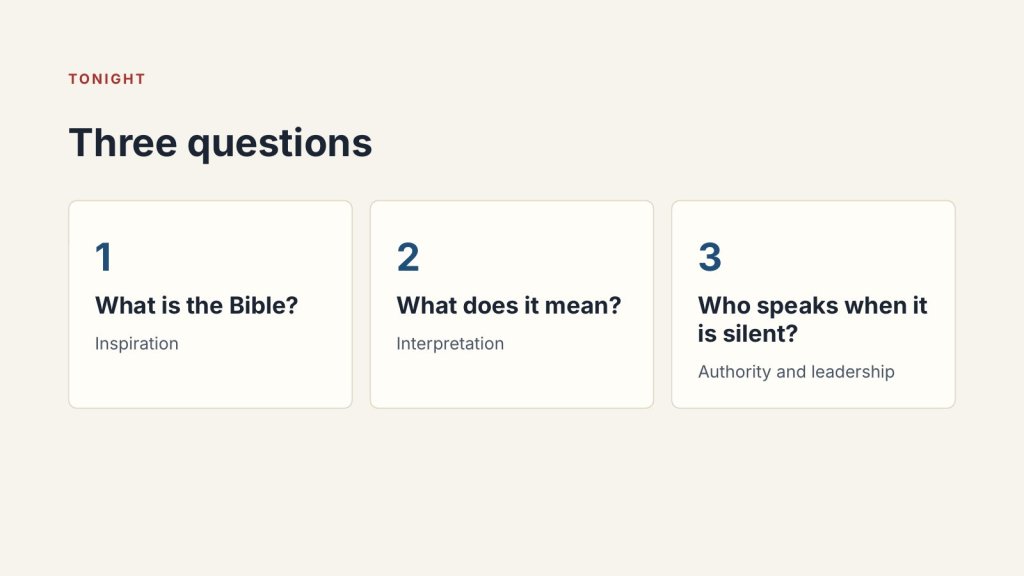
    Slide 5: Three questions

    In our last class we studied how God gave us the Bible. In this one we study how to read it, and who speaks for it. Three questions guide us:

    • What is the Bible? (inspiration)
    • What does it mean? (interpretation)
    • Who speaks when it is silent? (authority and leadership)

    Bible Nugget: Jesus was the first great hermeneutics teacher (Luke 24:27). On the road to Emmaus, “he explained to them what was said in all the Scriptures concerning himself.” “Explained” is diermēneuō. Our word hermeneutics comes from the same family: the art and science of interpretation. If Jesus took two discouraged disciples through a Bible study, we can take our study seriously.
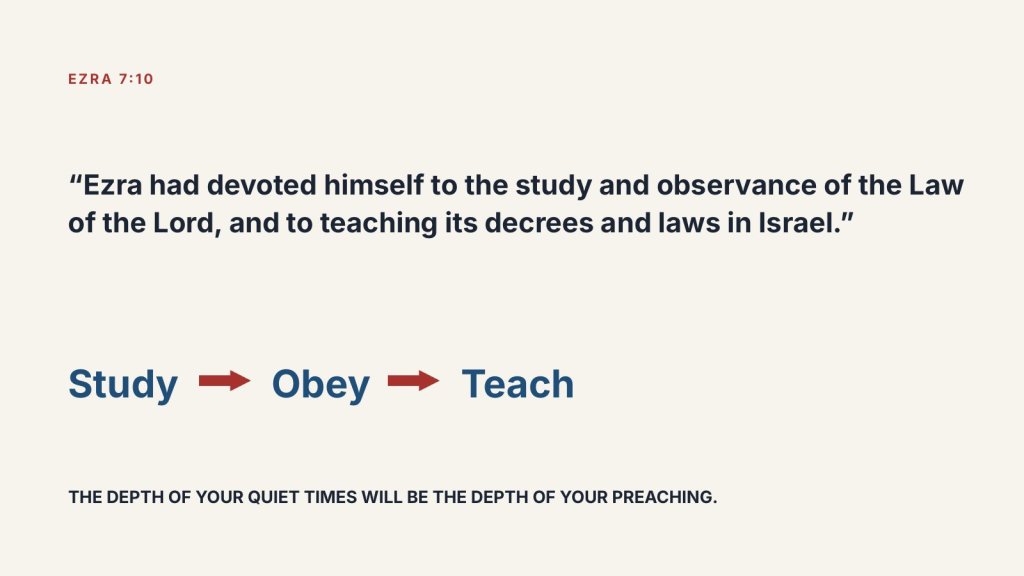
    Slide 6: Ezra 7:10

    Ezra 7:10 is the theme verse for every minister’s study life: “Ezra had devoted himself to the study and observance of the Law of the Lord, and to teaching its decrees and laws in Israel.” Study, then obey, then teach. The order is the point.

    The depth of your quiet times will be the depth of your preaching.

    I. Your View of the Book Shapes How You Read It (2 Timothy 3:16-17; 2 Peter 1:20-21)

    How you believe the Bible came to be will decide how you study it. Last class we covered how the books were written, gathered, and recognized. Now we ask what that means for the way we open them.
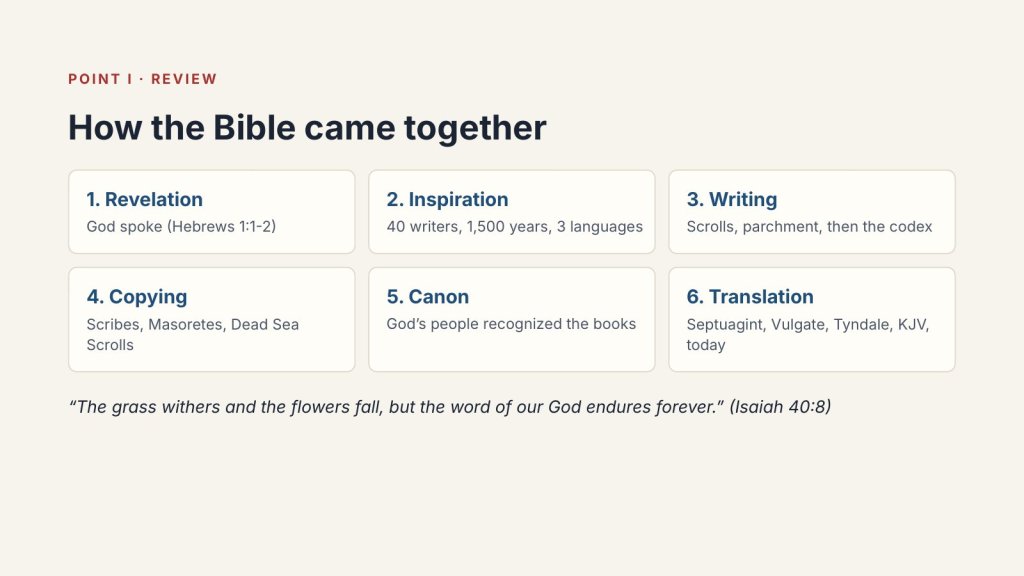
    Slide 7: How the Bible came together

    Here is a quick review of how the Bible came together, from God to your hands:

    • Revelation: God spoke. He spoke through the prophets at many times and in many ways, and last of all through his Son (Hebrews 1:1-2).
    • Inspiration: God breathed out his word through about 40 human writers over roughly 1,500 years, in Hebrew, Aramaic, and Greek.
    • Writing: on papyrus scrolls, then parchment, and by the second century the church was using the codex, the first book with pages.
    • Copying: scribes copied by hand with great care. The Masoretes counted letters to protect the Hebrew text, and the Dead Sea Scrolls showed how faithfully Isaiah had been copied over a thousand years.
    • Canon: God’s people recognized which books God had breathed out. (More on this in a moment.)
    • Translation: the Greek Septuagint (about 250 BC), Jerome’s Latin Vulgate (about AD 400), Wycliffe’s English (1380s), Tyndale’s New Testament (1526), the King James (1611), and the modern translations we use today.

    Every link in that chain is God keeping his promise: “The grass withers and the flowers fall, but the word of our God endures forever” (Isaiah 40:8).

    Bible Nugget: “All Scripture is God-breathed” (2 Timothy 3:16). The word is theopneustos: breathed out by God. B. B. Warfield made the point a century ago: Scripture is not a human book God breathed into. It is a word God breathed out.

    The prophets spoke as they were “carried along by the Holy Spirit” (2 Peter 1:21). It is the same word Luke uses for a ship driven by the wind (Acts 27:15, 17). The men raised the sails. The Spirit supplied the wind.
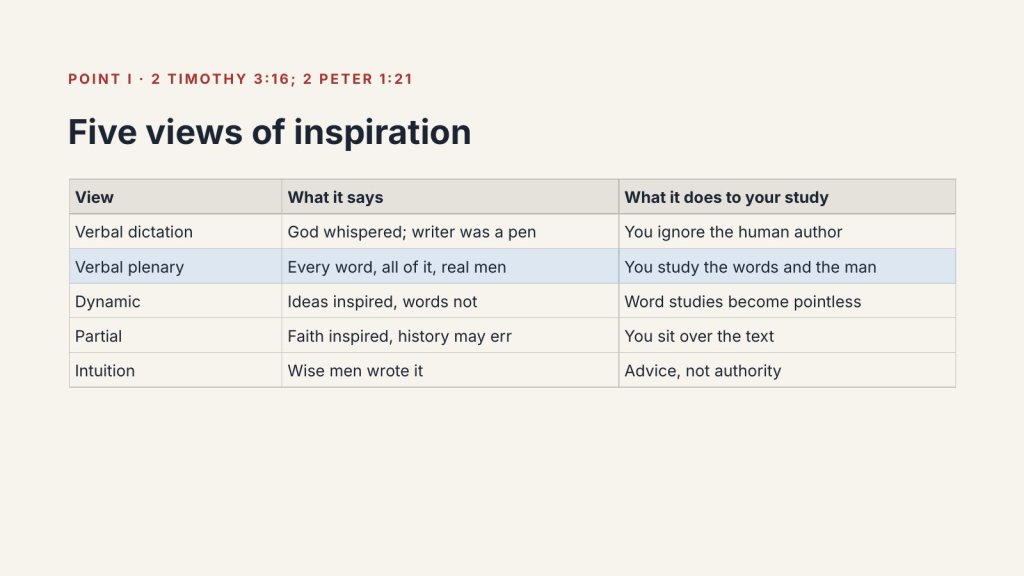
    Slide 8: Five views of inspiration

    There are five views of inspiration, and each one does something to your Bible study:

    • 1. Verbal dictation: God whispered every word and the writer was a pen. Result: the human author does not matter, so you ignore his background, style, and audience.
    • 2. Verbal plenary: every word (verbal), all of Scripture (plenary), breathed out by God through real men whose backgrounds God prepared. Result: you study the words and you study the man.
    • 3. Dynamic (thought) inspiration: the ideas are inspired, the wording is not. Result: word studies become pointless, and the wording becomes negotiable.
    • 4. Partial inspiration: faith and morals are inspired, history and science may be wrong. Result: the reader decides which parts are God’s. You now sit over the text instead of under it.
    • 5. Intuition: the Bible is the writing of wise men. Result: the Bible becomes advice, not authority. We reject this.

    The Bible itself shows real human authors.

    • (Luke 1:1-4) Luke did research. He interviewed eyewitnesses and wrote an orderly account.
    • (1 Corinthians 1:14-16) Paul cannot remember whether he baptized anyone else. God did not erase the man; he guarded the message.
    • Every writer sounds like himself. John does not write like Paul, and Amos the shepherd does not write like Isaiah in the palace.
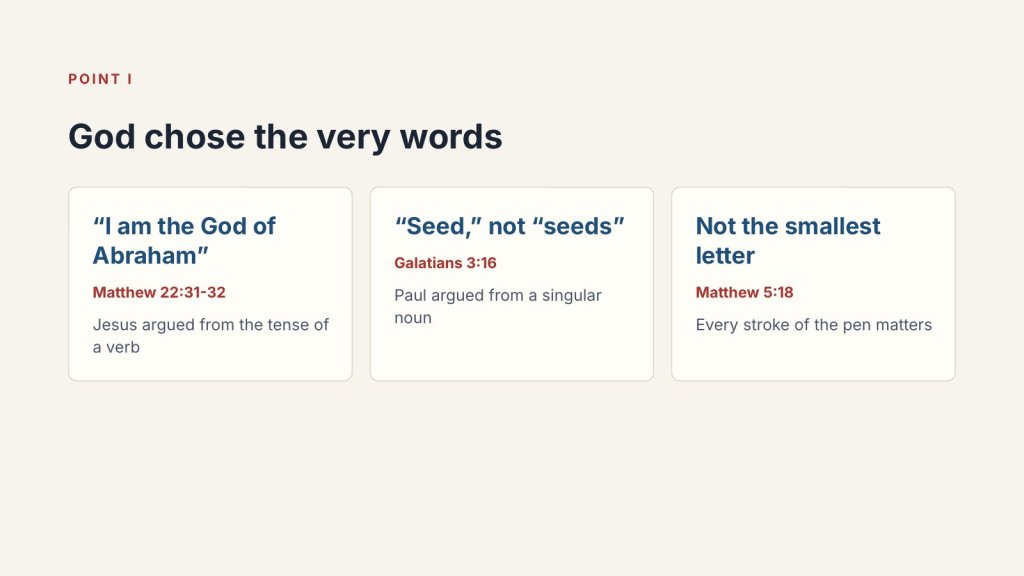
    Slide 9: God chose the very words

    The Bible also shows that God chose the very words.

    • (Matthew 22:31-32) Jesus wins an argument about the resurrection on the tense of a verb: “I am the God of Abraham,” not “I was.”
    • (Galatians 3:16) Paul builds an argument on a singular noun: “seed,” not “seeds.”
    • (Matthew 5:18) Not the smallest letter, not the least stroke of a pen, will disappear.

    You cannot hold the dynamic view and preach like Jesus did. He trusted the words, not just the ideas.
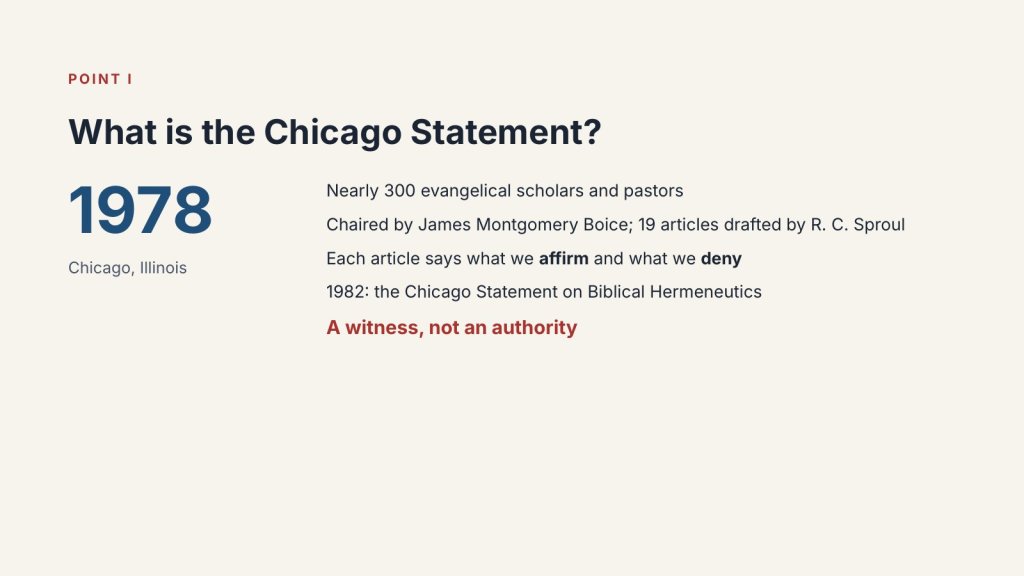
    Slide 10: What is the Chicago Statement?

    What is the Chicago Statement? I quote it several times in this lesson, so here is the background.

    • In October 1978, nearly 300 evangelical scholars and pastors met at the Hyatt Regency O’Hare in Chicago.
    • The meeting was called by the International Council on Biblical Inerrancy, chaired by James Montgomery Boice. Leaders included R. C. Sproul, J. I. Packer, Norman Geisler, and Francis Schaeffer.
    • Why? In the 1970s, seminaries and denominations that once held the Bible to be without error were backing away from it. Harold Lindsell’s book The Battle for the Bible (1976) put the fight in the open.
    • R. C. Sproul drafted the nineteen articles. Each one says what we affirm and what we deny. About four out of five who attended signed it.
    • The council met again in 1982 and wrote the Chicago Statement on Biblical Hermeneutics, about how to interpret the Bible. A third statement in 1986 covered application. The council then disbanded.
    • The drafters themselves said it should not be given the weight of a creed. That fits us well: we do not follow creeds, but we can learn from good brothers who stood for the Bible. Use it as a witness, not an authority.

    The Chicago Statement on Biblical Inerrancy (1978), Article VIII, says it well:

    “We affirm that God in His work of inspiration utilized the distinctive personalities and literary styles of the writers whom He had chosen and prepared. We deny that God, in causing these writers to use the very words that He chose, overrode their personalities.”

    Theologians call this concursus: God and man both fully at work, with God as the primary author. Warfield compared it to a musician playing different instruments. Same musician, different sound, every note his.
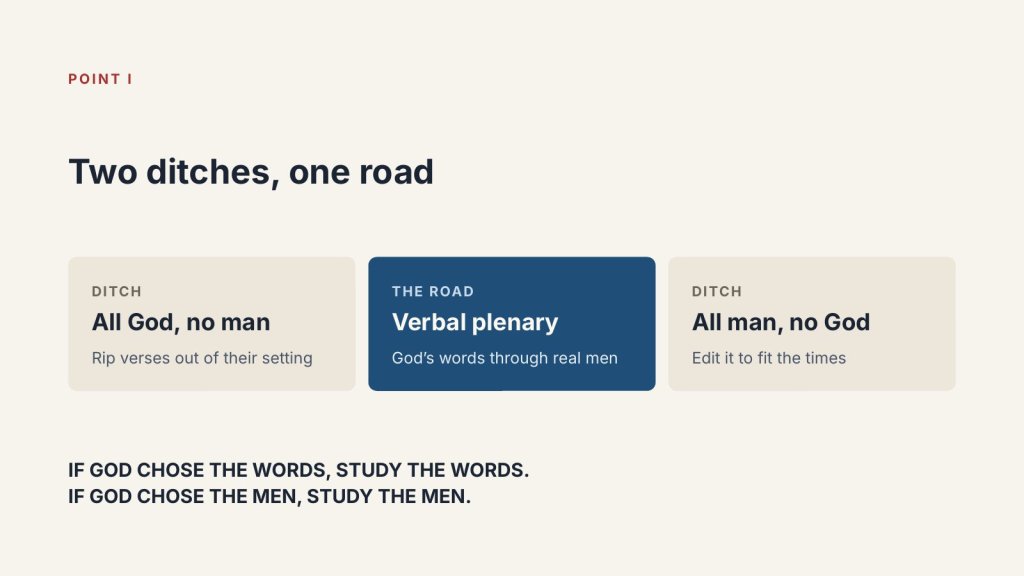
    Slide 11: Two ditches, one road

    There are two ditches on either side of this road.

    • Ditch one: all God, no man. You rip verses out of their setting because “it’s all God talking anyway.”
    • Ditch two: all man, no God. You treat the Bible like any other old book and edit it to fit the times.

    Verbal plenary inspiration keeps you on the road.

    If God chose the words, study the words. If God chose the men, study the men.
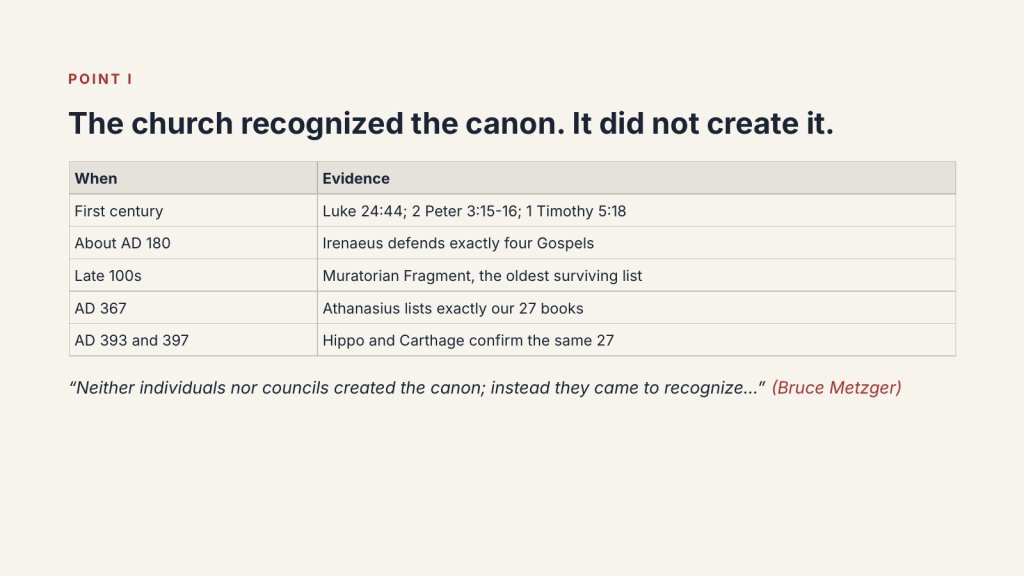
    Slide 12: The church recognized the canon. It did not create it.

    The church recognized the canon; it did not create it. “Canon” comes from a Greek word for a measuring rod. The canon is the measuring rod; the church is what gets measured. Chicago Article I says the Scriptures do not receive their authority from the church, tradition, or any human source.

    The evidence starts inside the Bible itself.

    • (Luke 24:44) Jesus affirmed the Old Testament as Israel already had it: the Law of Moses, the Prophets, and the Psalms.
    • (Luke 11:51) “From the blood of Abel to the blood of Zechariah” runs from Genesis to Chronicles, the first and last books in the Hebrew order. Jesus recognized the whole collection.
    • (2 Peter 3:15-16) Peter puts Paul’s letters alongside “the other Scriptures.” The apostles were already recognizing New Testament writings as Scripture.
    • (1 Timothy 5:18) Paul quotes Deuteronomy 25:4 and Luke 10:7 side by side and calls both “Scripture.”
    • (Colossians 4:16; 1 Thessalonians 5:27) The letters were read aloud and passed from church to church. Recognition began the day they arrived.

    Then the early church kept recognizing what it had received.

    • Around AD 180: Irenaeus defends exactly four Gospels, Matthew, Mark, Luke, and John, against the heretics’ add-ons.
    • Late 100s: the Muratorian Fragment, the oldest surviving list, names most of our New Testament.
    • AD 367: Athanasius, bishop of Alexandria, lists exactly our 27 books in his Easter letter.
    • AD 393 and 397: councils at Hippo and Carthage confirmed the same 27. They did not vote books in; they put in writing what the churches had already been reading for generations.

    The tests were simple. Was it written by an apostle or a close companion of one? Does it agree with the faith already delivered (Jude 3)? Was it received and used by the churches everywhere?

    Bruce Metzger of Princeton Seminary, the leading canon scholar of the last century, put it this way:

    “Neither individuals nor councils created the canon; instead they came to recognize” the authority those writings already had.

    It is like Jesus’ sheep: “My sheep listen to my voice” (John 10:27). The church did not make the word God’s; it recognized his voice. Hold onto that. It will matter when we talk about leadership: the church stands under the word, never over it.

    II. Read Out, Not Into (Genesis 3:1-5; Nehemiah 8:8)

    The first Bible was one command (Genesis 2:16-17): “You are free to eat from any tree in the garden; but you must not eat from the tree of the knowledge of good and evil, for when you eat from it you will certainly die.” Short, clear, and loving. No commentary needed.
    Slide 13: Satan introduced interpretation

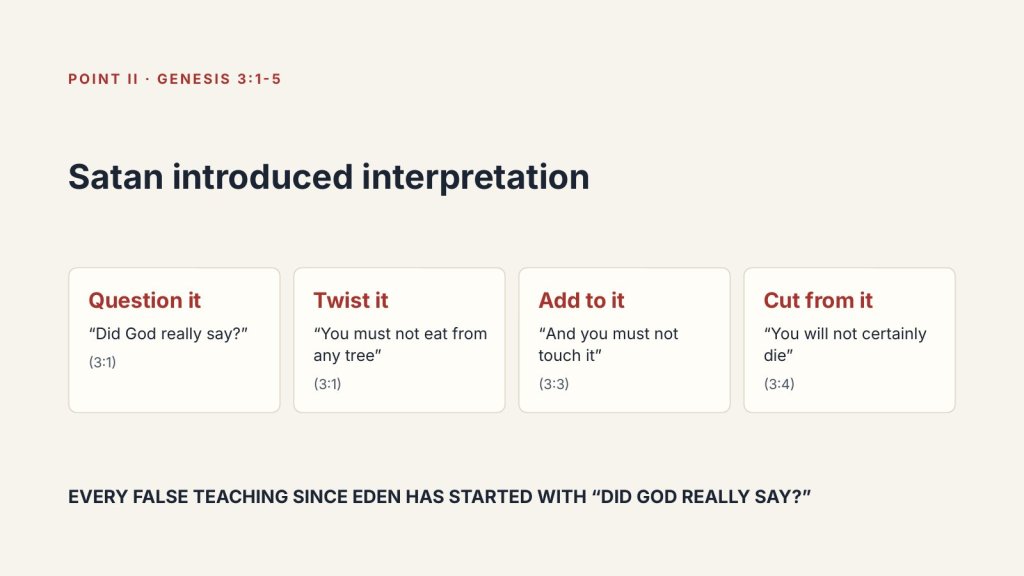
    Satan introduced interpretation by questioning what God said (Genesis 3:1-5). His first words in the Bible are “Did God really say?” He did not deny God’s word at first. He reinterpreted it.

    • He twisted it into “You must not eat from any tree in the garden.” God had said the opposite: eat from any tree but one.
    • Eve then added to it: “and you must not touch it” (3:3). God never said that.
    • Then Satan subtracted from it: “You will not certainly die” (3:4).

    Question it, twist it, add to it, cut from it. The first sin started with a bad interpretation.

    Bible Nugget: Satan has not changed his method; he just learned to quote Scripture. In the wilderness he quotes Psalm 91:11-12 to Jesus, ripped out of context (Matthew 4:6). Jesus answers, “It is also written” (Matthew 4:7). He corrects a misused verse with the rest of the Bible. That is hermeneutics. The devil uses one verse; Jesus uses the whole word.

    Every false teaching since Eden has started with “Did God really say?”

    Nehemiah 8:8 gives us the first picture of expository preaching in the Bible: “They read from the Book of the Law of God, making it clear and giving the meaning so that the people understood what was being read.” Read it. Explain it. Make sure they get it. That is still the job.
    Slide 14: Read out, not into

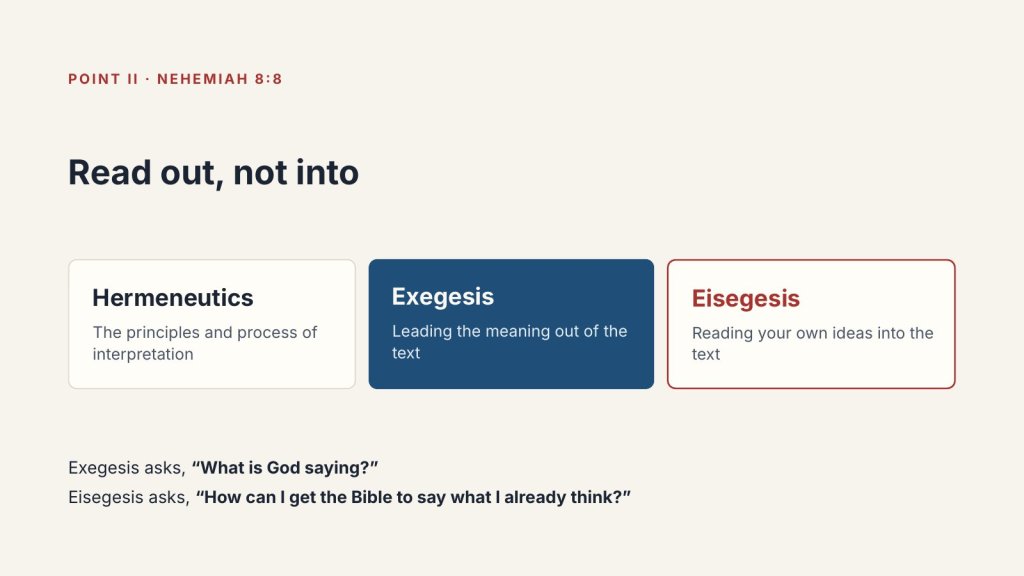
    Three words every minister needs to own:

    • Hermeneutics: the principles and process of interpretation.
    • Exegesis: to lead the meaning out of the text.
    • Eisegesis: to read your own ideas into the text.

    Exegesis asks, “What is God saying?” Eisegesis asks, “How can I get the Bible to say what I already think?”

    Eisegesis has done real damage.

    • (Revelation 8:13) Some preachers have made the eagle flying in midair into the United States.
    • (Philippians 4:13) We print it on football jerseys, but Paul wrote it about being content when he was hungry and in need (Philippians 4:11-12).
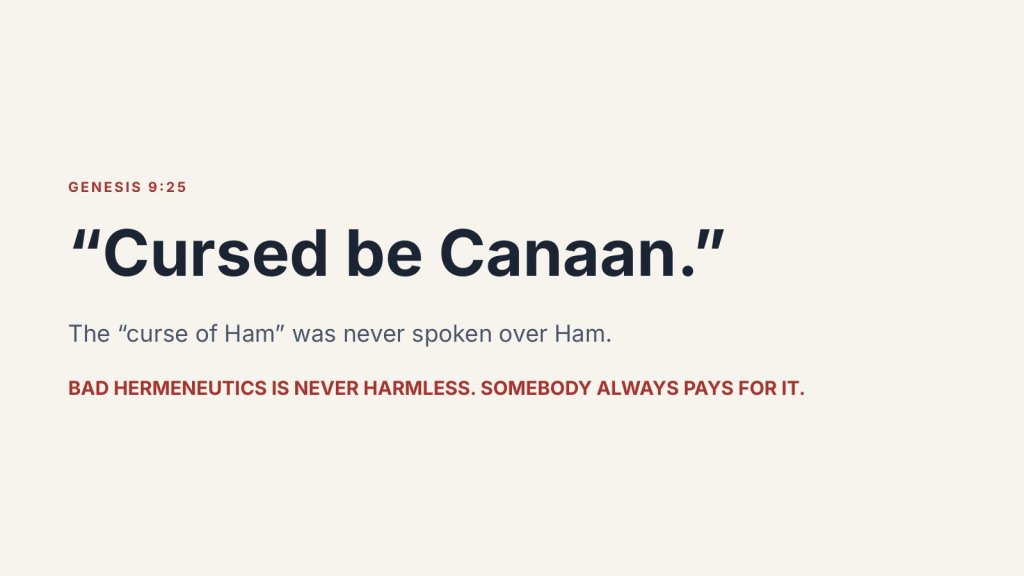
    • In the 1700s and 1800s, slave owners preached that Africans were under “the curse of Ham.”
    Slide 15: “Cursed be Canaan.”

    Bible Nugget: Read the text (Genesis 9:25). The curse was not even spoken over Ham. Noah says, “Cursed be Canaan.” Canaan, Ham’s son, was the father of the Canaanites, not of Africa. Men read their sin into a verse that never said what they needed it to say.

    Bad hermeneutics is never harmless. Somebody always pays for it.
    Slide 16: Ask two questions before the third

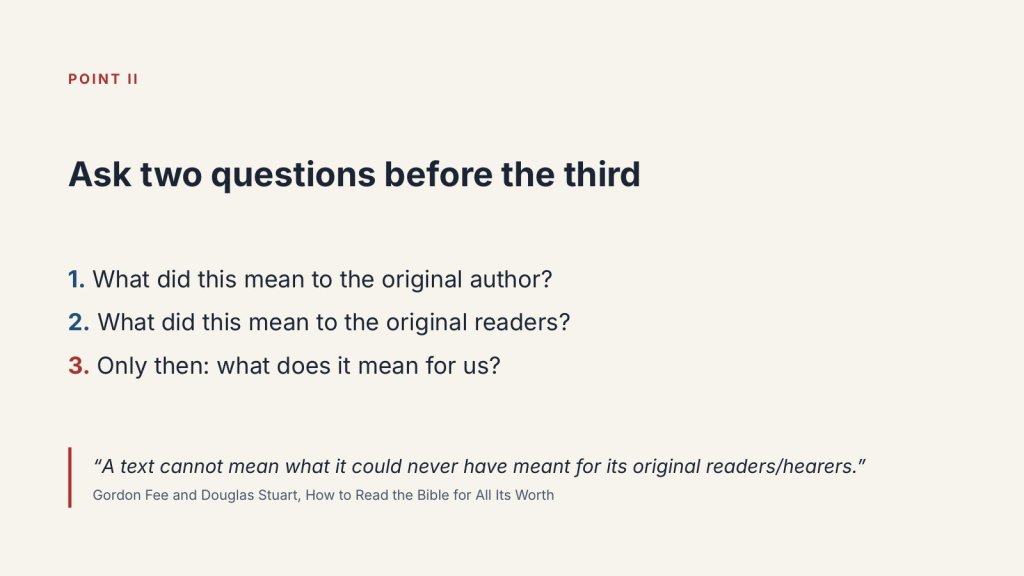
    Ask two questions before you ever ask the third.

    • 1. What did this mean to the original author?
    • 2. What did this mean to the original readers?
    • 3. Only then: what does it mean for us?

    Gordon Fee and Douglas Stuart, in How to Read the Bible for All Its Worth, say it plainly:

    “A text cannot mean what it could never have meant for its original readers/hearers.”

    They also warn that interpretation which thrives on being new and unique usually comes from pride, a false idea of spirituality, or a bias we are protecting. If nobody in two thousand years saw what you just “discovered,” slow down.
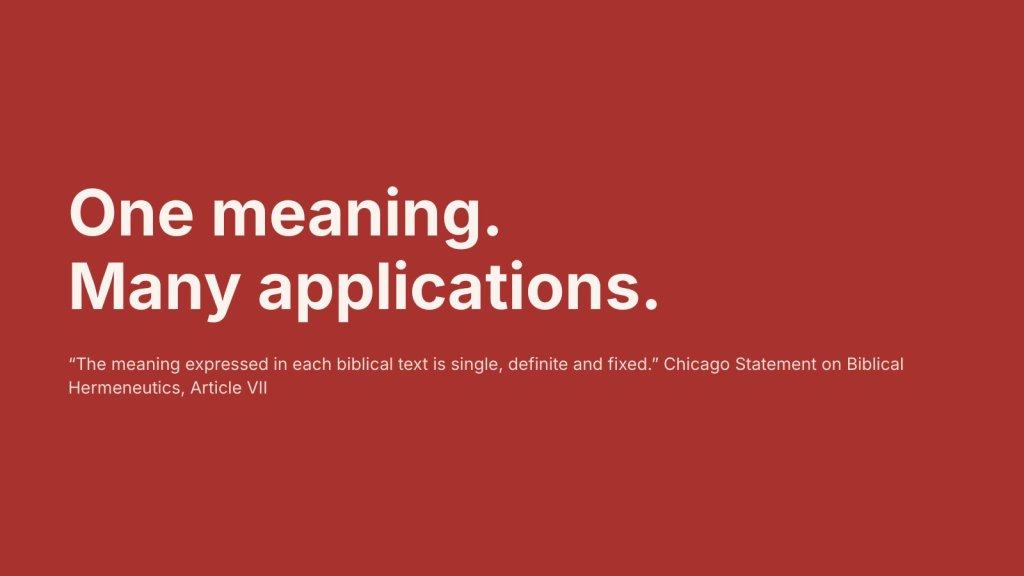
    Slide 17: One meaning. Many applications.

    The Chicago Statement on Biblical Hermeneutics (1982), Article VII:

    “We affirm that the meaning expressed in each biblical text is single, definite and fixed.”

    It also denies that this single meaning eliminates the variety of its application.

    One meaning. Many applications.

    Most interpretation is sanctified common sense. Fee and Stuart call common sense the most important hermeneutical skill most believers already have. We spent years in English class learning to read a letter, a poem, and a news story differently. Use it.

    Jesus’ own listeners kept missing figures of speech.

    • (John 3:4) Nicodemus: can a man enter his mother’s womb a second time?
    • (John 4:11) The Samaritan woman: you have nothing to draw with, and the well is deep.
    • (John 6:52) The crowd: how can this man give us his flesh to eat?

    They were not too spiritual. They were too literal in the wrong places.

    Challenge: When you prepare a lesson, write the “then” sentence before you write the “now” sentence. If you cannot say what it meant to them, you are not ready to say what it means to us.

    III. The Interpreter’s Toolbox: Six Kinds of Criticism (Acts 17:11)
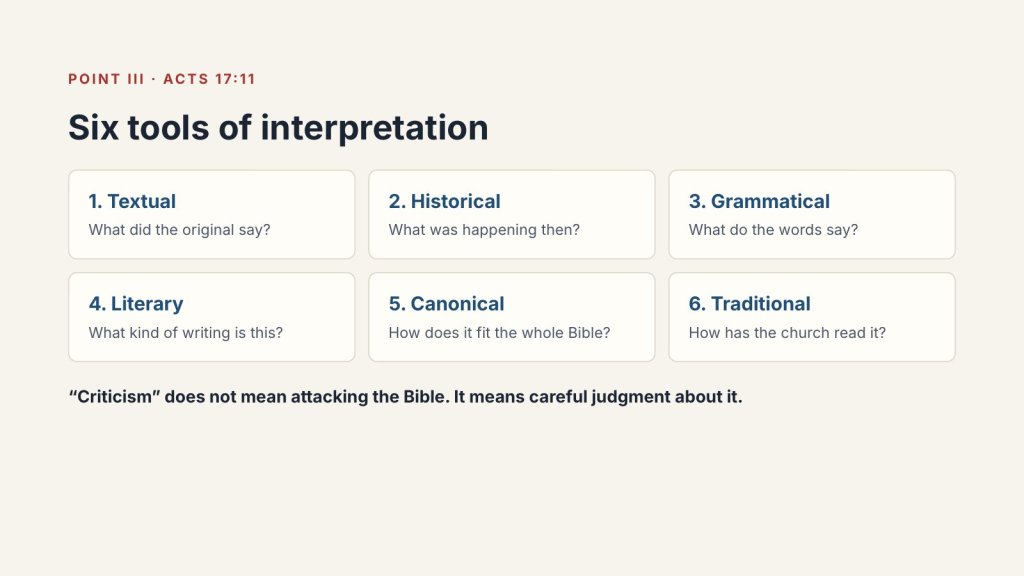
    Slide 18: Six tools of interpretation

    Bible Nugget: The Bereans were doing biblical criticism. They “examined the Scriptures every day to see if what Paul said was true” (Acts 17:11). “Examined” is anakrinō: to investigate, to judge carefully, like a court hearing evidence. In Bible study, “criticism” does not mean attacking the Bible. It means careful judgment about the Bible.

    Know the difference between lower and higher criticism.

    • Lower criticism asks: what exactly did the original text say?
    • Higher criticism asks: who wrote it, when, from what sources, and how was it put together?

    Asking those questions is not wrong. But since the 1800s, much of higher criticism started with the assumption that miracles and prophecy cannot happen, and then reached the conclusions it started with. The Chicago Statement on Hermeneutics (Article XVI) affirms using legitimate critical methods to establish the text and its meaning, and denies any method used to question the truth of what the writer said.

    Eat the fish. Spit out the bones.

    Bible Nugget: Grant Osborne called this process The Hermeneutical Spiral. It is not a circle that goes nowhere, but a spiral: text, context, text again, each pass bringing you closer to the author’s meaning. Here are the six tools that move you up the spiral.

    1. Textual Criticism: What did the original manuscripts say?

    • We have no original autographs, but we have about 5,800 Greek New Testament manuscripts, far more than any other ancient book.
    • Comparing them lets scholars recover the original wording with remarkable confidence. Most differences are spelling and word order.
    • Conservative textual scholars point out that no core doctrine rests on a disputed reading.
    • This is why your Bible brackets Mark 16:9-20 and John 7:53-8:11 with a note. Know why before a student asks you.
    • The KJV translators did faithful work with the manuscripts they had. Since 1611 we have found far older ones: Codex Sinaiticus, Codex Vaticanus, early papyri, and the Dead Sea Scrolls.

    Slide 19: Know your translation

    Know your translation: word for word (NASB, ESV, NKJV), thought for thought (NIV, NLT), paraphrase (The Message). Study with a word for word; compare with the others.

    2. Historical and Cultural Criticism: What was happening when it was written?

    • For the Old Testament, know the Ancient Near East and Israel’s culture. For the New Testament, know the Roman world and first century Judaism.
    • (Revelation 3:15-16) Laodicea is widely taught to have piped its water in by aqueduct, so it arrived lukewarm, unlike the hot springs of Hierapolis or the cold water of Colossae. Lukewarm was not a feeling. It was useless.
    • Slavery: critics read the Bible through the lens of 1800s race-based chattel slavery. But the Law made kidnapping a man to sell him a capital crime (Exodus 21:16), and Paul lists slave traders among the lawless (1 Timothy 1:10).
    • Head coverings (1 Corinthians 11:2-16): without culture you either bind a veil on every woman or throw out the passage. With culture you find the principle and honor it.

    3. Grammatical Criticism: What do the words and sentences actually say?

    • This is where word studies live. Look up the word, then see how the same author uses it elsewhere.
    • (Matthew 28:19-20) There is one command in the Great Commission: make disciples. Going, baptizing, and teaching describe how.
    • Watch the grammar: a “therefore” always points back. An “if” sets a condition. A question can be sarcasm.

    Bible Nugget: D. A. Carson’s Exegetical Fallacies should be on every minister’s shelf. He warns against the root fallacy: assuming a word always means what its root means. His famous example is that the gospel is the dunamis of God (Romans 1:16). Preachers love to say “dynamite.” But dynamite was invented in 1867. Paul never thought of an explosion. He meant God’s power to save. A word means what its author used it to mean in that sentence. Usage beats etymology.

    4. Literary Criticism: What kind of writing is this?
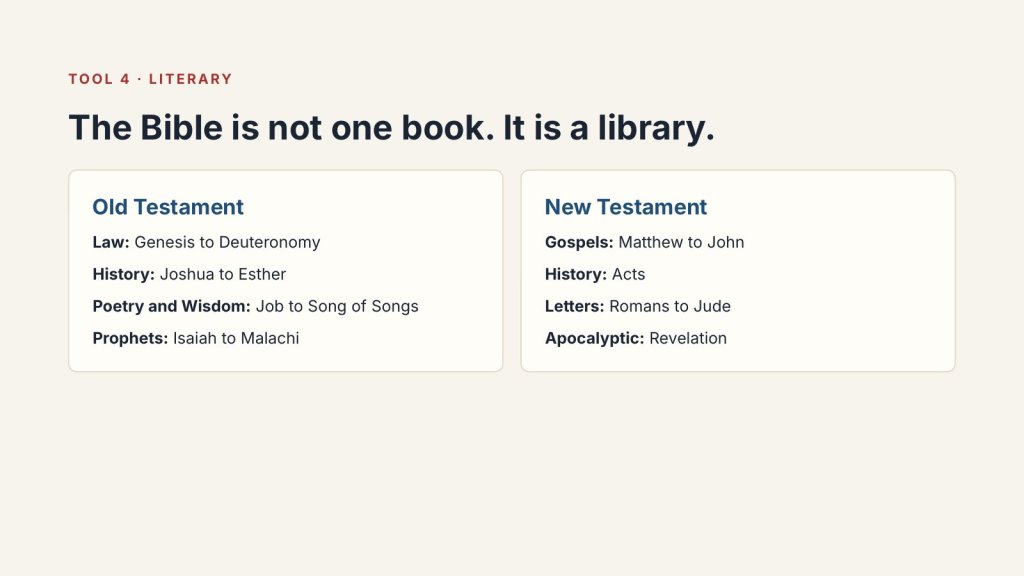
    Slide 20: The Bible is not one book. It is a library.

    The Bible is not one book. It is a library. You do not read a cookbook the way you read a love letter.

    • Old Testament: Law (Genesis to Deuteronomy), History (Joshua to Esther), Poetry and Wisdom (Job to Song of Songs), Prophets (Isaiah to Malachi).
    • New Testament: Gospels, History (Acts), Letters (Romans to Jude), Apocalyptic Prophecy (Revelation).
    • Proverbs are probabilities, not promises. Proverbs 22:6 is wise counsel, not a guarantee.
    • Poetry uses images. (Psalm 91:4) God does not have feathers.
    • Hyperbole exaggerates to make a point. (Matthew 5:29-30) Nobody reading this should be missing an eye.
    • Apocalyptic speaks in symbols. Do not turn every beast in Revelation into this week’s headlines.

    For balance, the Chicago Statement on Hermeneutics (Article XIII) values genre study but denies that genre can be used to turn history the Bible presents as fact into myth. Genesis and Acts are narrative, and narrative is history.

    Narrative tells you what happened. It does not always tell you what to do.

    • (Acts 1:26) They cast lots to choose an apostle. Are we commanded to?
    • (Acts 2:45) They sold property. Is every disciple commanded to?
    • (Matthew 27:5) Judas hanged himself. You see where this is going.

    Narrative becomes our pattern when the rest of Scripture teaches it. The baptism of Acts 2:38 is taught again in Romans 6:3-4, Colossians 2:12, and 1 Peter 3:21.

    5. Canonical Criticism: How does this passage fit the whole Bible?

    • Scripture interprets Scripture. The Chicago Statement on Hermeneutics (Article XVII) calls the Bible its own best interpreter.
    • Let the clear passages explain the unclear ones. Even Peter said Paul wrote some things hard to understand (2 Peter 3:16).
    • (1 Corinthians 15:29) Baptism for the dead appears once and is never taught again. Do not build a practice on it.

    Never build a doctrine on one verse the rest of the Bible never repeats.

    Know where you are in the timeline of God’s covenants.

    • (Luke 23:43) The thief on the cross was saved before Jesus died, while the old covenant still stood. A will takes effect only when the one who made it has died (Hebrews 9:16-17).
    • (Ephesians 2:14-16; Colossians 2:16-17) The Sabbath was a sign given to Israel. The law was set aside in Christ’s flesh.
    • (2 Timothy 3:16-17) When Paul wrote “all Scripture,” he was pointing Timothy to the Old Testament. Too many disciples do not know their Old Testament.

    6. Traditional Criticism: How has the church understood this passage?

    • Augustine, Luther, Calvin, the early church fathers, the Restoration preachers: they are not our authority, but they are wise company.
    • Chicago Article II denies that creeds, councils, or declarations have authority equal to the Bible. History is a guardrail, not a steering wheel.

    Tradition: Is the “morning star” of Isaiah 14:12 Satan or the king of Babylon? In context the taunt is aimed at the king of Babylon (Isaiah 14:4). The church has long also read it as a picture of Satan’s fall. That is possible, but hold it as tradition, not as the plain meaning of the text. Learn to say, “The text says this. Tradition adds this.” That honesty builds trust.

    Challenge: Pick the one tool you have never really used and use it in your quiet times this week. Most of us live in tool three and skip the rest.

    IV. Where the Bible Speaks and Where It Is Silent (Deuteronomy 29:29; 1 Corinthians 4:6)

    God has not told us everything, but he has told us enough: “The secret things belong to the Lord our God, but the things revealed belong to us and to our children forever, that we may follow all the words of this law” (Deuteronomy 29:29).

    “Do not go beyond what is written” (1 Corinthians 4:6). Paul says this so the church would stop taking pride in one leader over another. Going beyond Scripture always ends up exalting a man.
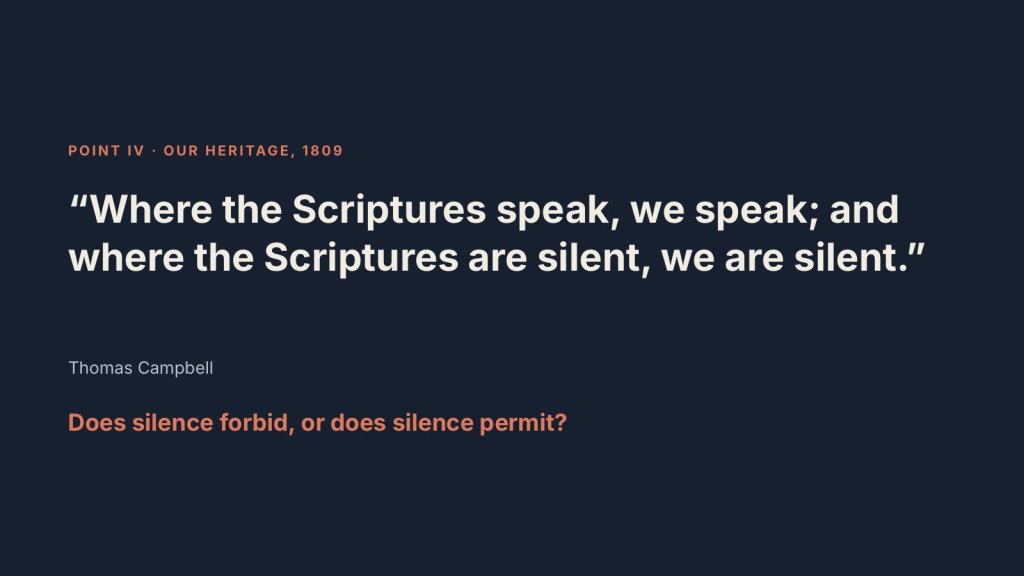
    Slide 21: Thomas Campbell, 1809

    Our heritage gives us a famous rule. In 1809, Thomas Campbell wrote this for the Restoration Movement:

    “Where the Scriptures speak, we speak; and where the Scriptures are silent, we are silent.”

    It is a great rule. But the movement later split over what “silent” means.
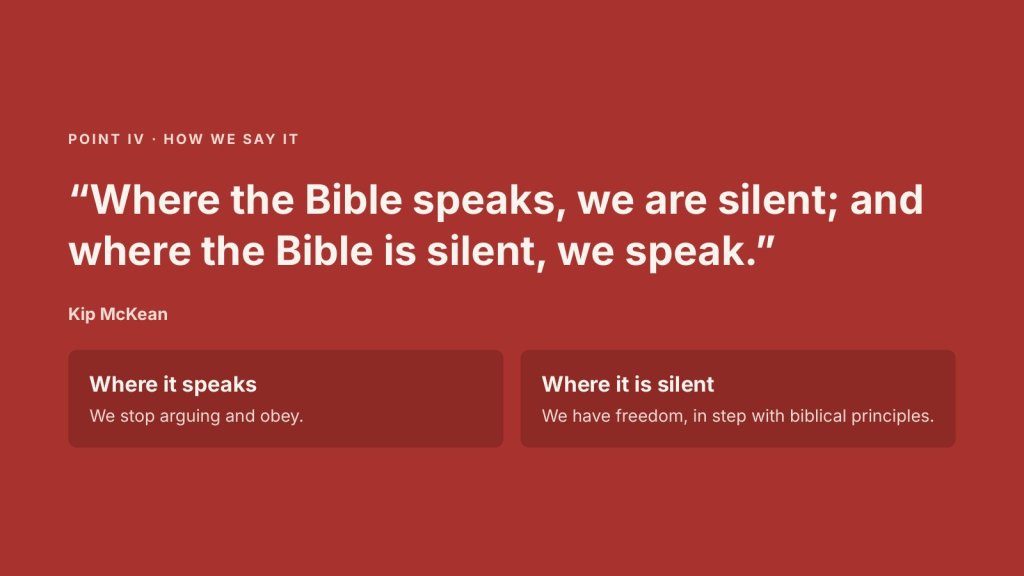
    Slide 22: Kip McKean: where the Bible speaks and where it is silent

    Does silence forbid, or does silence permit? Brothers broke fellowship over that question in the late 1800s.
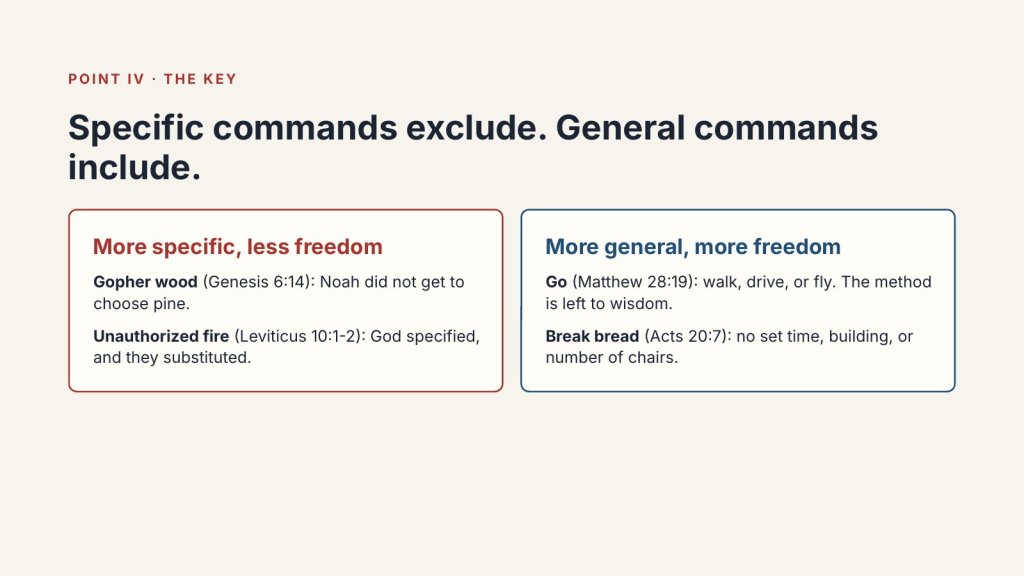
    Slide 23: Specific commands exclude. General commands include.

    Here is the key: specific commands exclude, and general commands include. The more specific the command, the less freedom. The more general the command, the more freedom.

    • (Genesis 6:14) God said cypress (gopher) wood. Noah did not get to choose pine.
    • (Leviticus 10:1-2) Nadab and Abihu offered fire “contrary to his command.” God had specified, and they substituted.
    • (Matthew 28:19) God said go. He did not say walk, drive, or fly. The method is left to wisdom. There is silence in the method, so we speak!
    • (Acts 20:7) God shows us the church gathering to break bread. He does not tell us what time, what building, or how many chairs.
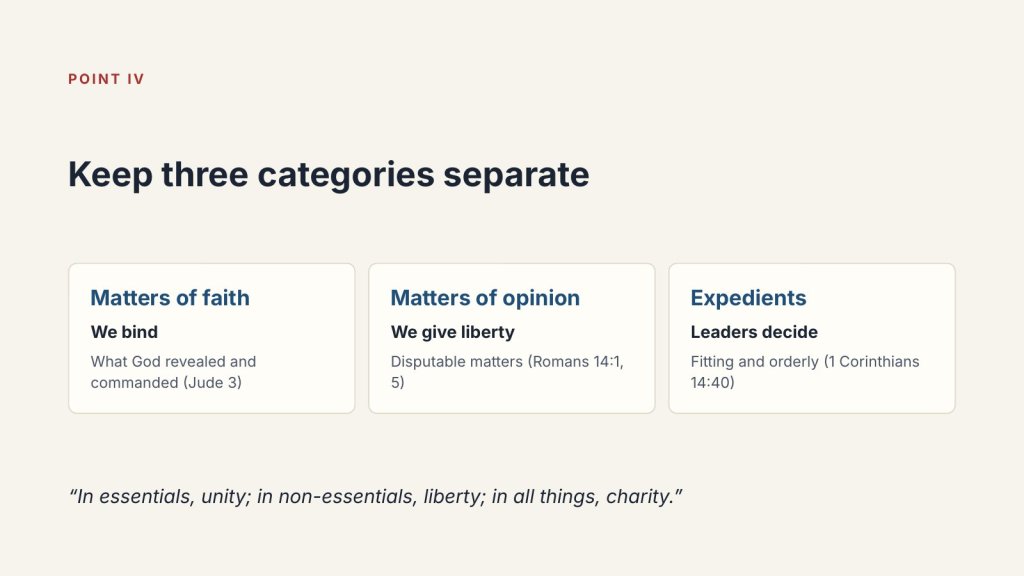
    Slide 24: Keep three categories separate

    Three categories every minister must keep separate:

    • Matters of faith: what God has revealed and commanded. We bind these (Jude 3).
    • Matters of opinion: disputable matters God leaves to conscience. We give liberty (Romans 14:1, 5).
    • Expedients: the best way to carry out what God commanded. Leaders decide these with wisdom, so that everything is done in a fitting and orderly way (1 Corinthians 14:40).

    A seventeenth century line usually credited to Rupertus Meldenius sums it up:

    “In essentials, unity; in non-essentials, liberty; in all things, charity.”

    Unity where God has spoken. Liberty where he has not. Love everywhere.
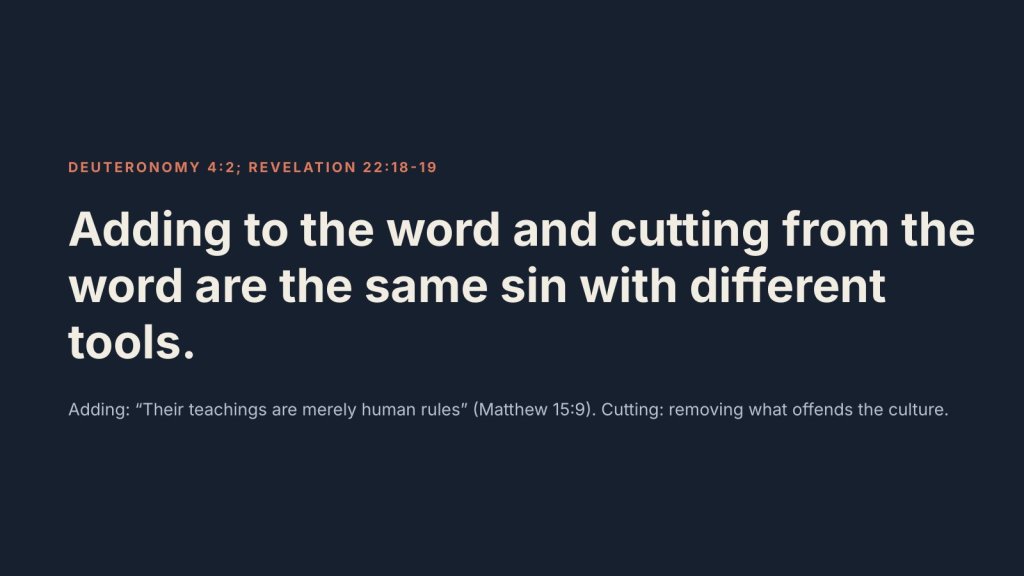
    Slide 25: Adding and cutting are the same sin

    There are two ways to break the rule, and both are deadly.

    • Adding: the Pharisees bound their traditions on people. “They worship me in vain; their teachings are merely human rules” (Matthew 15:9).
    • Subtracting: the modern church cuts out what offends the culture.

    God warns against both (Deuteronomy 4:2; Revelation 22:18-19).

    Adding to the word and cutting from the word are the same sin with different tools.

    V. Who Speaks When the Bible Is Silent? (Acts 15:28; Hebrews 13:17)
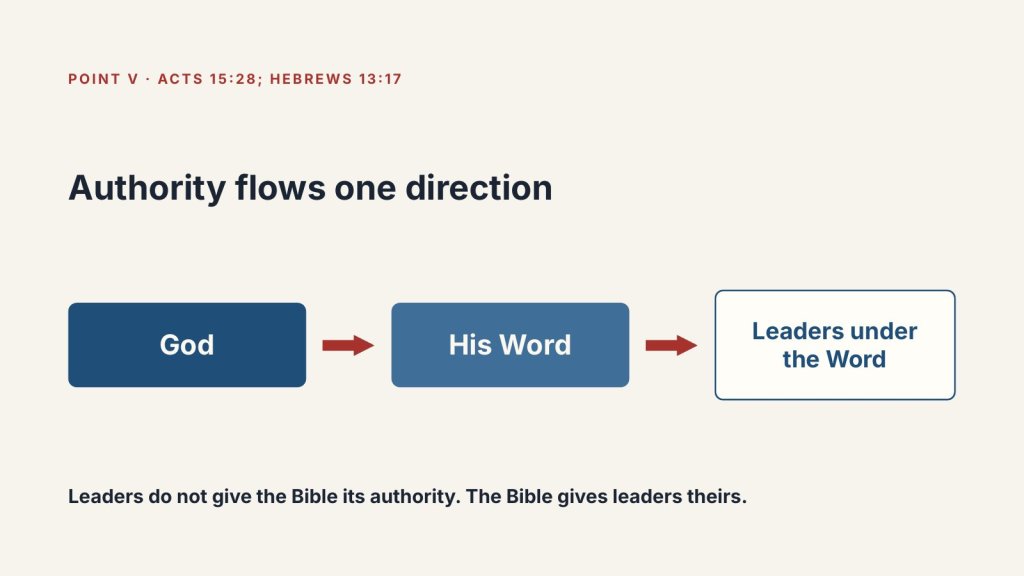
    Slide 26: Authority flows one direction

    Authority flows in one direction: God, then his word, then leaders who stand under his word. Leaders do not give the Bible its authority. The Bible gives leaders theirs. Every bit of authority a leader has is borrowed, and borrowed authority must be used the way the owner intended.

    “It seemed good to the Holy Spirit and to us” (Acts 15:28). Watch their process: a real question, an open discussion, testimony of what God was doing, and Scripture (Amos 9:11-12 quoted in Acts 15:16-18). Then came a decision, written down and delivered in person. The apostles’ authority was unique, but their process is a model: Scripture first, then sanctified judgment. And notice their heart: “We should not make it difficult for the Gentiles who are turning to God” (Acts 15:19).

    Leaders are called to bring order where Scripture gives the goal but not the details.

    • (Titus 1:5) Titus was left in Crete to “put in order what was left unfinished.”
    • (1 Corinthians 14:33, 40) “Everything should be done in a fitting and orderly way.”
    • (1 Corinthians 11:16) Paul appeals to the practice of the churches.

    Bible Nugget: “Have confidence in your leaders and submit to their authority” (Hebrews 13:17). The word often translated “obey” is peithō: to be persuaded. Good leaders persuade from Scripture. Good disciples choose to be persuadable. Leaders “keep watch over you as those who must give an account.” That is weight, not privilege.
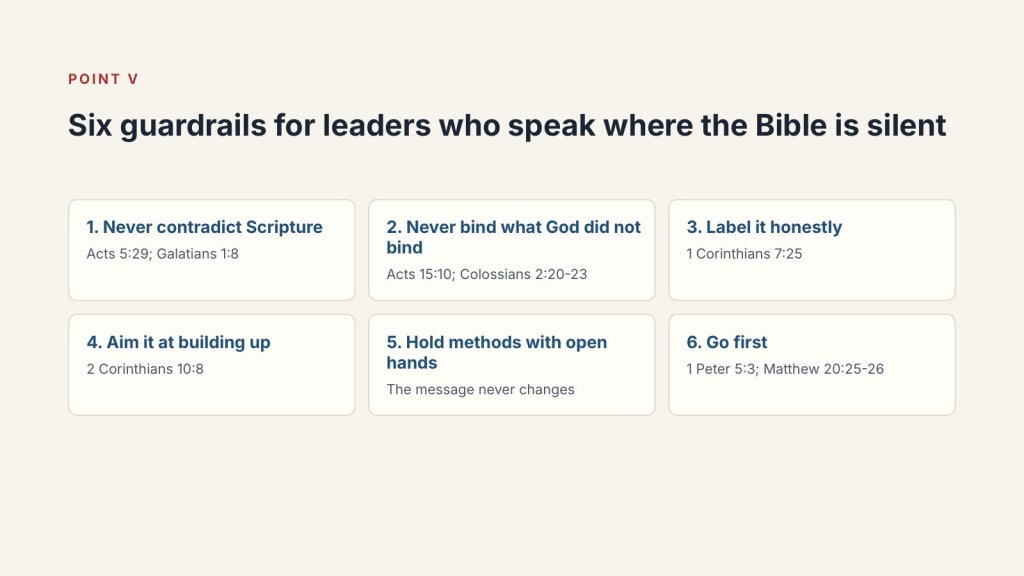
    Slide 27: Six guardrails for leaders who speak where the Bible is silent

    Six guardrails for leaders who speak where the Bible is silent:

    • 1. Never contradict Scripture (Acts 5:29; Galatians 1:8).
    • 2. Never bind as salvation what God did not bind (Acts 15:10; Colossians 2:20-23).
    • 3. Label it honestly. “Thus says the Lord” is different from “This is our best judgment” (1 Corinthians 7:25).
    • 4. Aim it at building up. Paul’s authority was “for building you up rather than tearing you down” (2 Corinthians 10:8).
    • 5. Hold methods with open hands. The message never changes. Methods should.
    • 6. Go first. Shepherds lead by example, not by lording it over people (1 Peter 5:3; Matthew 20:25-26).

    Disciples have a responsibility too.

    • Follow leaders in matters of judgment even when you would have done it differently.
    • Disagree biblically, privately, and respectfully, and keep following while you talk it through.
    • Do not confuse your preference with a conviction, and do not confuse a leader’s judgment with a command of God.
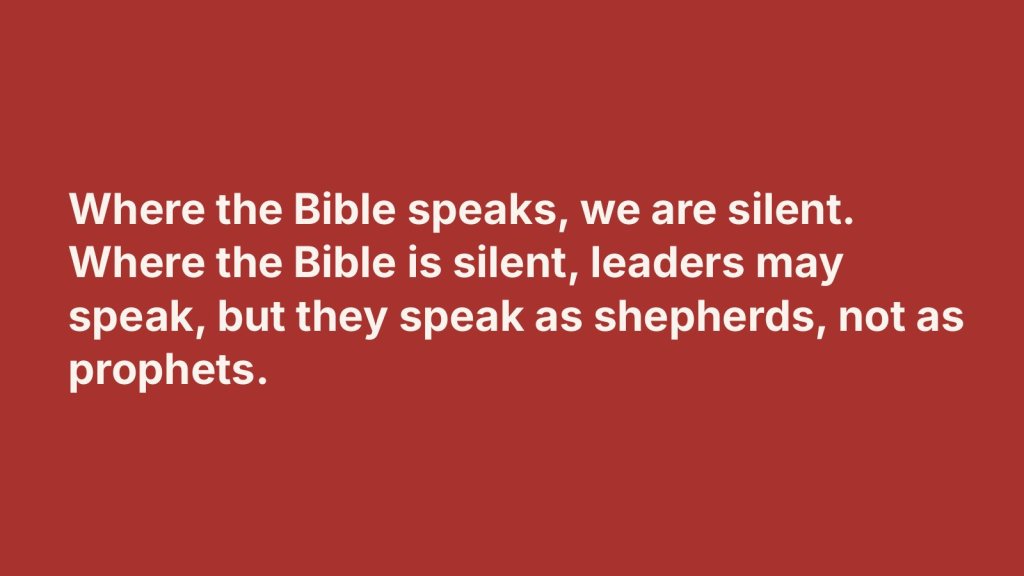
    Slide 28: Shepherds, not prophets

    Where the Bible speaks, we are silent. Where the Bible is silent, leaders may speak, but they speak as shepherds, not as prophets.

    Challenge: Write down three things you are teaching or directing in your ministry this week. Put each one in a category: command, principle, or our judgment.

    VI. The Minister’s Study Life (1 Timothy 4:13-16; Hebrews 5:12-14)

    Paul tells Timothy to devote himself to the word and watch his life and doctrine closely: “Be diligent in these matters; give yourself wholly to them, so that everyone may see your progress” (1 Timothy 4:15). People should be able to see your Bible study growing. If your schedule has no room for the word, your schedule is the problem.

    Bible Nugget: Mature believers are “trained by constant use” (Hebrews 5:14). “Trained” is gymnazō, where we get gymnasium. You do not become a skilled interpreter by attending a class. You become one by repetition. You don’t pick up a sword and know how to fight. Someone trained me.
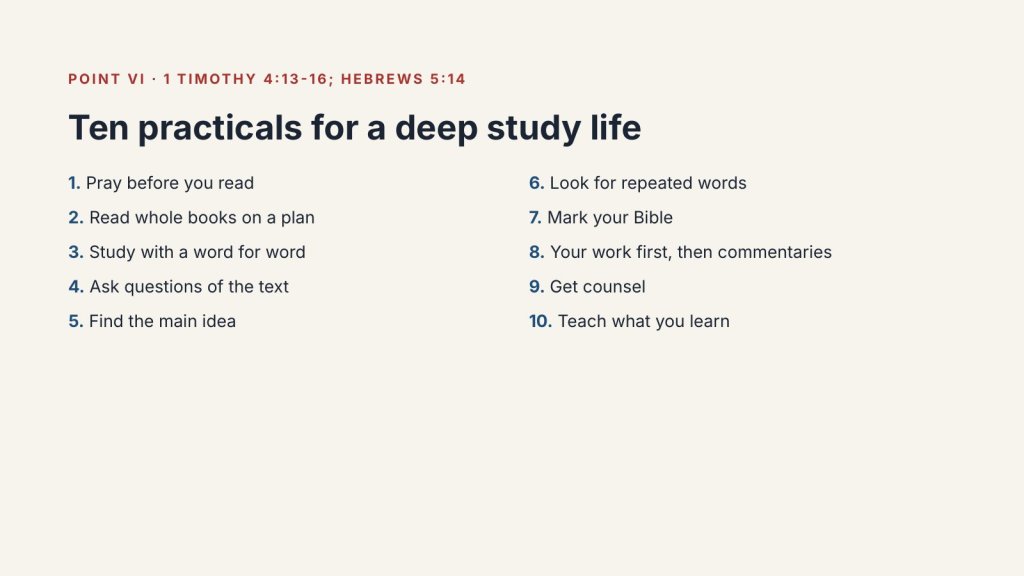
    Slide 29: Ten practicals for a deep study life

    Ten practicals for a deep study life:

    • 1. Pray before you read. “Open my eyes that I may see wonderful things in your law” (Psalm 119:18).
    • 2. Read whole books, by thought units, on a plan. Do not graze verse by verse.
    • 3. Use a word for word translation for study, and compare two or three others.
    • 4. Ask questions of the text: Who wrote it? To whom? Why? What problem is he answering? Reading a letter is like hearing one side of a phone call.
    • 5. Find the main idea of the passage, then where it fits in the big story of the Bible.
    • 6. Look for repeated words and do word studies the right way.
    • 7. Mark your Bible: red for commands, green for history, black for doctrine, blue for promises and prayers.
    • 8. Do your own work first, then check conservative commentaries: Blue Letter Bible, Coffman on StudyLight, Bible Hub, the Pulpit Commentary, Halley’s Bible Handbook.
    • 9. Get counsel. Talk through your study with your discipler and your evangelist (Romans 15:14; Ephesians 4:11-13).
    • 10. Teach what you learn. You never know a passage until you have taught it (2 Timothy 2:2).

    A note on AI tools: if you use them in your study, give them guardrails.
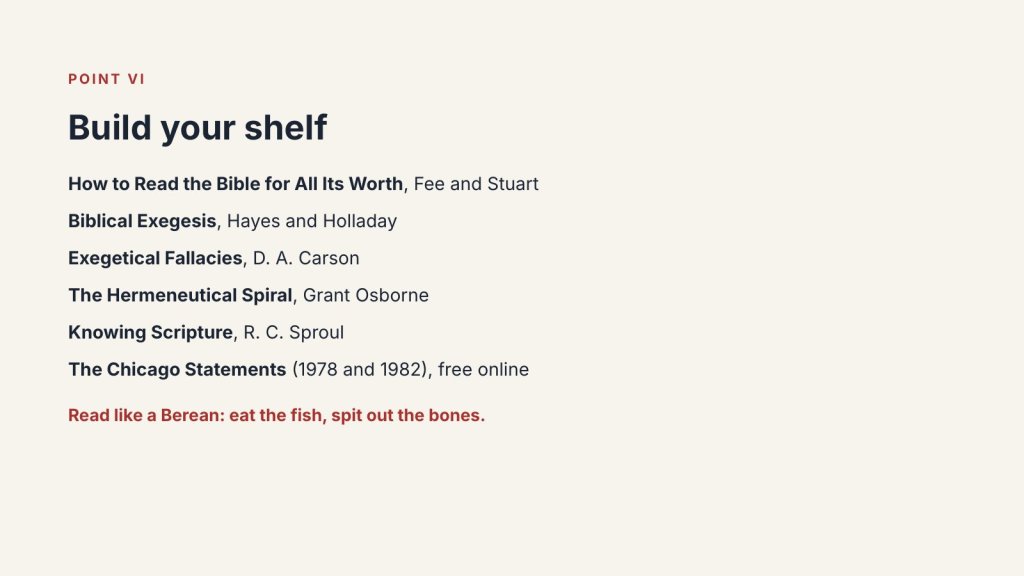
    Slide 30: Build your shelf

    Build your shelf. Here is my recommended reading:

    • Gordon Fee and Douglas Stuart, How to Read the Bible for All Its Worth
    • John H. Hayes and Carl R. Holladay, Biblical Exegesis
    • D. A. Carson, Exegetical Fallacies
    • Grant Osborne, The Hermeneutical Spiral
    • R. C. Sproul, Knowing Scripture
    • The Chicago Statements on Biblical Inerrancy (1978) and Biblical Hermeneutics (1982), free online

    Read every book like a Berean: eat the fish, spit out the bones.

    Conclusion (2 Timothy 2:15)

    Go back to the man with his finger on Judas. He loved the Bible. He just never learned to cut it straight. God is not asking for ministers who can quote verses. He is asking for workmen who handle them correctly.
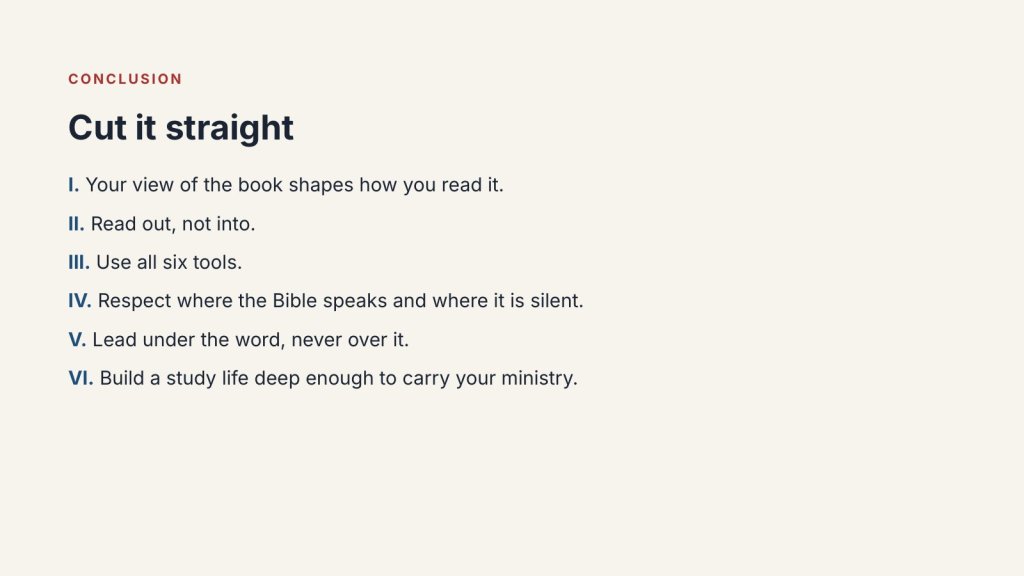
    Slide 31: Cut it straight
    • I. Your view of the book shapes how you read it.
    • II. Read out, not into.
    • III. Use all six tools.
    • IV. Respect where the Bible speaks and where it is silent.
    • V. Lead under the word, never over it.
    • VI. Build a study life deep enough to carry your ministry.

    Slide 32: 1 Corinthians 15:29

    Your assignment: Take 1 Corinthians 15:29 and walk it through all six tools. On one page, write what it meant then, what it means now, and one place you realize you have been reading something into the Bible.

  • Step Out of the Boat: An Update on Where I’m Serving Now

    It has been a while since I gave you a real update here, so let me do that now. Not a highlight reel. An honest picture of where I am serving, why I am serving there, and what the Bible has to say about the kind of step it took to get here.

    The Story Behind the Update

    In Matthew’s Gospel, Jesus sends His disciples out on the water while He goes up a mountain to pray. Hours later, in the fourth watch of the night, He comes to them walking on the sea. Peter, always the one who cannot help himself, calls out.

    “Lord, if it’s you, tell me to come to you on the water.” “Come,” he said. Then Peter got down out of the boat, walked on the water and came toward Jesus. (Matthew 14:28-29)

    Earlier this year I preached a message called “Step Out of the Boat” to thousands of students and leaders at the Revolution on Campus conference in Anaheim. I built it around Peter’s whole life, not just the moment he walked on water, but the moment he sank, the moment he denied Jesus at a charcoal fire, and the moment Jesus restored him on a beach and sent him back out to shepherd sheep. The passage resonates with me so much because it is my life. It is the story of how I ended up serving where I serve now.

    Ivan Aivazovsky, Walking on Water, 1888, Christ walking across a stormy sea toward the disciples' boat
    Ivan Aivazovsky, Walking on Water, 1888

    Where I Serve Now

    I am a pastor and evangelist with The Restored Church Worldwide. RCW exists because a group of us, after years inside the International Christian Churches, became convinced that Scripture, not tradition, not culture, not the preferences of any single church movement, has to be the final authority for what we believe and how we live. It was what the ICC was originally founded on, but the central leadership had lost its way. Our tagline says it plainly: the Bible must be our standard. That conviction is not a slogan for us. It is the reason RCW exists at all.

    Right now I lead a congregation in the San Francisco Bay Area. Before this, I served in ministry in Los Angeles and in Boston prior to the formation of RCW, and those years shaped nearly everything I do now, from how I preach to how I disciple. What matters most to me is not credentials but the years spent in actual rooms with actual people, walking with them through sin, doubt, marriage, singleness, grief, and the slow work of becoming like Jesus.

    My wife and I are also leading one of the largest mission teams in discipling history to plant Restored Church New England in Boston in the summer of 2027. Boston was where some of my most formative ministry happened, and going back to plant a church there, alongside my own wife and a team we love and trust, feels like one more step out of a boat we could have stayed comfortably in: the current church we lead, which we had the opportunity to see grow from 465 to 600. We are not stopping in Boston either. From there, we are already preparing to plant a church in New York City in 2029, because the same conviction that took us to the Bay Area will not let us settle once we arrive somewhere new.

    Alongside the local church work, I teach through a Ministry Training Academy, preach regularly on our church’s YouTube channel, and write. I have written six books, including Taking OCD Captive, Intruders, Project Tyrannus, So You Want to Study the Bible?, 7 Keys to Finding the Right One, and my newest project, Let’s Go There!, which wrestles with what it looks like to let Scripture, not our tribe or our feelings, settle how we think about race, sexuality, and politics. All of it is now published under Restored Publishing. None of it exists to build a platform for its own sake. It exists because I believe the church needs evangelists and pastors willing to teach hard texts plainly and lovingly, and because I would rather spend my life doing that than doing something safer.

    Why This Is a Bible Article and Not Just an Update

    I could have written all of that as a simple ministry update. But Peter’s story will not let me leave it there, because I think it explains what actually happened to get me here, and it may explain something in your own life too.

    Gustave Brion, Jesus and Peter on the Water, Peter reaching toward Christ as he begins to sink
    Gustave Brion, Jesus and Peter on the Water

    Step into God’s vision. Before Peter could walk on water, he had to leave the boat, which meant leaving the only place that felt safe in the middle of a storm. Every meaningful step I have taken in ministry, leaving a familiar movement to help start RCW, leaving Los Angeles for Boston, leaving Boston for the Bay Area, and now preparing to help plant a church back in Boston, has required letting go of something stable for the sake of something Jesus was calling me toward. You cannot walk toward Christ while keeping one hand on the side of the boat.

    Step into the impossible. Peter did not ask for an explanation of the physics of walking on water. He asked for a command, and then he obeyed it before he understood it. Planting a church, writing a book about the most divisive topics in American culture, taking one of the largest mission teams in discipling history into Boston and then aiming a second plant at New York City two years later, none of that makes sense by the world’s math. It only makes sense if Jesus really is who He says He is, and if His word really is trustworthy enough to build a life on (2 Timothy 3:16-17).

    Step into your calling, even after you sink. Peter sank. Peter denied Jesus three times at a charcoal fire, in the very moment loyalty mattered most. And yet the same Jesus who let him sink is the one who met him again at another charcoal fire in John 21, asked him three times if he loved Him, and told him to feed His sheep (John 21:15-17). If your ministry, your faith, or your life has a charcoal fire in its past, a failure you assumed disqualified you, hear this clearly. Grace has no limit. Jesus does not just forgive failure. He commissions people out of it.

    Where That Leaves You

    I am not telling you all of this so you will be impressed with a resume of churches and books. I am telling you because I think most of us are standing in the boat right now, gripping the side, waiting for the storm to calm down before we will move. Scripture does not promise the storm will calm first. It promises that Jesus is already walking toward you in the middle of it, and that His word is enough to stand on even when the water underneath you makes no sense.

    So here is the update, plainly. I serve as a pastor and evangelist with The Restored Church Worldwide, leading a church in the Bay Area, and my wife and I are now leading one of the largest mission teams in discipling history to plant a church in Boston in 2027, with New York City to follow in 2029. Alongside that, I am training the next generation of preachers, writing books that try to take Scripture seriously on hard subjects, and preaching every chance I get that the Bible must be our standard. I invite anyone who may feel called to evangelize the Northeast to step out of the boat and reach out to me. I got here by stepping out of a few boats I could have stayed in.

    If you want to walk with us, come visit Restored Church SF on a Sunday, watch the sermons on our YouTube channel, or follow along on my social media. But more than any of that, I would simply ask you to consider where Jesus might be saying “Come” in your own life, and whether you are willing to get out of the boat.

    Lord, if it is You, command me to come.

  • STAY UPDATED:

    A few updates! I have not kept this blog updated in a while and a lot has happened. Keep current with our ministry at the Facebook link below. Currently, my wife and I serve as Evangelist and Women’s Ministry Leader in the City of Angels International Christian Church Inland Empire Super Region. I’ve also released a couple of books listed below and you can keep up with my sermons at the Inland Empire YouTube Page (@inlandempireregionicc)

    Project Tyrannus: A Powerful Blueprint to Building Campus Ministry – https://www.amazon.com/dp/B0BGSHQ683

    Intruders: Overcoming False Guilt, Intrusive Thoughts, and Obsessive Thinking https://www.amazon.com/dp/B0DGLPPYBT

    So You Want to Study the Bible?- https://www.amazon.com/dp/B0DF6GZL3R

    Taking OCD Captive – https://www.amazon.com/dp/1722732660

    To keep current with our ministry and my weekly Bible Study “Lists” I put out, follow me on Facebook: https://www.facebook.com/mike.patterson.9028?mibextid=ZbWKwL

  • TAKING OCD CAPTIVE CHRISTMAS SALE!

    9D9D7792-68E0-40B2-AD9A-B7050E5547A0

    For the month of December, buy the ebook that is helping many find freedom from OCD for only $10! Click the “Buy Now” link in the upper left corner of this website. 


  • Strong in the Grace: Developing Inner Strength

    “You then, my son, be strong in the grace that is in Christ Jesus.” 2 Timothy 2:1

    Mike and Chenelle teaching the first class of the Spring Semester of the International College of Christian Ministry

    Running track in college and high school, it was always interesting to see those who quit early on. The workouts would destroy them, stopping in the middle of the runs and possibly throwing up. The strength wasn’t available (whether physically or mentally) to continue. You had to be strong mentally and strong physically to be able to have the endurance to win a race. The same is true of our Christian walk, we must have an inner strength to handle the training that comes in our discipleship. Paul tells the younger evangelist he discipled Timothy to be strong in the grace. Later, he would remind him that the scriptures are to be used for teaching, rebuking, correcting and training in righteousness (2 Timothy 3:16). Unfortunately, the training can crush a Christian who is not strong in the grace just as much as a track practice would crush someone who is not strong in their cardio. Paul understood that Timothy had to have an inner strength and security that only came in Christ Jesus and we need to grasp this as well.

    Disciples of Jesus who are not strong in the grace often experience worldly sorrow (2 Corinthians 7:8-11) instead of Godly sorrow when they fail. Negative self-talk fills their minds. This vicious form of selfishness turns your own soul into a victim and away from the grace of God. Discipling from mature brothers and sisters makes the worldly soul feel not good enough, threatened, criticized, or even suspicious of the discipling. An over-sensitivity plays out in the soul as they feel personally attacked. Certainly, athletes could choose to respond this way to a good coach admonishing and pushing them. Is something wrong with the coaching or the discipling? No! It is a foundational issue- the soul is not secure and strong in the grace. Paul would tell Timothy to join with him in suffering like a good soldier of Christ Jesus (2 Timothy 2:3-4)! A soldier has duties, expectations, and commands he must obey. Yet before Paul would tell Timothy any of this, he said be strong in the grace! There are three keys to becoming internally strong in God’s grace that is in Christ Jesus based on Ephesians 3:16-19:

    “I pray that out of his glorious riches he may strengthen you with power through his Spirit in your inner being, so that Christ may dwell in your hearts through faith. And I pray that you, being rooted and established in love, may have power, together with all the Lord’s holy people, to grasp how wide and long and high and deep is the love of Christ, and to know this love that surpasses knowledge- that you may be filled to the measure of all the fullness of God.” Ephesians 3:16-19

    I. In Your Hearts Through Faith

    The apostle Paul prays that his church may be strengthened in their inner being. This is done by allowing Christ to dwell and to be king of your heart. Christ dwells in our hearts through faith. Faith is the conviction and assurance of things unseen (Hebrews 11:1). Our faith is the anchor for our souls (Hebrews 6:19). Before becoming Christians, our hearts were broken by our own sins and the sins of others. So many grow up without one of their parents not receiving the love intended from their families to create wholeness inside. For me personally, my biological father took his life when I was seven and I never personally knew him. My adoptive father and mother eventually divorced and being in a military family coupled with the divorce I moved many times as a kid. The constant insecurity of my home life created a deep insecurity inside of me. Even after becoming a Christian it was easy to transpose this on my church family. After becoming Christians, we quickly find out that even in the church we will sin against each other. What we need is assurance, security, and conviction. Praise God, he is the perfect father and leader of the church. Faith is believing the unseen even against how we feel. Over time I had to learn to believe God was my rock, a name used for God many times in the Psalms representing security and immovability. Faith sees the sovereignty of God; everything that happens either God makes happen or allows to happen. We can trust because of God’s word that Christ is dwelling in our hearts and have assurance that in all things God is working for us (Romans 8:28). Strength and security comes from an assurance of God’s ever-present hand in all life’s situations. Decide to believe Christ dwells in you and is always working for the good of those who love him.

    II. Rooted and Established in Love

    Only God has unfailing love while man’s love often fails us because of sin. The Bible says that what man desires is unfailing love (Proverbs 19:22). In the world we looked for this in approval at work, grades in school, affirmation in relationships, living up to family expectations, sex and drugs, etc. These left us desperately empty leading us to the love of Christ. His unfailing love wooed us into his amazing kingdom. Once a seed is planted and starts to grow, it isn’t automatically deeply rooted in the ground. It must continue to grow its roots. After becoming a disciple, we must continue to grow deeper in our knowledge of God’s love for us. This takes faith since our God is normally unseen. If we look for this love to be met primarily in the church, you are once again looking for a group of people who still have sin to meet a need that only God can meet. Therefore, when your discipler challenges you in your character it can be crushing. You are looking for assurance from man and not from God. In fact, biblical love often involves a hardline rebuke. Jesus told the church in Laodicea, Those whom I love I rebuke and discipline (Revelation 3:19). A deep conviction that God loves you is needed to be trained through discipleship to experience God’s plan for our lives. This isn’t to say we shouldn’t expect each other to love as Christ loves (John 13:34-35) but we need to understand we are all working on becoming more like Jesus every day. We need to fundamentally trust one another as love always trust, believe in one another as love always hopes, and that those who are training us have our best interest as love always protects. And where their love is imperfect or not communicated the right way, we have a heavenly father we can rest secure in that is totally in control and passionately loves us.

    III. Together With All the Lord’s Holy People

    After deciding by faith that Christ dwells in the heart and growing in our understanding of how much God loves us; a power is unlocked where together with all of God’s people we can experience the fullness of Christ! The glue of our relationships is love. People who don’t feel loved don’t treat themselves or others right. I am convinced that those who are addicted to alcohol, drugs, sex, and pornography really have a very low view of themselves. They need God’s redeeming love. When we receive God’s love we can show it to others in a powerful way. Imagine a church were everyone was grasping the love of God! What would the discipling be like? What would the fellowship be like? Paul is on his knees praying for the church (Ephesians 3:15) to grasp who wide and long the love of God is. He is together with all the Lord’s people. Do you pray for your brothers and sisters? Do you get on your knees for them begging God to strengthen their inner being? Paul understood how essential this was. Without it, we can never move forward in Christianity. We need to strive to be together seeking to understand God’s love. There is power in the church to strengthen you in God’s grace. When we are together, we can rest secure that our relationships are not based on our performance but on the blood of Jesus which we all desperately need daily. Then we can push each other in our performance to be our best for Christ but there is a security knowing that God has our back and as family we have each other’s back when we fail. Two of my favorite track coaches were Coach Hunt and Coach Rankins. They helped me excel in track and I wanted to do my best to make them proud along with my dad. Coach Hunt let me use his classroom for my high school Bible Talk and Coach Rankins was my middle school history teacher, track coach, and in high school my summer track coach. He also was a disciple in the church!  I share this to say, that I was secure and trusted they had my best interest because of what they did for me. This allowed me to receive the coaching, the demanding work outs, and to be pushed beyond what I thought I could do. Together with God’s people we must do this spiritually for one-another.

    Will you decide today through faith to believe Christ is in your heart, to be rooted in God’s love, and together with God’s people to allow the Spirit to strengthen your inner being? Ask God for help today and practice receiving and even seeking out discipling trusting that God is working for your good.

  • New eBook: “Living in the Book of Acts”

    BookCoverPreview.do

    Click “Buy Now” below to purchase for only $5

    Buy Now

    You can also order the paper back version here: https://www.createspace.com/7276928

  • How to Start Dating in God’s Kingdom

    “Take delight in the LORD, and he will give you the desires of your heart.” Psalm 37:4

    Love is in the air at the Boston International Christian Church! Congratulations to our newest married couple Joe and Amelia Mack! Also to our engaged couples Peter Markarian and Jessica Polum and Andre Carreo and Mara Eagen! Finally, congratulations to the newest dating couples in the church Jackie Gomes and Aradhna Masih and Gianni DiFusco and Skyla Eastman. Do you feel the love?


    joeamelia
    Joe proposes to Amelia at church!


    With so many new dating, engaged, and now a married couple, it could be tempting as a single to ask “when is it going to be my turn?!” Certainly, disciples of Jesus have the conviction that disciples date and marry only disciples (2 Corinthians 6:14-18). Yet even in the church, we can struggle on how to spiritually go about pursuing an interest in someone we like and desire a dating relationship with. Satan can even take things further when we allow feelings of jealousy, impatience, and lust fill our hearts. The scripture above shows that God wants to give us the desires of our hearts. The condition is that we delight in the LORD! God needs to be first. God must be our ultimate desire. Whom have I in heaven but you? And earth has nothing I desire besides you. (Psalm 73:25). God must be our great reward (Genesis 15:1). Jesus commanded us to become like children to enter the kingdom of God. When you come into the kingdom, you must put away old worldly ways of dating and be completely humble to learn to date in a way that glorifies God. How do you begin a dating relationship in God’s kingdom? Here are a few biblical principles.

    1. Patience

    “Love is patient…” 1 Corinthians 13:4

    “So Jacob served seven years to get Rachel, but they seemed like only a few days to him because of his love for her.” Genesis 29:20

    Biblical love is long-suffering, willing to wait, and patient. Patience is also a fruit of the Holy Spirit (Galatians 5:22-23). When someone is impatient, they are not qualified to date in God’s kingdom. Unspiritual impatience shows itself in many ways. It is not submissive to advice or input. Idolatry of dating itself or of the person is the root of impatience. The impatient brother or sister wants what they want right away. They are not at peace if someone tries to get in their way or encourages them to slow down. The question must be asked, why would someone not be willing to wait if advised to? The phrase “wait on the Lord” is used so many times in the Bible. Time allows what is in the heart to be revealed so that a proper foundation can be built. Are you willing to wait on God to make clear to you when it is time to start pursuing the brother or sister that you have an interest in dating? How does God do this?

    1. Advice and Community

    “The way of fools seems right to them, but the wise listen to advice.” Proverbs 12:15


    jackiearadna
    Jackie & Aradhna start dating in God’s kingdom!

    In Biblical times when someone desired to marry, they sought the blessing of the community. Usually, a bride price was paid. In 1 Samuel 18:24-29, Saul (God’s anointed and yet evil king at this point) conspires to get David killed by sending him out to fight the Philistines. He tells David he will give him his daughter Michal if he brings back 100 Philistine foreskins. David trusted his God was bigger than men’s motives and submitted to God’s anointed leader. He came back with 200 foreskins and married Michal! David could submit to Saul’s direction (though ill-motivated) because he was submitted to God. The story of Jacob serving fourteen years under Laban who lies to him and takes advantage of him serves as another example of this principle (Genesis 29). The point is, you cannot stop God’s plans. If God desires you to be with someone it will happen, but you must remain submitted to leadership (Hebrews 13:17) and seek tons of advice. In the church, we strive to follow the biblical principle of seeking the blessing of the community. Everyone has a discipling partner as commanded by Jesus (Matthew 28:20) and we should seek tons of advice when it comes to making moves in pursuing a dating relationship. This helps guard hearts (Proverbs 4:23). Can you make your own decisions without seeking and submitting to advice? Absolutely! Will God bless it? Probably not. Remember, the way of a fool seems right to him. What stops someone from getting advice? Pride, and we know pride always comes before the fall. Consider these verses if you need to gain deeper convictions on seeking advice: Proverbs 12:15, 13:10, 19:20,  and 20:18. Decide today to seek the blessing of the community by seeking advice and submitting to leadership (Ephesians 5:21).


    1. Absolute Purity

    “Do not rebuke an older man harshly, but exhort him as if he were your father. Treat younger men as brothers, older women as mothers, and younger women as sisters, with absolute purity.” 1 Timothy 5:1

    “But among you there must not be even a hint of sexual immorality, or of any kind of impurity, or of greed, because these are improper for God’s holy people.” Ephesians 5:3


    andremara
    Andre proposes to Mara!


    The Bible teaches that we should treat our relationships as we would our own physical family, with absolute purity. If you are single in the congregation, do you in your interactions, physical touch, and in your heart, treat the opposite sex as your own physical sibling? I am very grateful to God that my first kiss and intimacy was with Chenelle (and in my life ever since I was baptized at 13 as a teen) when I was married! Maybe you can’t say that, but I want to encourage you; if you are in Christ, God sees you as a pure virgin! Chenelle’s white dress meant something since we strove for purity in our dating relationship and prior to dating. There were many shortcomings we had and times we were too close emotionally and physically but we would quickly confess and not allow it to go that far. It is complete foolishness to think you can handle being alone with the opposite sex. Paul admonished the church to make sure there is no hint of impurity. It doesn’t even have to be the act, but if it just smells or looks like it, it is a sin in God’s eyes. In the church, we encourage everyone to go on double dates. Singles should never be alone with the opposite sex to fulfill these verses. It isn’t about whether we trust each other or not, it is that we don’t trust Satan! He is a schemer and wants to take you out of the kingdom. More people fall away from God because of sexual sin. Emotional impurity can also be a huge challenge. Late night texting, flirting, talking about marriage, or spending undue amounts of time with someone does not produce a pure heart. We need to welcome correction and accountability in this area. Paul expected the church to hold each other to God’s standard of purity. Do you have absolute purity in your relationships with the opposite sex? God will only give his daughters and brothers to men or women of God he trusts.

    1. Date Often

    “See to it, brothers and sisters that none of you has a sinful, unbelieving heart that turns away from the living God. But encourage one another daily, as long as it is called “Today,” so that none of you may be hardened by sin’s deceitfulness.” Hebrews 3:12-13

    One of the most exciting parts of our church culture is “Kingdom Dates”. The Bible tells us that we need encouragement to prevent our hearts from becoming hardened by sin’s deceitfulness and eventually unbelieving! The brothers in the church are constantly tempted with the immodesty of the world and our sexualized culture. The sisters constantly get hit on and flirted with by men in the world. As brothers and sisters, we have a responsibility to encourage and protect one another. Kingdom dates are Saturday evening (or another convenient evening) where two brothers will ask two sisters on a date (or vice versa) and go out on a fun double date to encourage one another. There is nothing romantic about it or it doesn’t even mean there is a mutual romantic interest. The goal is to have an encouraging time and get to know the brothers and sisters in a pure environment. Christians need to learn to develop spiritual relationships with the opposite sex and unlearn the ways the world taught us to build relationships. Maybe you found a sister or brother that you want to start dating. Be patient, seek advice, be pure, and finally date often! That may seem strange if you like someone specifically, but love is totally selfless. Dating different brothers and sisters show you are concerned with all of God’s family being encouraged. I personally do not encourage my blessing to start dating in the church if the brother takes the same sister out that he likes every week. This shows a selfish heart which will hurt him later if things progress to marriage. If you have not wanted to go on kingdom dates with different brothers and sisters. I want to challenge you to repent and love your brothers and sisters. This also allows you to grow spiritually and see different qualities in different people to make a wise decision on who you want to date.


    Gianni & Skyla started dating in the kingdom and powerfully lead our AMS ministry!
    These are all just principles to delight in the LORD so that he will give you the desires of your heart. At the end of the day, you can make your own decisions and don’t need the blessing of the church to date if you take the unspiritual rout, but as the old saying goes, you will have to make your bed and sleep in it. After counseling many relationships and seeing the devastation that comes from not following these biblical principles, I encourage you to really consider the way you are going about pursuing a relationship in God’s kingdom. Talk to your discipler today and seek tons of advice and watch God give you the desire of your heart.  To God be the glory!


    In Christ,

    Mike Patterson


  • Help Keep Our Ministry Alive!

    Help Keep Our Ministry Alive!

    Go to this web site to donate to our special missions contribution! We have put together a slide show displaying how God has used Chenelle and I in the past and currently to bring the gospel to today’s generation.

    mikechenelle

  • School of Discipleship- Session 2- “Heart Transfer Discipling”

    TEST

    • Write down “Discipleship” study scriptures in order
    • Draw the diagram from the Existence of God study with a point for each triangle
    • Write yes or no if you are caught up on the reading

    LESSON: “HEART TRANSFER DISCIPLING”

    Introduction- Effective discipling is the ability to transfer your heart into another man. It requires trust, humility, and friendship.

    1 Thessalonians 2:6-12

    1. Discipling is based off relationship and not title/role (1 Thess. 2:6-8)

    • It wasn’t a burden but a joy. They delighted in sharing the gospel with their disciples.
    • Discipling requires mother like care. Are you gentle? Do you have this type of relationship?
    • Discipling involves “sharing your life” not just the word. Openness breeds openness.
    • Mark 3:13-19- Jesus defined the discipling relationship with a role, yet Jesus’ even understood family/trust is built by calling his disciples to be with him.
    • Mark 3:31-35- Already, Jesus called them is family. You must strive to be closer to your disciples then even physical family. These most likely were the twelve he called to be with him and from the get go he had this deep of relationships!
    • Philippians 2:19-24- Paul transferred his heart to Timothy! A selfless heart…what will you transfer?
    • GO AROUND: Have everyone answer the question “would your disciples say they have this type of relationship with you, why or why not?”

    2. Discipling involves daily work (1 Thess. 2:9)

    • They worked a secular job as to not require money from their disciples and still cranked their discipling relationships.
    • Colossians 1:28-29– Goal of discipling: Present each other perfect in Christ. How to disciple someone: a) Look at Jesus b) Look at your disciple c) See how they compare d) create a bible study on the areas they need inspired on to be like Jesus.
    • It takes labor and reliance on God’s power daily.
    • Daily admonishing, teaching, and laboring.
    • Jeremiah 48:10– laziness curses our discipling relationships. Must know how to handle the sword (Bible). This is the reason we have all these test so you can effectively use the scalpel in your d-times.

    3. Discipling requires a worthy example (1 Thess. 2:10)

    • They had a confidence in their example and could make such a statement about their holiness, could you?
    • 1 Timothy 4:11-16- EXAMPLE backs your discipling just like love and trust do. Are you excellent in your speech, faith, love life, purity, etc.? How can you disciple someone in these areas if you aren’t strong in them?
    • Cory Blackwell would always say “your actions speak so loud that I can’t hear what your mouth is saying.”
    • Discipling involves commanding and teaching. A great discipler knows when to do each.
    • Must devote yourself to reading and teaching. It is the ONLY way to get better. There are no shortcuts. If you are devoted to video games more then reading or teaching you will get the results you keep getting ministry wise.
    • 1 Corinthians 4:14-17– Example produces exact representation. Paul produced Timothy because he had transfered his heart into Timothy. Part of being a great disciple is imitating those who disciple you. You can’t just wait for d-times but you must watch your discipler (ie how they respond to people, how they fellowship, how they preach, how they study the bible, etc.).
    • 1 Corinthians 11:1- Decide today to call your disciple to follow your example.
    • Mark 1:14-18– Notice in this familiar passage that when Jesus called these guys to be his disciples, he had a plan for them…to be fishers of men. The point is, he was taking them somewhere. Making them into something. This is what moves the kingdom of God.
    • DISCUSS: What are you making your disciples into and what is your plan for them?

    4. Discipling moves the kingdom (1 Thess. 2:11-12)

    • A good father helps his kid grow up. He moves him somewhere.
    • How do you move your disciple? a) Encouraging b) Comforting c) Urging
    • Jesus moved the disicples to be fishers of men.
    • Matthew 11:12- Are you forcefully advancing your disciples so that the kingdom is being moved?

    D-GROUP

    • Honestly talk about how the discipling relationships are going.
    • Disciple one-another and come up with a plan for every person in the ministry on where you are taking them.

    HOMEWORK:

    • Old Testament Tabernacle assignment (Tabernacle Assignment)  (NOTE: I did this with the whole ministry for Bible/Real Talk and it went amazing, but I had the leaders in my discipleship d-group/class lead the groups)
    • Listen to Kip lead the Kingdom study and memorize the dates/along with the passages.
  • Sermon: “7 Things in Hell that Need to be in God’s Church”

    Hell is a dreadful place prepared for those who rebel against God. Learn about the place those who don’t have go will spend an eternity in and also you will be surprised to learn there are some things in Hell that actually should be in the church!