Author: Truth Seeker

  • Cutting It Straight

    Biblical Interpretation, Hermeneutics, Authority, and Leadership

    Notes from a class I taught recently to our Ministry Training Academy (MTA)
    Slide 1: Cutting It Straight

    Introduction (2 Timothy 2:15)

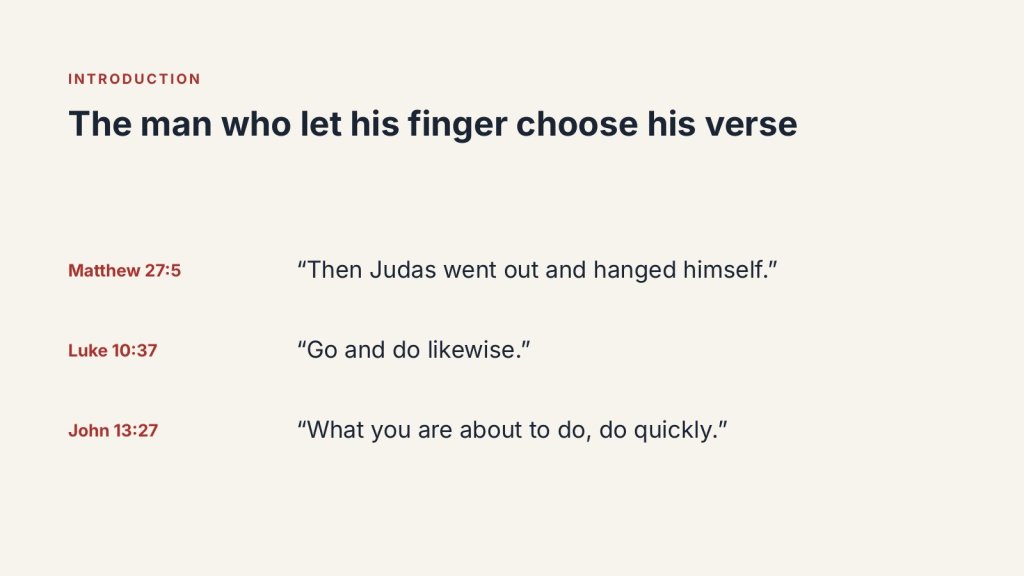
    Slide 2: The man who let his finger choose his verse

    There was a man who sought God’s will by opening his Bible at random and obeying the first verse his finger landed on. He was going through a hard season with his family, so he prayed, opened, and pointed.

    • (Matthew 27:5) “Then Judas went out and hanged himself.”
    • Puzzled, he called a do-over and flipped again. (Luke 10:37) “Go and do likewise.”
    • Flustered, he gave it one last try. (John 13:27) “What you are about to do, do quickly.”

    Every verse he read was true. Every conclusion he drew was deadly.

    Everybody interprets the Bible. The only question is whether we interpret it well. The man in the story believed every word. His problem was not faith; it was method. Sincerity does not protect you from misreading God. Training does.
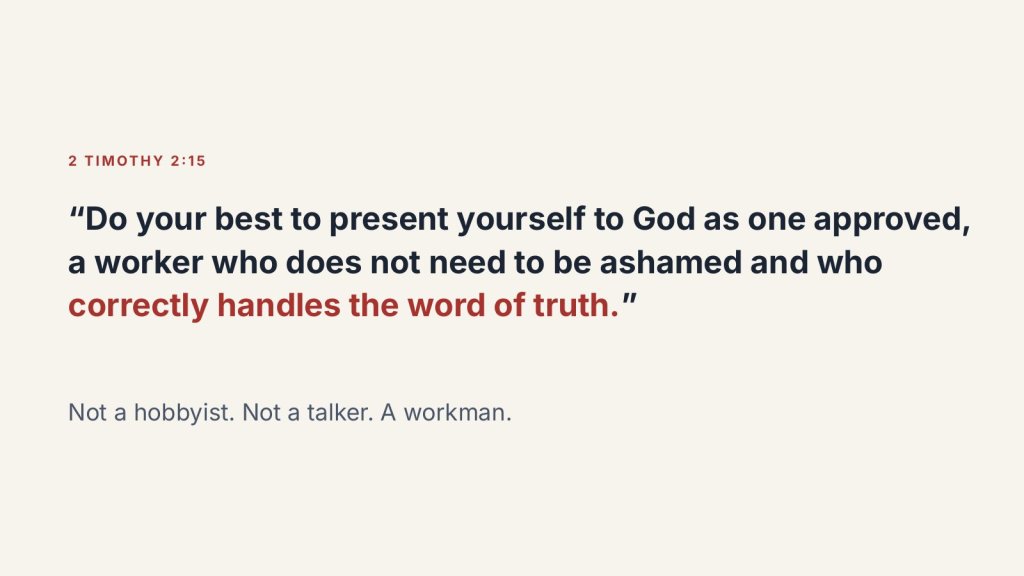
    Slide 3: 2 Timothy 2:15

    In 2 Timothy 2:15, Paul charges a young evangelist to handle the word like a craftsman: “Do your best to present yourself to God as one approved, a worker who does not need to be ashamed and who correctly handles the word of truth.” Not a hobbyist. Not a talker. A workman.
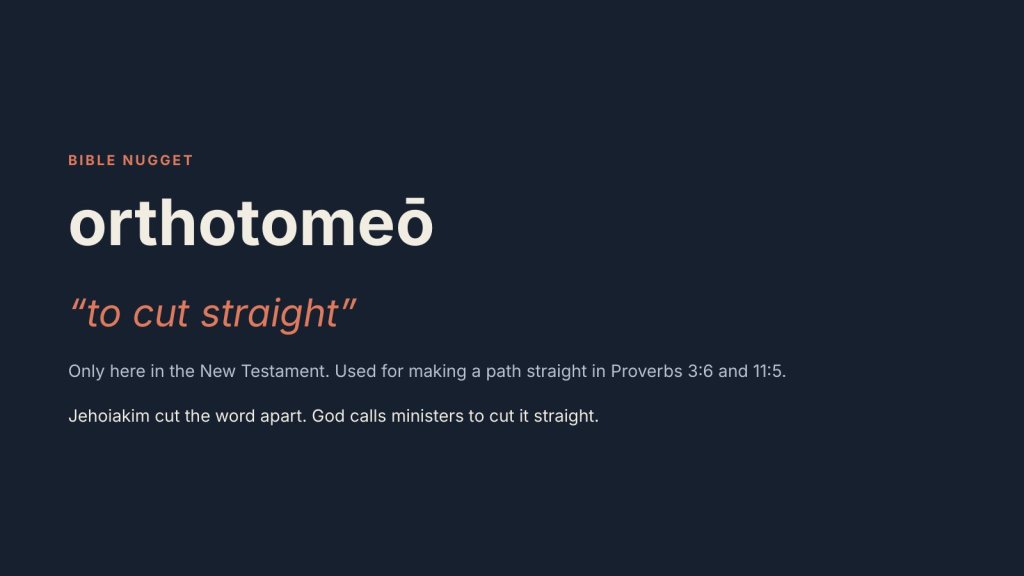
    Slide 4: orthotomeō

    Bible Nugget: “Correctly handles” is one Greek word: orthotomeō, “to cut straight.”

    • It appears only here in the New Testament.
    • The Greek Old Testament uses it in Proverbs 3:6 and 11:5 for God making a path straight.
    • Picture a road crew cutting a straight road through rough country, so others can travel it safely.
    • Some older commentators (Pulpit Commentary) suggest Paul the tentmaker had his own trade in mind: cut the pieces straight or nothing fits together.
    • Remember Jehoiakim? He took a knife to the word and cut it apart. God calls ministers to take the word and cut it straight.
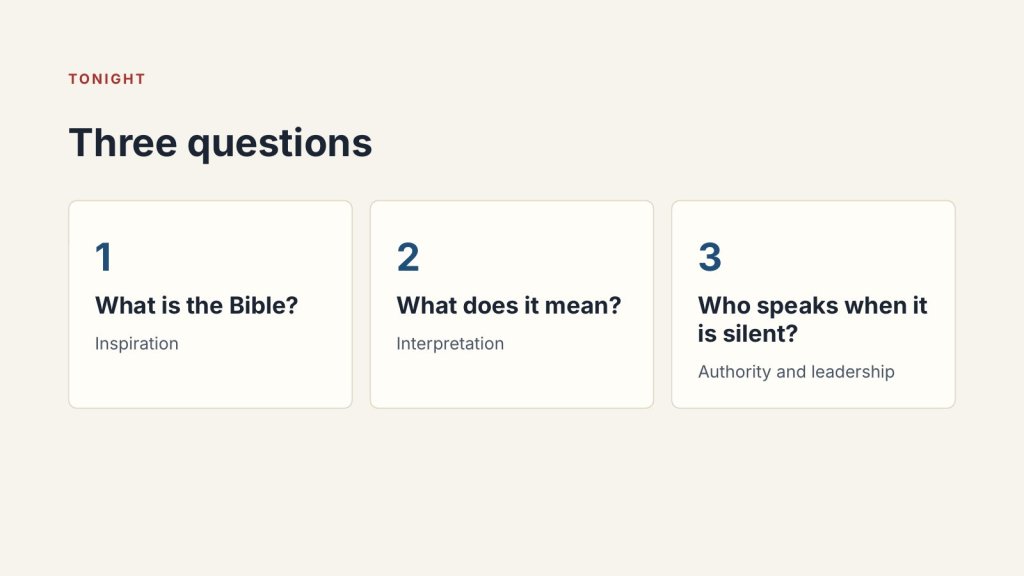
    Slide 5: Three questions

    In our last class we studied how God gave us the Bible. In this one we study how to read it, and who speaks for it. Three questions guide us:

    • What is the Bible? (inspiration)
    • What does it mean? (interpretation)
    • Who speaks when it is silent? (authority and leadership)

    Bible Nugget: Jesus was the first great hermeneutics teacher (Luke 24:27). On the road to Emmaus, “he explained to them what was said in all the Scriptures concerning himself.” “Explained” is diermēneuō. Our word hermeneutics comes from the same family: the art and science of interpretation. If Jesus took two discouraged disciples through a Bible study, we can take our study seriously.
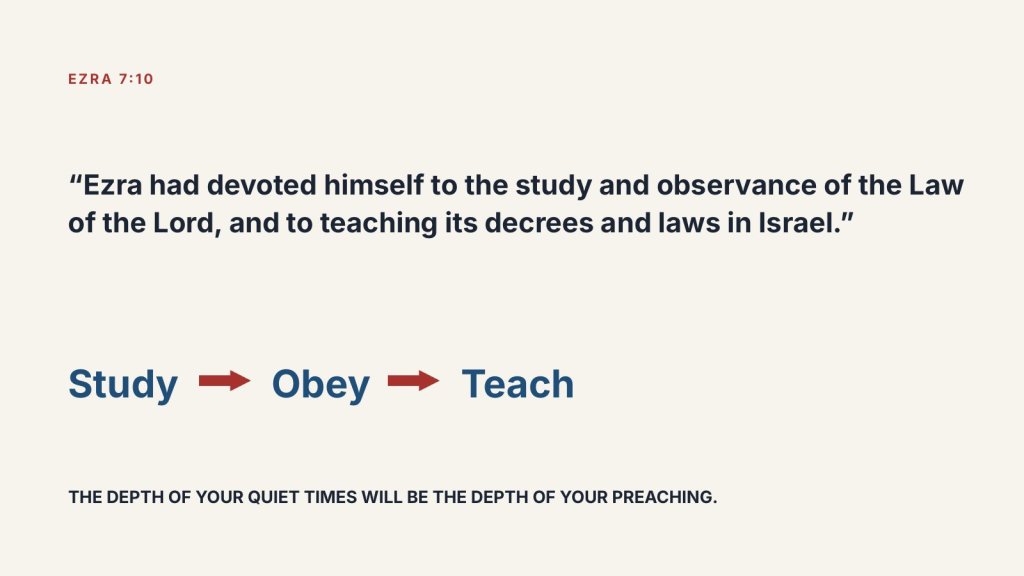
    Slide 6: Ezra 7:10

    Ezra 7:10 is the theme verse for every minister’s study life: “Ezra had devoted himself to the study and observance of the Law of the Lord, and to teaching its decrees and laws in Israel.” Study, then obey, then teach. The order is the point.

    The depth of your quiet times will be the depth of your preaching.

    I. Your View of the Book Shapes How You Read It (2 Timothy 3:16-17; 2 Peter 1:20-21)

    How you believe the Bible came to be will decide how you study it. Last class we covered how the books were written, gathered, and recognized. Now we ask what that means for the way we open them.
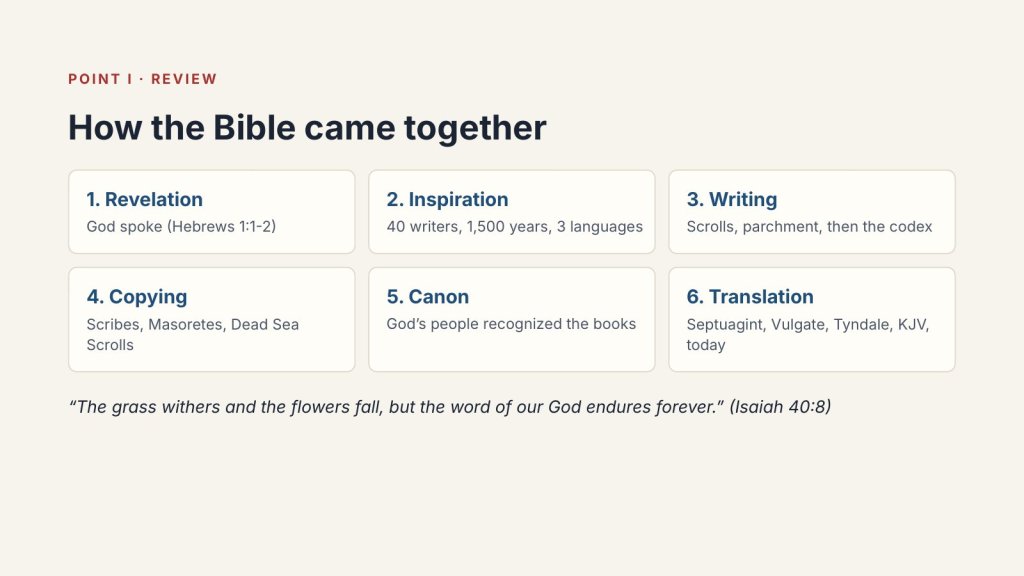
    Slide 7: How the Bible came together

    Here is a quick review of how the Bible came together, from God to your hands:

    • Revelation: God spoke. He spoke through the prophets at many times and in many ways, and last of all through his Son (Hebrews 1:1-2).
    • Inspiration: God breathed out his word through about 40 human writers over roughly 1,500 years, in Hebrew, Aramaic, and Greek.
    • Writing: on papyrus scrolls, then parchment, and by the second century the church was using the codex, the first book with pages.
    • Copying: scribes copied by hand with great care. The Masoretes counted letters to protect the Hebrew text, and the Dead Sea Scrolls showed how faithfully Isaiah had been copied over a thousand years.
    • Canon: God’s people recognized which books God had breathed out. (More on this in a moment.)
    • Translation: the Greek Septuagint (about 250 BC), Jerome’s Latin Vulgate (about AD 400), Wycliffe’s English (1380s), Tyndale’s New Testament (1526), the King James (1611), and the modern translations we use today.

    Every link in that chain is God keeping his promise: “The grass withers and the flowers fall, but the word of our God endures forever” (Isaiah 40:8).

    Bible Nugget: “All Scripture is God-breathed” (2 Timothy 3:16). The word is theopneustos: breathed out by God. B. B. Warfield made the point a century ago: Scripture is not a human book God breathed into. It is a word God breathed out.

    The prophets spoke as they were “carried along by the Holy Spirit” (2 Peter 1:21). It is the same word Luke uses for a ship driven by the wind (Acts 27:15, 17). The men raised the sails. The Spirit supplied the wind.
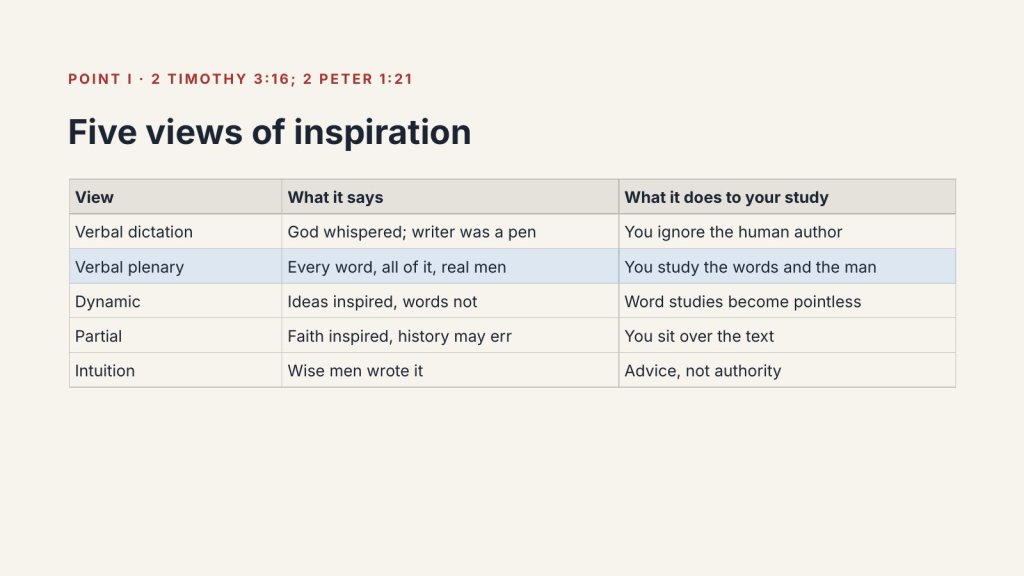
    Slide 8: Five views of inspiration

    There are five views of inspiration, and each one does something to your Bible study:

    • 1. Verbal dictation: God whispered every word and the writer was a pen. Result: the human author does not matter, so you ignore his background, style, and audience.
    • 2. Verbal plenary: every word (verbal), all of Scripture (plenary), breathed out by God through real men whose backgrounds God prepared. Result: you study the words and you study the man.
    • 3. Dynamic (thought) inspiration: the ideas are inspired, the wording is not. Result: word studies become pointless, and the wording becomes negotiable.
    • 4. Partial inspiration: faith and morals are inspired, history and science may be wrong. Result: the reader decides which parts are God’s. You now sit over the text instead of under it.
    • 5. Intuition: the Bible is the writing of wise men. Result: the Bible becomes advice, not authority. We reject this.

    The Bible itself shows real human authors.

    • (Luke 1:1-4) Luke did research. He interviewed eyewitnesses and wrote an orderly account.
    • (1 Corinthians 1:14-16) Paul cannot remember whether he baptized anyone else. God did not erase the man; he guarded the message.
    • Every writer sounds like himself. John does not write like Paul, and Amos the shepherd does not write like Isaiah in the palace.
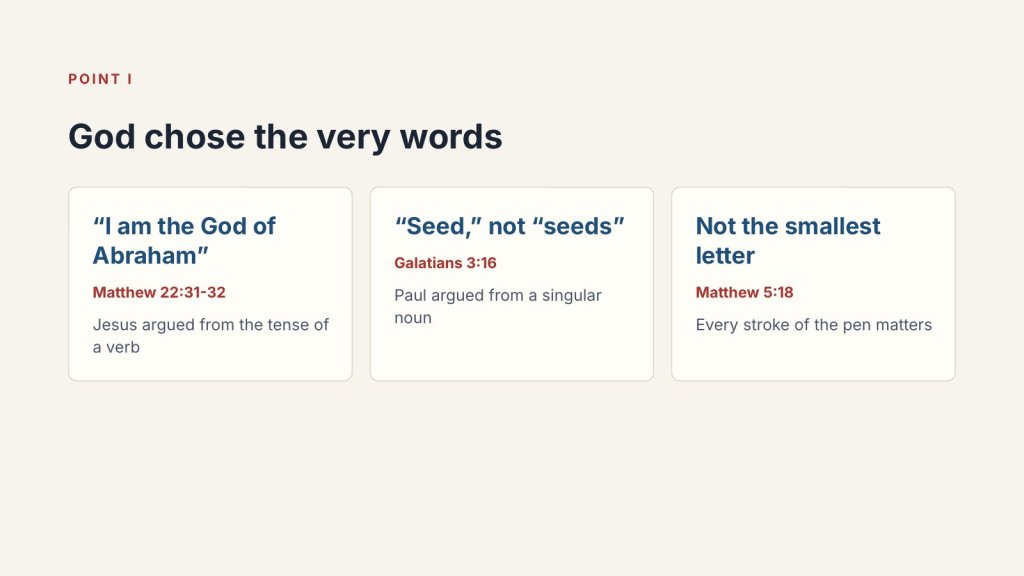
    Slide 9: God chose the very words

    The Bible also shows that God chose the very words.

    • (Matthew 22:31-32) Jesus wins an argument about the resurrection on the tense of a verb: “I am the God of Abraham,” not “I was.”
    • (Galatians 3:16) Paul builds an argument on a singular noun: “seed,” not “seeds.”
    • (Matthew 5:18) Not the smallest letter, not the least stroke of a pen, will disappear.

    You cannot hold the dynamic view and preach like Jesus did. He trusted the words, not just the ideas.
    Slide 10: What is the Chicago Statement?

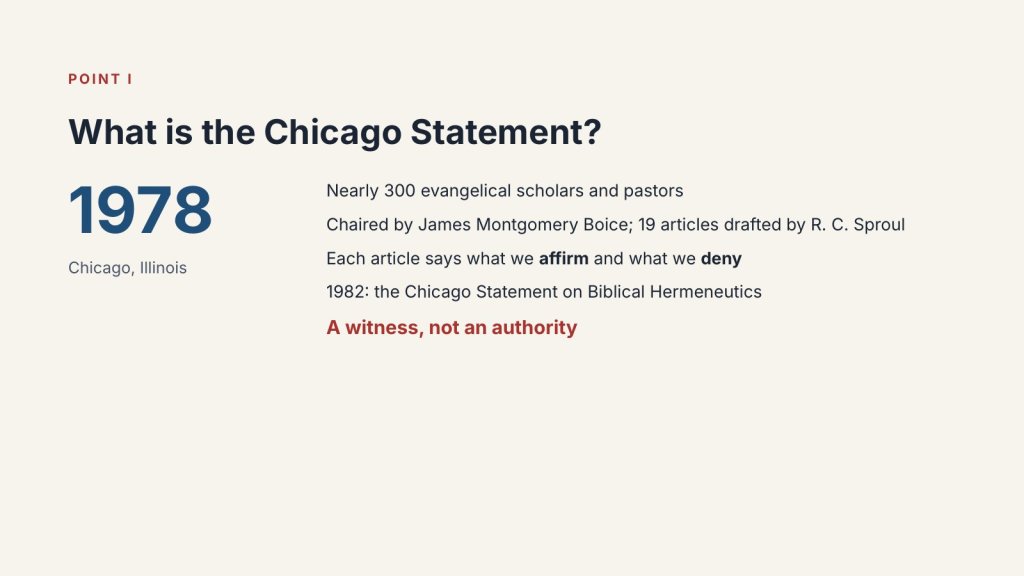
    What is the Chicago Statement? I quote it several times in this lesson, so here is the background.

    • In October 1978, nearly 300 evangelical scholars and pastors met at the Hyatt Regency O’Hare in Chicago.
    • The meeting was called by the International Council on Biblical Inerrancy, chaired by James Montgomery Boice. Leaders included R. C. Sproul, J. I. Packer, Norman Geisler, and Francis Schaeffer.
    • Why? In the 1970s, seminaries and denominations that once held the Bible to be without error were backing away from it. Harold Lindsell’s book The Battle for the Bible (1976) put the fight in the open.
    • R. C. Sproul drafted the nineteen articles. Each one says what we affirm and what we deny. About four out of five who attended signed it.
    • The council met again in 1982 and wrote the Chicago Statement on Biblical Hermeneutics, about how to interpret the Bible. A third statement in 1986 covered application. The council then disbanded.
    • The drafters themselves said it should not be given the weight of a creed. That fits us well: we do not follow creeds, but we can learn from good brothers who stood for the Bible. Use it as a witness, not an authority.

    The Chicago Statement on Biblical Inerrancy (1978), Article VIII, says it well:

    “We affirm that God in His work of inspiration utilized the distinctive personalities and literary styles of the writers whom He had chosen and prepared. We deny that God, in causing these writers to use the very words that He chose, overrode their personalities.”

    Theologians call this concursus: God and man both fully at work, with God as the primary author. Warfield compared it to a musician playing different instruments. Same musician, different sound, every note his.
    Slide 11: Two ditches, one road

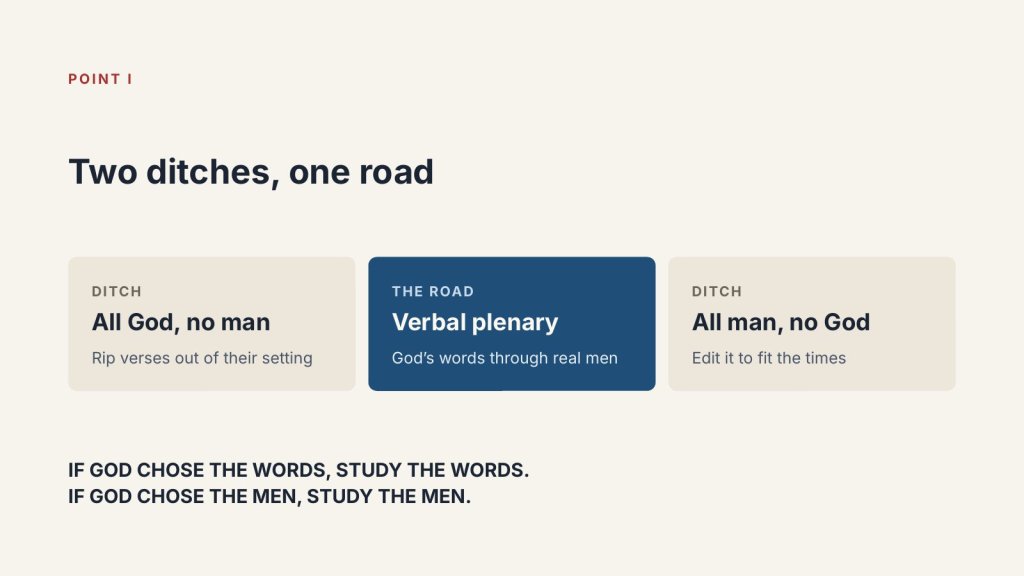
    There are two ditches on either side of this road.

    • Ditch one: all God, no man. You rip verses out of their setting because “it’s all God talking anyway.”
    • Ditch two: all man, no God. You treat the Bible like any other old book and edit it to fit the times.

    Verbal plenary inspiration keeps you on the road.

    If God chose the words, study the words. If God chose the men, study the men.
    Slide 12: The church recognized the canon. It did not create it.

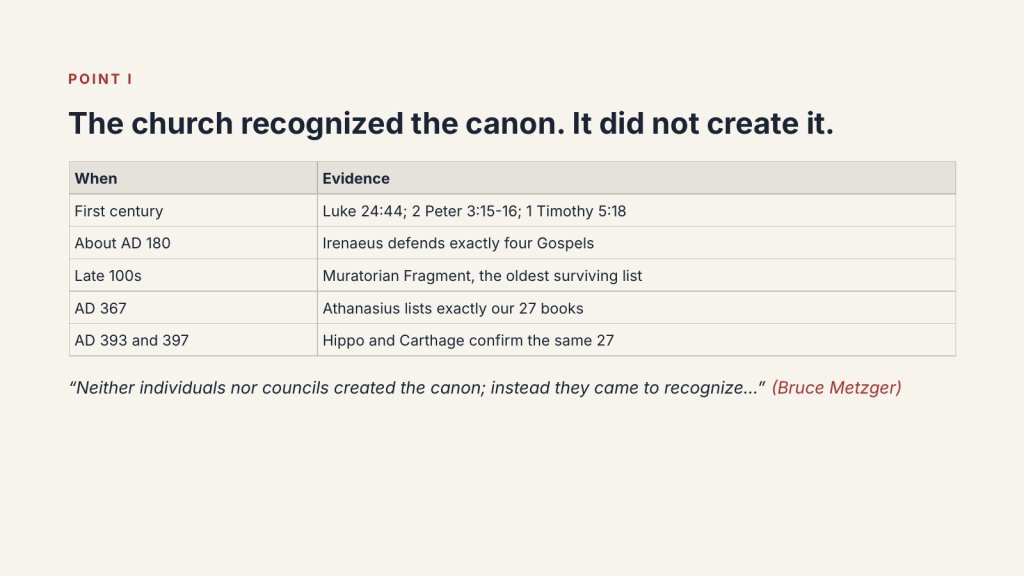
    The church recognized the canon; it did not create it. “Canon” comes from a Greek word for a measuring rod. The canon is the measuring rod; the church is what gets measured. Chicago Article I says the Scriptures do not receive their authority from the church, tradition, or any human source.

    The evidence starts inside the Bible itself.

    • (Luke 24:44) Jesus affirmed the Old Testament as Israel already had it: the Law of Moses, the Prophets, and the Psalms.
    • (Luke 11:51) “From the blood of Abel to the blood of Zechariah” runs from Genesis to Chronicles, the first and last books in the Hebrew order. Jesus recognized the whole collection.
    • (2 Peter 3:15-16) Peter puts Paul’s letters alongside “the other Scriptures.” The apostles were already recognizing New Testament writings as Scripture.
    • (1 Timothy 5:18) Paul quotes Deuteronomy 25:4 and Luke 10:7 side by side and calls both “Scripture.”
    • (Colossians 4:16; 1 Thessalonians 5:27) The letters were read aloud and passed from church to church. Recognition began the day they arrived.

    Then the early church kept recognizing what it had received.

    • Around AD 180: Irenaeus defends exactly four Gospels, Matthew, Mark, Luke, and John, against the heretics’ add-ons.
    • Late 100s: the Muratorian Fragment, the oldest surviving list, names most of our New Testament.
    • AD 367: Athanasius, bishop of Alexandria, lists exactly our 27 books in his Easter letter.
    • AD 393 and 397: councils at Hippo and Carthage confirmed the same 27. They did not vote books in; they put in writing what the churches had already been reading for generations.

    The tests were simple. Was it written by an apostle or a close companion of one? Does it agree with the faith already delivered (Jude 3)? Was it received and used by the churches everywhere?

    Bruce Metzger of Princeton Seminary, the leading canon scholar of the last century, put it this way:

    “Neither individuals nor councils created the canon; instead they came to recognize” the authority those writings already had.

    It is like Jesus’ sheep: “My sheep listen to my voice” (John 10:27). The church did not make the word God’s; it recognized his voice. Hold onto that. It will matter when we talk about leadership: the church stands under the word, never over it.

    II. Read Out, Not Into (Genesis 3:1-5; Nehemiah 8:8)

    The first Bible was one command (Genesis 2:16-17): “You are free to eat from any tree in the garden; but you must not eat from the tree of the knowledge of good and evil, for when you eat from it you will certainly die.” Short, clear, and loving. No commentary needed.
    Slide 13: Satan introduced interpretation

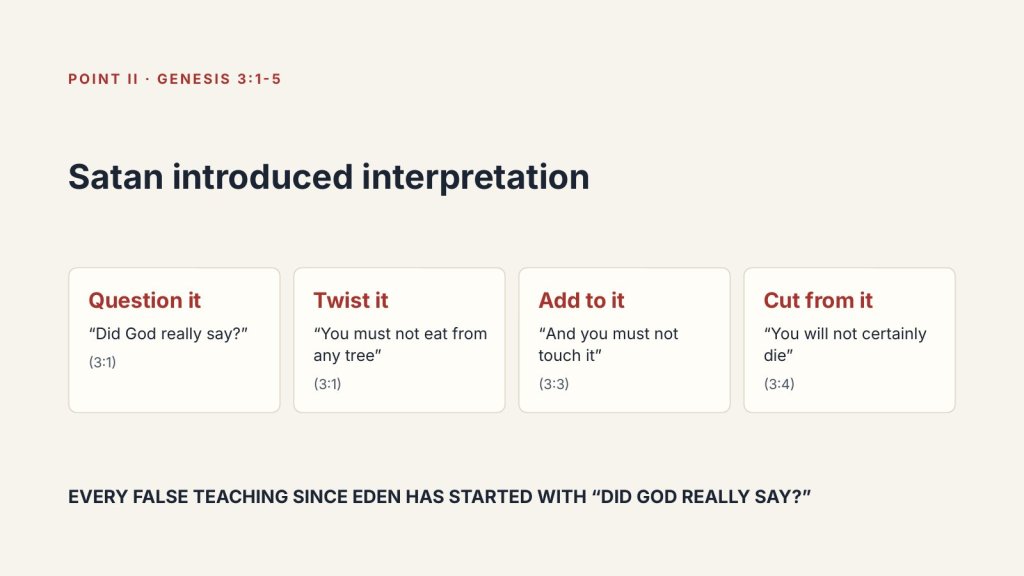
    Satan introduced interpretation by questioning what God said (Genesis 3:1-5). His first words in the Bible are “Did God really say?” He did not deny God’s word at first. He reinterpreted it.

    • He twisted it into “You must not eat from any tree in the garden.” God had said the opposite: eat from any tree but one.
    • Eve then added to it: “and you must not touch it” (3:3). God never said that.
    • Then Satan subtracted from it: “You will not certainly die” (3:4).

    Question it, twist it, add to it, cut from it. The first sin started with a bad interpretation.

    Bible Nugget: Satan has not changed his method; he just learned to quote Scripture. In the wilderness he quotes Psalm 91:11-12 to Jesus, ripped out of context (Matthew 4:6). Jesus answers, “It is also written” (Matthew 4:7). He corrects a misused verse with the rest of the Bible. That is hermeneutics. The devil uses one verse; Jesus uses the whole word.

    Every false teaching since Eden has started with “Did God really say?”

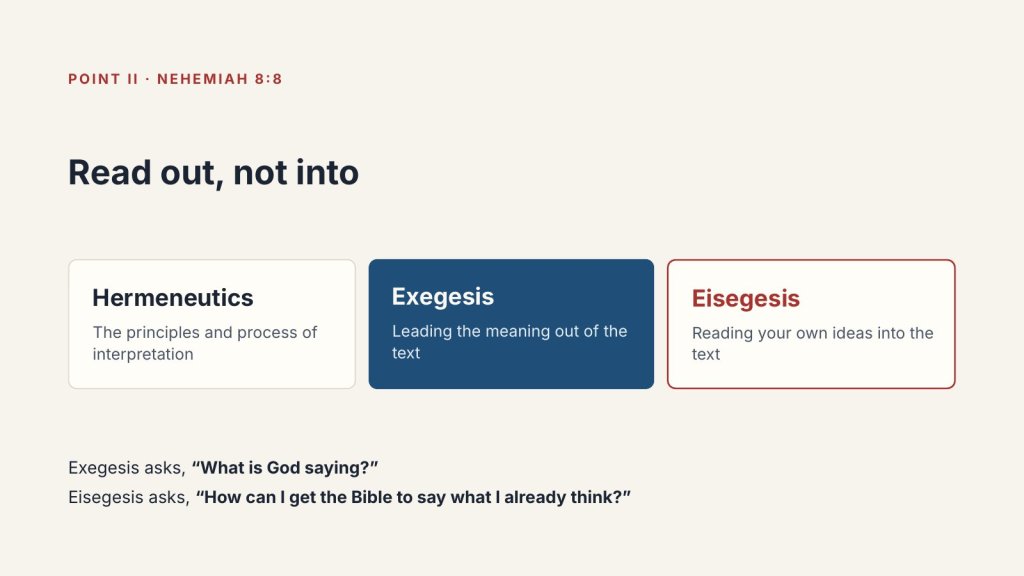
    Nehemiah 8:8 gives us the first picture of expository preaching in the Bible: “They read from the Book of the Law of God, making it clear and giving the meaning so that the people understood what was being read.” Read it. Explain it. Make sure they get it. That is still the job.
    Slide 14: Read out, not into

    Three words every minister needs to own:

    • Hermeneutics: the principles and process of interpretation.
    • Exegesis: to lead the meaning out of the text.
    • Eisegesis: to read your own ideas into the text.

    Exegesis asks, “What is God saying?” Eisegesis asks, “How can I get the Bible to say what I already think?”

    Eisegesis has done real damage.

    • (Revelation 8:13) Some preachers have made the eagle flying in midair into the United States.
    • (Philippians 4:13) We print it on football jerseys, but Paul wrote it about being content when he was hungry and in need (Philippians 4:11-12).
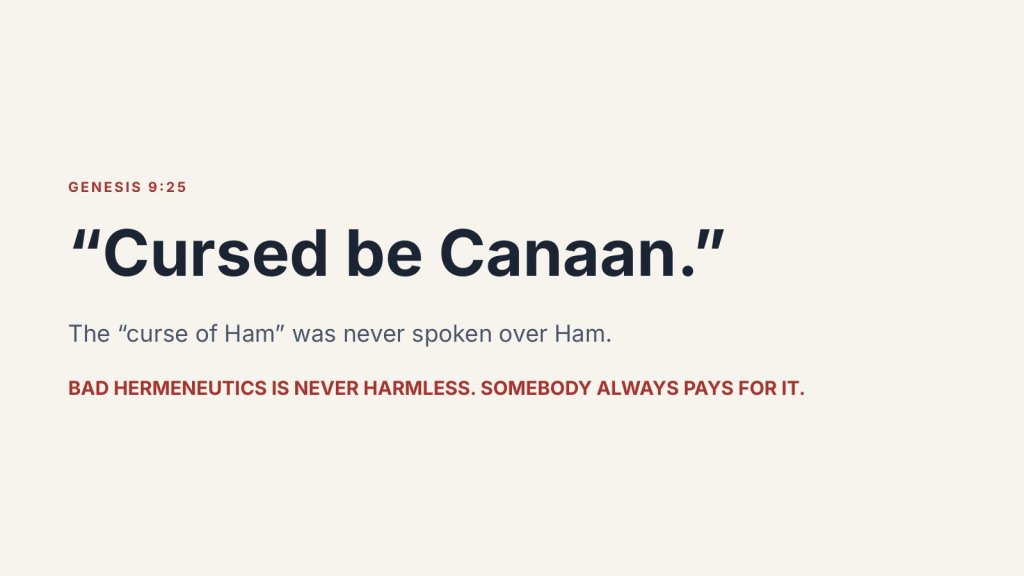
    • In the 1700s and 1800s, slave owners preached that Africans were under “the curse of Ham.”
    Slide 15: “Cursed be Canaan.”

    Bible Nugget: Read the text (Genesis 9:25). The curse was not even spoken over Ham. Noah says, “Cursed be Canaan.” Canaan, Ham’s son, was the father of the Canaanites, not of Africa. Men read their sin into a verse that never said what they needed it to say.

    Bad hermeneutics is never harmless. Somebody always pays for it.
    Slide 16: Ask two questions before the third

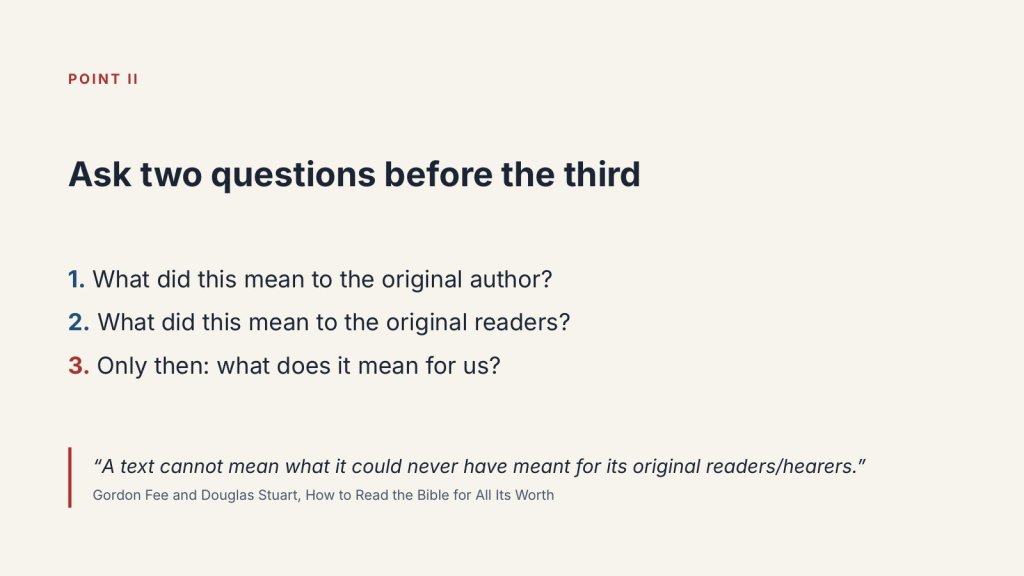
    Ask two questions before you ever ask the third.

    • 1. What did this mean to the original author?
    • 2. What did this mean to the original readers?
    • 3. Only then: what does it mean for us?

    Gordon Fee and Douglas Stuart, in How to Read the Bible for All Its Worth, say it plainly:

    “A text cannot mean what it could never have meant for its original readers/hearers.”

    They also warn that interpretation which thrives on being new and unique usually comes from pride, a false idea of spirituality, or a bias we are protecting. If nobody in two thousand years saw what you just “discovered,” slow down.
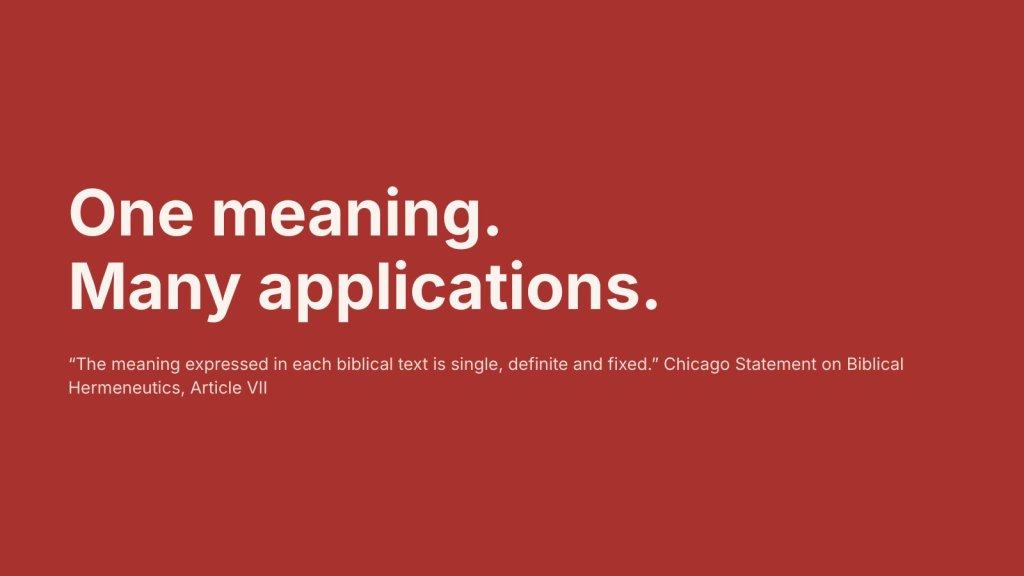
    Slide 17: One meaning. Many applications.

    The Chicago Statement on Biblical Hermeneutics (1982), Article VII:

    “We affirm that the meaning expressed in each biblical text is single, definite and fixed.”

    It also denies that this single meaning eliminates the variety of its application.

    One meaning. Many applications.

    Most interpretation is sanctified common sense. Fee and Stuart call common sense the most important hermeneutical skill most believers already have. We spent years in English class learning to read a letter, a poem, and a news story differently. Use it.

    Jesus’ own listeners kept missing figures of speech.

    • (John 3:4) Nicodemus: can a man enter his mother’s womb a second time?
    • (John 4:11) The Samaritan woman: you have nothing to draw with, and the well is deep.
    • (John 6:52) The crowd: how can this man give us his flesh to eat?

    They were not too spiritual. They were too literal in the wrong places.

    Challenge: When you prepare a lesson, write the “then” sentence before you write the “now” sentence. If you cannot say what it meant to them, you are not ready to say what it means to us.

    III. The Interpreter’s Toolbox: Six Kinds of Criticism (Acts 17:11)
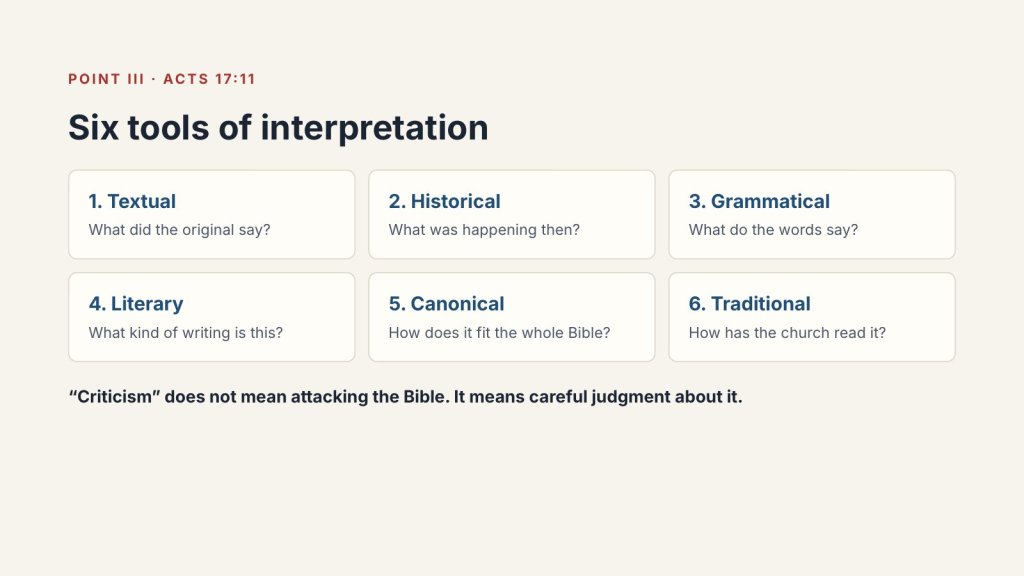
    Slide 18: Six tools of interpretation

    Bible Nugget: The Bereans were doing biblical criticism. They “examined the Scriptures every day to see if what Paul said was true” (Acts 17:11). “Examined” is anakrinō: to investigate, to judge carefully, like a court hearing evidence. In Bible study, “criticism” does not mean attacking the Bible. It means careful judgment about the Bible.

    Know the difference between lower and higher criticism.

    • Lower criticism asks: what exactly did the original text say?
    • Higher criticism asks: who wrote it, when, from what sources, and how was it put together?

    Asking those questions is not wrong. But since the 1800s, much of higher criticism started with the assumption that miracles and prophecy cannot happen, and then reached the conclusions it started with. The Chicago Statement on Hermeneutics (Article XVI) affirms using legitimate critical methods to establish the text and its meaning, and denies any method used to question the truth of what the writer said.

    Eat the fish. Spit out the bones.

    Bible Nugget: Grant Osborne called this process The Hermeneutical Spiral. It is not a circle that goes nowhere, but a spiral: text, context, text again, each pass bringing you closer to the author’s meaning. Here are the six tools that move you up the spiral.

    1. Textual Criticism: What did the original manuscripts say?

    • We have no original autographs, but we have about 5,800 Greek New Testament manuscripts, far more than any other ancient book.
    • Comparing them lets scholars recover the original wording with remarkable confidence. Most differences are spelling and word order.
    • Conservative textual scholars point out that no core doctrine rests on a disputed reading.
    • This is why your Bible brackets Mark 16:9-20 and John 7:53-8:11 with a note. Know why before a student asks you.
    • The KJV translators did faithful work with the manuscripts they had. Since 1611 we have found far older ones: Codex Sinaiticus, Codex Vaticanus, early papyri, and the Dead Sea Scrolls.
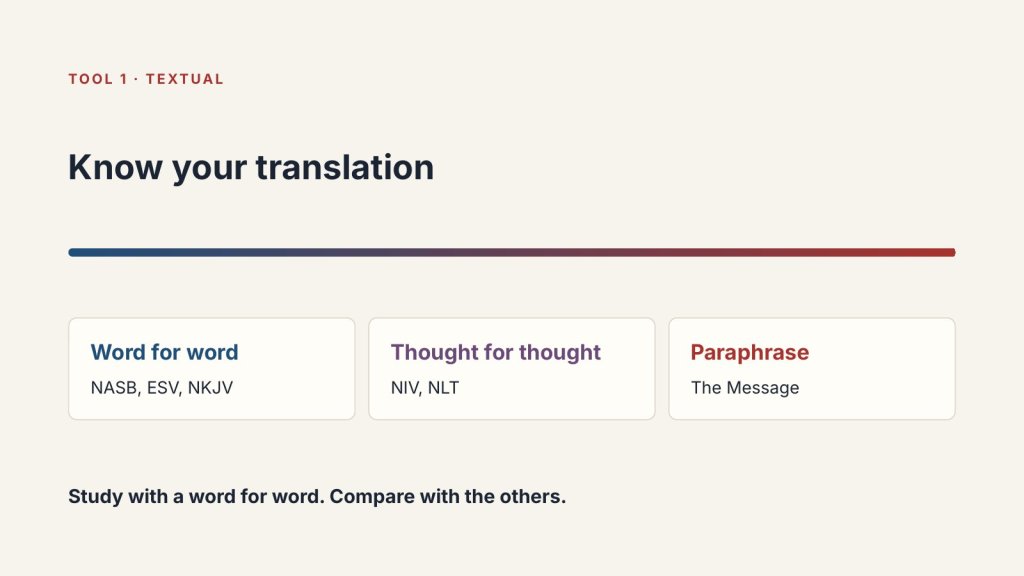
    Slide 19: Know your translation

    Know your translation: word for word (NASB, ESV, NKJV), thought for thought (NIV, NLT), paraphrase (The Message). Study with a word for word; compare with the others.

    2. Historical and Cultural Criticism: What was happening when it was written?

    • For the Old Testament, know the Ancient Near East and Israel’s culture. For the New Testament, know the Roman world and first century Judaism.
    • (Revelation 3:15-16) Laodicea is widely taught to have piped its water in by aqueduct, so it arrived lukewarm, unlike the hot springs of Hierapolis or the cold water of Colossae. Lukewarm was not a feeling. It was useless.
    • Slavery: critics read the Bible through the lens of 1800s race-based chattel slavery. But the Law made kidnapping a man to sell him a capital crime (Exodus 21:16), and Paul lists slave traders among the lawless (1 Timothy 1:10).
    • Head coverings (1 Corinthians 11:2-16): without culture you either bind a veil on every woman or throw out the passage. With culture you find the principle and honor it.

    3. Grammatical Criticism: What do the words and sentences actually say?

    • This is where word studies live. Look up the word, then see how the same author uses it elsewhere.
    • (Matthew 28:19-20) There is one command in the Great Commission: make disciples. Going, baptizing, and teaching describe how.
    • Watch the grammar: a “therefore” always points back. An “if” sets a condition. A question can be sarcasm.

    Bible Nugget: D. A. Carson’s Exegetical Fallacies should be on every minister’s shelf. He warns against the root fallacy: assuming a word always means what its root means. His famous example is that the gospel is the dunamis of God (Romans 1:16). Preachers love to say “dynamite.” But dynamite was invented in 1867. Paul never thought of an explosion. He meant God’s power to save. A word means what its author used it to mean in that sentence. Usage beats etymology.

    4. Literary Criticism: What kind of writing is this?
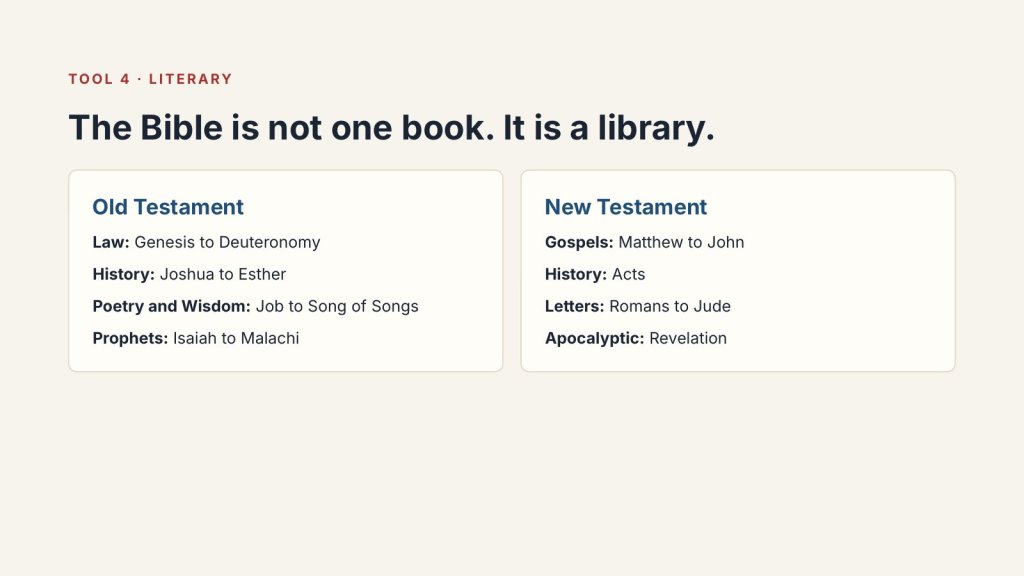
    Slide 20: The Bible is not one book. It is a library.

    The Bible is not one book. It is a library. You do not read a cookbook the way you read a love letter.

    • Old Testament: Law (Genesis to Deuteronomy), History (Joshua to Esther), Poetry and Wisdom (Job to Song of Songs), Prophets (Isaiah to Malachi).
    • New Testament: Gospels, History (Acts), Letters (Romans to Jude), Apocalyptic Prophecy (Revelation).
    • Proverbs are probabilities, not promises. Proverbs 22:6 is wise counsel, not a guarantee.
    • Poetry uses images. (Psalm 91:4) God does not have feathers.
    • Hyperbole exaggerates to make a point. (Matthew 5:29-30) Nobody reading this should be missing an eye.
    • Apocalyptic speaks in symbols. Do not turn every beast in Revelation into this week’s headlines.

    For balance, the Chicago Statement on Hermeneutics (Article XIII) values genre study but denies that genre can be used to turn history the Bible presents as fact into myth. Genesis and Acts are narrative, and narrative is history.

    Narrative tells you what happened. It does not always tell you what to do.

    • (Acts 1:26) They cast lots to choose an apostle. Are we commanded to?
    • (Acts 2:45) They sold property. Is every disciple commanded to?
    • (Matthew 27:5) Judas hanged himself. You see where this is going.

    Narrative becomes our pattern when the rest of Scripture teaches it. The baptism of Acts 2:38 is taught again in Romans 6:3-4, Colossians 2:12, and 1 Peter 3:21.

    5. Canonical Criticism: How does this passage fit the whole Bible?

    • Scripture interprets Scripture. The Chicago Statement on Hermeneutics (Article XVII) calls the Bible its own best interpreter.
    • Let the clear passages explain the unclear ones. Even Peter said Paul wrote some things hard to understand (2 Peter 3:16).
    • (1 Corinthians 15:29) Baptism for the dead appears once and is never taught again. Do not build a practice on it.

    Never build a doctrine on one verse the rest of the Bible never repeats.

    Know where you are in the timeline of God’s covenants.

    • (Luke 23:43) The thief on the cross was saved before Jesus died, while the old covenant still stood. A will takes effect only when the one who made it has died (Hebrews 9:16-17).
    • (Ephesians 2:14-16; Colossians 2:16-17) The Sabbath was a sign given to Israel. The law was set aside in Christ’s flesh.
    • (2 Timothy 3:16-17) When Paul wrote “all Scripture,” he was pointing Timothy to the Old Testament. Too many disciples do not know their Old Testament.

    6. Traditional Criticism: How has the church understood this passage?

    • Augustine, Luther, Calvin, the early church fathers, the Restoration preachers: they are not our authority, but they are wise company.
    • Chicago Article II denies that creeds, councils, or declarations have authority equal to the Bible. History is a guardrail, not a steering wheel.

    Tradition: Is the “morning star” of Isaiah 14:12 Satan or the king of Babylon? In context the taunt is aimed at the king of Babylon (Isaiah 14:4). The church has long also read it as a picture of Satan’s fall. That is possible, but hold it as tradition, not as the plain meaning of the text. Learn to say, “The text says this. Tradition adds this.” That honesty builds trust.

    Challenge: Pick the one tool you have never really used and use it in your quiet times this week. Most of us live in tool three and skip the rest.

    IV. Where the Bible Speaks and Where It Is Silent (Deuteronomy 29:29; 1 Corinthians 4:6)

    God has not told us everything, but he has told us enough: “The secret things belong to the Lord our God, but the things revealed belong to us and to our children forever, that we may follow all the words of this law” (Deuteronomy 29:29).

    “Do not go beyond what is written” (1 Corinthians 4:6). Paul says this so the church would stop taking pride in one leader over another. Going beyond Scripture always ends up exalting a man.
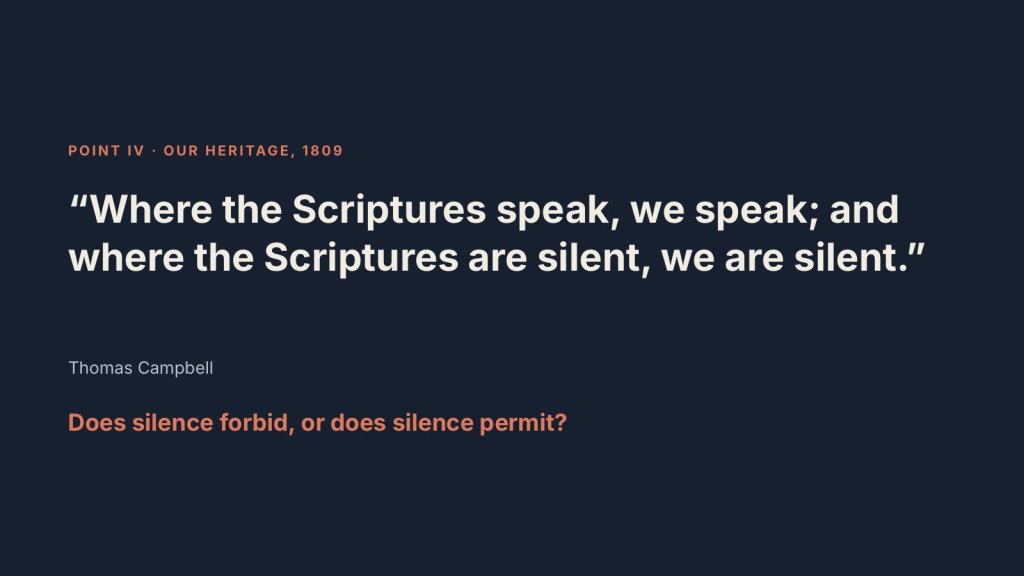
    Slide 21: Thomas Campbell, 1809

    Our heritage gives us a famous rule. In 1809, Thomas Campbell wrote this for the Restoration Movement:

    “Where the Scriptures speak, we speak; and where the Scriptures are silent, we are silent.”

    It is a great rule. But the movement later split over what “silent” means.
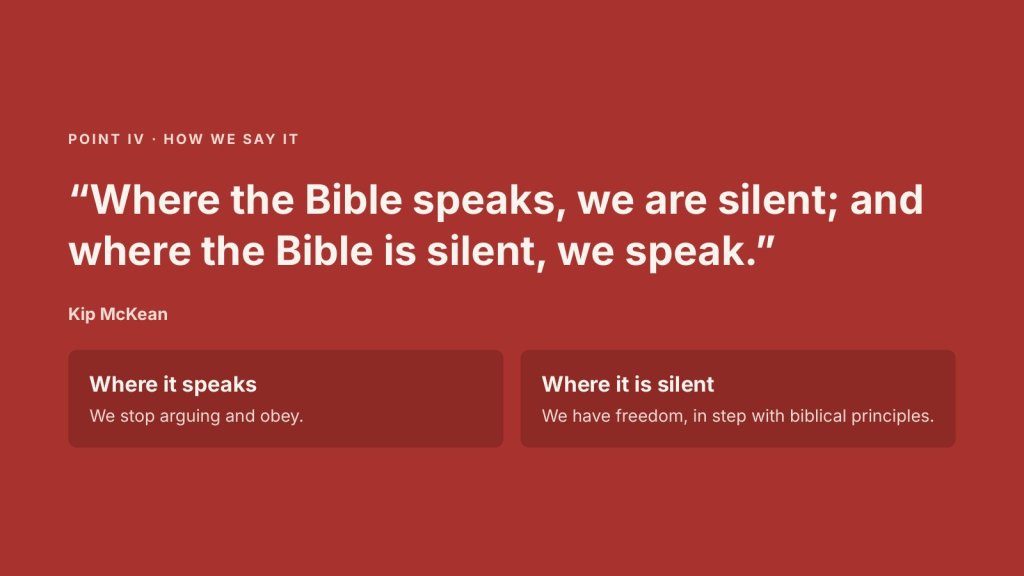
    Slide 22: Kip McKean: where the Bible speaks and where it is silent

    Does silence forbid, or does silence permit? Brothers broke fellowship over that question in the late 1800s.
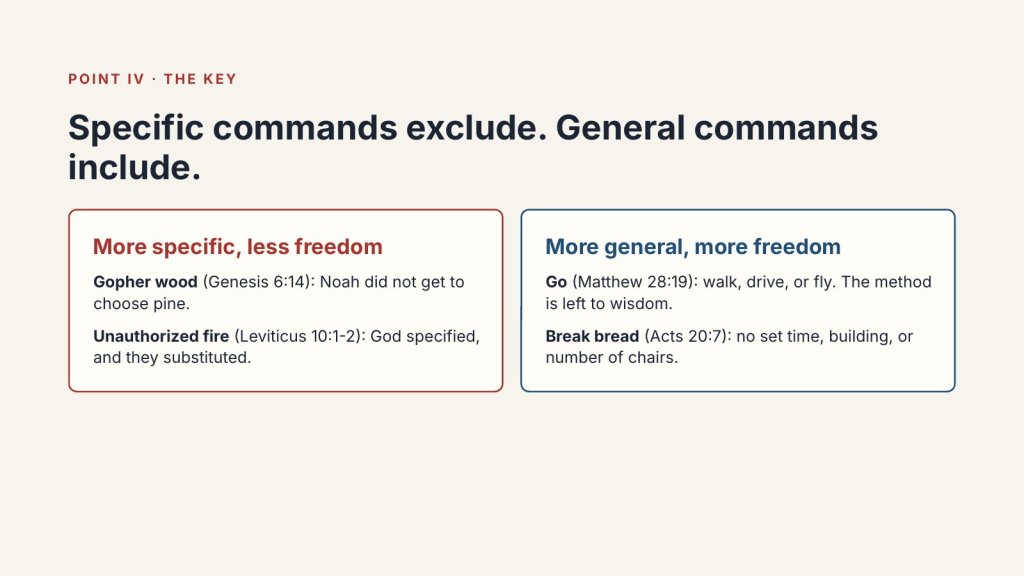
    Slide 23: Specific commands exclude. General commands include.

    Here is the key: specific commands exclude, and general commands include. The more specific the command, the less freedom. The more general the command, the more freedom.

    • (Genesis 6:14) God said cypress (gopher) wood. Noah did not get to choose pine.
    • (Leviticus 10:1-2) Nadab and Abihu offered fire “contrary to his command.” God had specified, and they substituted.
    • (Matthew 28:19) God said go. He did not say walk, drive, or fly. The method is left to wisdom. There is silence in the method, so we speak!
    • (Acts 20:7) God shows us the church gathering to break bread. He does not tell us what time, what building, or how many chairs.
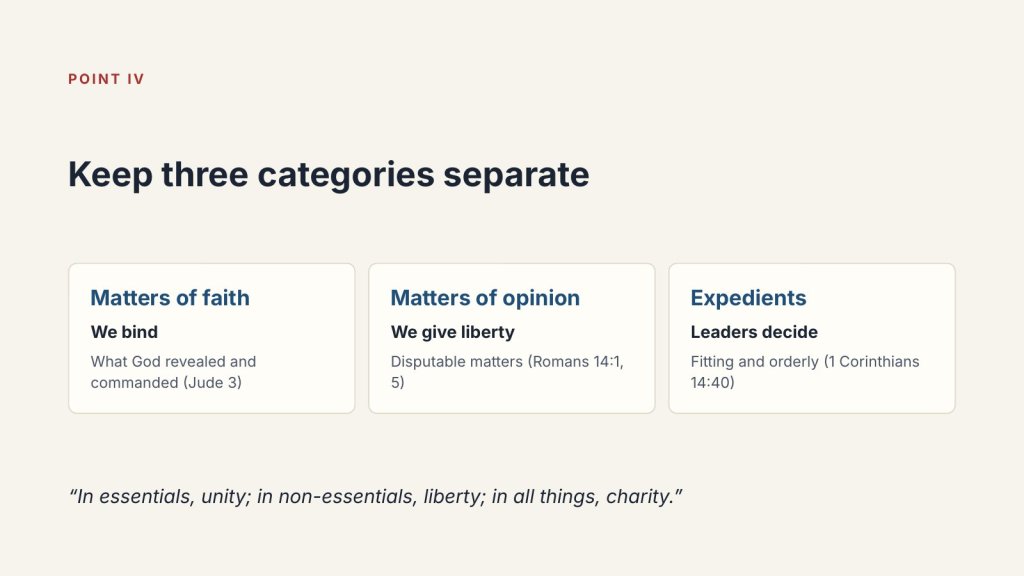
    Slide 24: Keep three categories separate

    Three categories every minister must keep separate:

    • Matters of faith: what God has revealed and commanded. We bind these (Jude 3).
    • Matters of opinion: disputable matters God leaves to conscience. We give liberty (Romans 14:1, 5).
    • Expedients: the best way to carry out what God commanded. Leaders decide these with wisdom, so that everything is done in a fitting and orderly way (1 Corinthians 14:40).

    A seventeenth century line usually credited to Rupertus Meldenius sums it up:

    “In essentials, unity; in non-essentials, liberty; in all things, charity.”

    Unity where God has spoken. Liberty where he has not. Love everywhere.
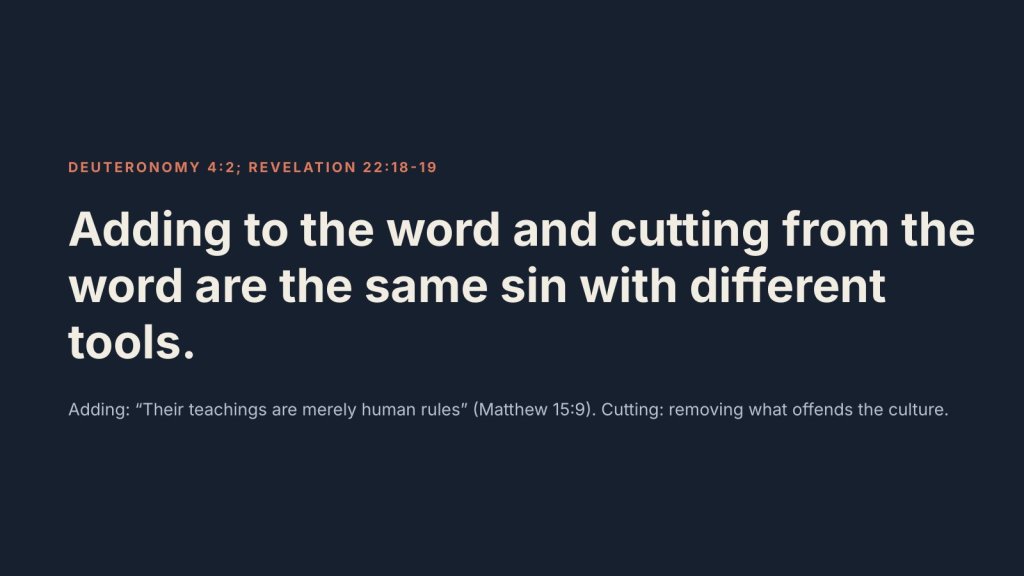
    Slide 25: Adding and cutting are the same sin

    There are two ways to break the rule, and both are deadly.

    • Adding: the Pharisees bound their traditions on people. “They worship me in vain; their teachings are merely human rules” (Matthew 15:9).
    • Subtracting: the modern church cuts out what offends the culture.

    God warns against both (Deuteronomy 4:2; Revelation 22:18-19).

    Adding to the word and cutting from the word are the same sin with different tools.

    V. Who Speaks When the Bible Is Silent? (Acts 15:28; Hebrews 13:17)
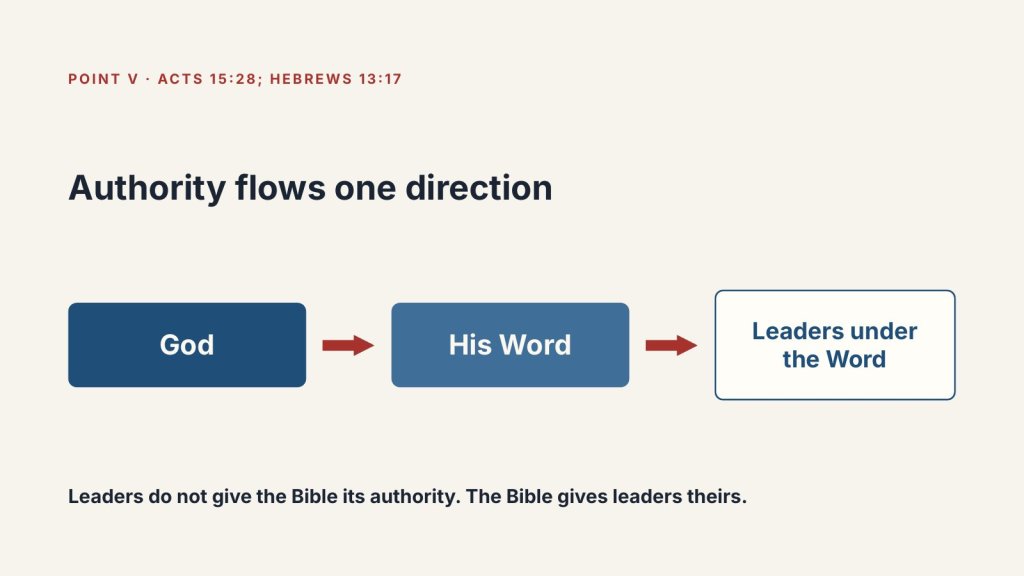
    Slide 26: Authority flows one direction

    Authority flows in one direction: God, then his word, then leaders who stand under his word. Leaders do not give the Bible its authority. The Bible gives leaders theirs. Every bit of authority a leader has is borrowed, and borrowed authority must be used the way the owner intended.

    “It seemed good to the Holy Spirit and to us” (Acts 15:28). Watch their process: a real question, an open discussion, testimony of what God was doing, and Scripture (Amos 9:11-12 quoted in Acts 15:16-18). Then came a decision, written down and delivered in person. The apostles’ authority was unique, but their process is a model: Scripture first, then sanctified judgment. And notice their heart: “We should not make it difficult for the Gentiles who are turning to God” (Acts 15:19).

    Leaders are called to bring order where Scripture gives the goal but not the details.

    • (Titus 1:5) Titus was left in Crete to “put in order what was left unfinished.”
    • (1 Corinthians 14:33, 40) “Everything should be done in a fitting and orderly way.”
    • (1 Corinthians 11:16) Paul appeals to the practice of the churches.

    Bible Nugget: “Have confidence in your leaders and submit to their authority” (Hebrews 13:17). The word often translated “obey” is peithō: to be persuaded. Good leaders persuade from Scripture. Good disciples choose to be persuadable. Leaders “keep watch over you as those who must give an account.” That is weight, not privilege.
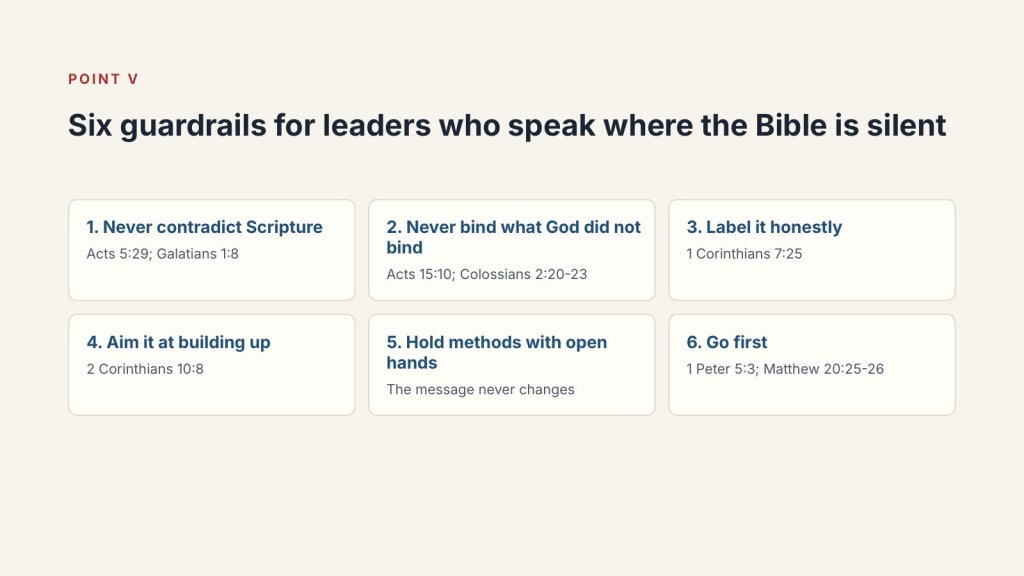
    Slide 27: Six guardrails for leaders who speak where the Bible is silent

    Six guardrails for leaders who speak where the Bible is silent:

    • 1. Never contradict Scripture (Acts 5:29; Galatians 1:8).
    • 2. Never bind as salvation what God did not bind (Acts 15:10; Colossians 2:20-23).
    • 3. Label it honestly. “Thus says the Lord” is different from “This is our best judgment” (1 Corinthians 7:25).
    • 4. Aim it at building up. Paul’s authority was “for building you up rather than tearing you down” (2 Corinthians 10:8).
    • 5. Hold methods with open hands. The message never changes. Methods should.
    • 6. Go first. Shepherds lead by example, not by lording it over people (1 Peter 5:3; Matthew 20:25-26).

    Disciples have a responsibility too.

    • Follow leaders in matters of judgment even when you would have done it differently.
    • Disagree biblically, privately, and respectfully, and keep following while you talk it through.
    • Do not confuse your preference with a conviction, and do not confuse a leader’s judgment with a command of God.
    Slide 28: Shepherds, not prophets

    Where the Bible speaks, we are silent. Where the Bible is silent, leaders may speak, but they speak as shepherds, not as prophets.

    Challenge: Write down three things you are teaching or directing in your ministry this week. Put each one in a category: command, principle, or our judgment.

    VI. The Minister’s Study Life (1 Timothy 4:13-16; Hebrews 5:12-14)

    Paul tells Timothy to devote himself to the word and watch his life and doctrine closely: “Be diligent in these matters; give yourself wholly to them, so that everyone may see your progress” (1 Timothy 4:15). People should be able to see your Bible study growing. If your schedule has no room for the word, your schedule is the problem.

    Bible Nugget: Mature believers are “trained by constant use” (Hebrews 5:14). “Trained” is gymnazō, where we get gymnasium. You do not become a skilled interpreter by attending a class. You become one by repetition. You don’t pick up a sword and know how to fight. Someone trained me.
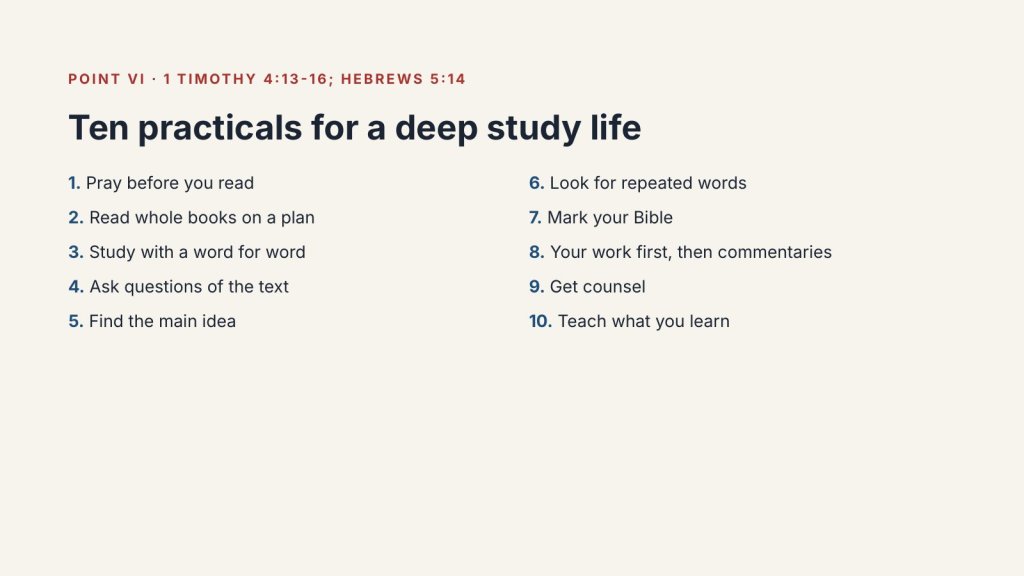
    Slide 29: Ten practicals for a deep study life

    Ten practicals for a deep study life:

    • 1. Pray before you read. “Open my eyes that I may see wonderful things in your law” (Psalm 119:18).
    • 2. Read whole books, by thought units, on a plan. Do not graze verse by verse.
    • 3. Use a word for word translation for study, and compare two or three others.
    • 4. Ask questions of the text: Who wrote it? To whom? Why? What problem is he answering? Reading a letter is like hearing one side of a phone call.
    • 5. Find the main idea of the passage, then where it fits in the big story of the Bible.
    • 6. Look for repeated words and do word studies the right way.
    • 7. Mark your Bible: red for commands, green for history, black for doctrine, blue for promises and prayers.
    • 8. Do your own work first, then check conservative commentaries: Blue Letter Bible, Coffman on StudyLight, Bible Hub, the Pulpit Commentary, Halley’s Bible Handbook.
    • 9. Get counsel. Talk through your study with your discipler and your evangelist (Romans 15:14; Ephesians 4:11-13).
    • 10. Teach what you learn. You never know a passage until you have taught it (2 Timothy 2:2).

    A note on AI tools: if you use them in your study, give them guardrails.
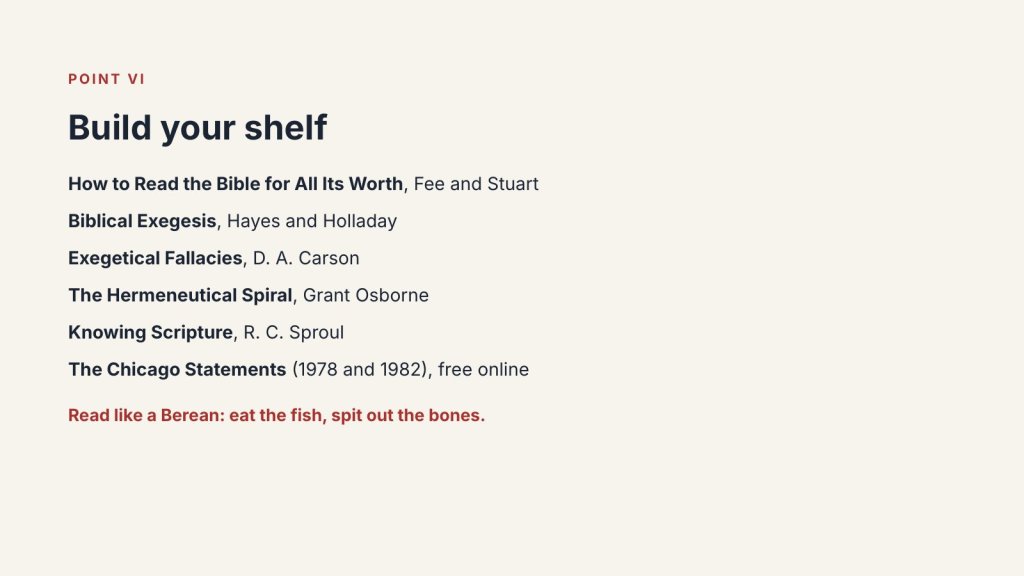
    Slide 30: Build your shelf

    Build your shelf. Here is my recommended reading:

    • Gordon Fee and Douglas Stuart, How to Read the Bible for All Its Worth
    • John H. Hayes and Carl R. Holladay, Biblical Exegesis
    • D. A. Carson, Exegetical Fallacies
    • Grant Osborne, The Hermeneutical Spiral
    • R. C. Sproul, Knowing Scripture
    • The Chicago Statements on Biblical Inerrancy (1978) and Biblical Hermeneutics (1982), free online

    Read every book like a Berean: eat the fish, spit out the bones.

    Conclusion (2 Timothy 2:15)

    Go back to the man with his finger on Judas. He loved the Bible. He just never learned to cut it straight. God is not asking for ministers who can quote verses. He is asking for workmen who handle them correctly.
    Slide 31: Cut it straight
    • I. Your view of the book shapes how you read it.
    • II. Read out, not into.
    • III. Use all six tools.
    • IV. Respect where the Bible speaks and where it is silent.
    • V. Lead under the word, never over it.
    • VI. Build a study life deep enough to carry your ministry.

    Slide 32: 1 Corinthians 15:29

    Your assignment: Take 1 Corinthians 15:29 and walk it through all six tools. On one page, write what it meant then, what it means now, and one place you realize you have been reading something into the Bible.

  • Step Out of the Boat: An Update on Where I’m Serving Now

    It has been a while since I gave you a real update here, so let me do that now. Not a highlight reel. An honest picture of where I am serving, why I am serving there, and what the Bible has to say about the kind of step it took to get here.

    The Story Behind the Update

    In Matthew’s Gospel, Jesus sends His disciples out on the water while He goes up a mountain to pray. Hours later, in the fourth watch of the night, He comes to them walking on the sea. Peter, always the one who cannot help himself, calls out.

    “Lord, if it’s you, tell me to come to you on the water.” “Come,” he said. Then Peter got down out of the boat, walked on the water and came toward Jesus. (Matthew 14:28-29)

    Earlier this year I preached a message called “Step Out of the Boat” to thousands of students and leaders at the Revolution on Campus conference in Anaheim. I built it around Peter’s whole life, not just the moment he walked on water, but the moment he sank, the moment he denied Jesus at a charcoal fire, and the moment Jesus restored him on a beach and sent him back out to shepherd sheep. The passage resonates with me so much because it is my life. It is the story of how I ended up serving where I serve now.

    Ivan Aivazovsky, Walking on Water, 1888, Christ walking across a stormy sea toward the disciples' boat
    Ivan Aivazovsky, Walking on Water, 1888

    Where I Serve Now

    I am a pastor and evangelist with The Restored Church Worldwide. RCW exists because a group of us, after years inside the International Christian Churches, became convinced that Scripture, not tradition, not culture, not the preferences of any single church movement, has to be the final authority for what we believe and how we live. It was what the ICC was originally founded on, but the central leadership had lost its way. Our tagline says it plainly: the Bible must be our standard. That conviction is not a slogan for us. It is the reason RCW exists at all.

    Right now I lead a congregation in the San Francisco Bay Area. Before this, I served in ministry in Los Angeles and in Boston prior to the formation of RCW, and those years shaped nearly everything I do now, from how I preach to how I disciple. What matters most to me is not credentials but the years spent in actual rooms with actual people, walking with them through sin, doubt, marriage, singleness, grief, and the slow work of becoming like Jesus.

    My wife and I are also leading one of the largest mission teams in discipling history to plant Restored Church New England in Boston in the summer of 2027. Boston was where some of my most formative ministry happened, and going back to plant a church there, alongside my own wife and a team we love and trust, feels like one more step out of a boat we could have stayed comfortably in: the current church we lead, which we had the opportunity to see grow from 465 to 600. We are not stopping in Boston either. From there, we are already preparing to plant a church in New York City in 2029, because the same conviction that took us to the Bay Area will not let us settle once we arrive somewhere new.

    Alongside the local church work, I teach through a Ministry Training Academy, preach regularly on our church’s YouTube channel, and write. I have written six books, including Taking OCD Captive, Intruders, Project Tyrannus, So You Want to Study the Bible?, 7 Keys to Finding the Right One, and my newest project, Let’s Go There!, which wrestles with what it looks like to let Scripture, not our tribe or our feelings, settle how we think about race, sexuality, and politics. All of it is now published under Restored Publishing. None of it exists to build a platform for its own sake. It exists because I believe the church needs evangelists and pastors willing to teach hard texts plainly and lovingly, and because I would rather spend my life doing that than doing something safer.

    Why This Is a Bible Article and Not Just an Update

    I could have written all of that as a simple ministry update. But Peter’s story will not let me leave it there, because I think it explains what actually happened to get me here, and it may explain something in your own life too.

    Gustave Brion, Jesus and Peter on the Water, Peter reaching toward Christ as he begins to sink
    Gustave Brion, Jesus and Peter on the Water

    Step into God’s vision. Before Peter could walk on water, he had to leave the boat, which meant leaving the only place that felt safe in the middle of a storm. Every meaningful step I have taken in ministry, leaving a familiar movement to help start RCW, leaving Los Angeles for Boston, leaving Boston for the Bay Area, and now preparing to help plant a church back in Boston, has required letting go of something stable for the sake of something Jesus was calling me toward. You cannot walk toward Christ while keeping one hand on the side of the boat.

    Step into the impossible. Peter did not ask for an explanation of the physics of walking on water. He asked for a command, and then he obeyed it before he understood it. Planting a church, writing a book about the most divisive topics in American culture, taking one of the largest mission teams in discipling history into Boston and then aiming a second plant at New York City two years later, none of that makes sense by the world’s math. It only makes sense if Jesus really is who He says He is, and if His word really is trustworthy enough to build a life on (2 Timothy 3:16-17).

    Step into your calling, even after you sink. Peter sank. Peter denied Jesus three times at a charcoal fire, in the very moment loyalty mattered most. And yet the same Jesus who let him sink is the one who met him again at another charcoal fire in John 21, asked him three times if he loved Him, and told him to feed His sheep (John 21:15-17). If your ministry, your faith, or your life has a charcoal fire in its past, a failure you assumed disqualified you, hear this clearly. Grace has no limit. Jesus does not just forgive failure. He commissions people out of it.

    Where That Leaves You

    I am not telling you all of this so you will be impressed with a resume of churches and books. I am telling you because I think most of us are standing in the boat right now, gripping the side, waiting for the storm to calm down before we will move. Scripture does not promise the storm will calm first. It promises that Jesus is already walking toward you in the middle of it, and that His word is enough to stand on even when the water underneath you makes no sense.

    So here is the update, plainly. I serve as a pastor and evangelist with The Restored Church Worldwide, leading a church in the Bay Area, and my wife and I are now leading one of the largest mission teams in discipling history to plant a church in Boston in 2027, with New York City to follow in 2029. Alongside that, I am training the next generation of preachers, writing books that try to take Scripture seriously on hard subjects, and preaching every chance I get that the Bible must be our standard. I invite anyone who may feel called to evangelize the Northeast to step out of the boat and reach out to me. I got here by stepping out of a few boats I could have stayed in.

    If you want to walk with us, come visit Restored Church SF on a Sunday, watch the sermons on our YouTube channel, or follow along on my social media. But more than any of that, I would simply ask you to consider where Jesus might be saying “Come” in your own life, and whether you are willing to get out of the boat.

    Lord, if it is You, command me to come.

  • STAY UPDATED:

    A few updates! I have not kept this blog updated in a while and a lot has happened. Keep current with our ministry at the Facebook link below. Currently, my wife and I serve as Evangelist and Women’s Ministry Leader in the City of Angels International Christian Church Inland Empire Super Region. I’ve also released a couple of books listed below and you can keep up with my sermons at the Inland Empire YouTube Page (@inlandempireregionicc)

    Project Tyrannus: A Powerful Blueprint to Building Campus Ministry – https://www.amazon.com/dp/B0BGSHQ683

    Intruders: Overcoming False Guilt, Intrusive Thoughts, and Obsessive Thinking https://www.amazon.com/dp/B0DGLPPYBT

    So You Want to Study the Bible?- https://www.amazon.com/dp/B0DF6GZL3R

    Taking OCD Captive – https://www.amazon.com/dp/1722732660

    To keep current with our ministry and my weekly Bible Study “Lists” I put out, follow me on Facebook: https://www.facebook.com/mike.patterson.9028?mibextid=ZbWKwL

  • BUY NOW: Taking OCD Captive Book!

    Take OCD Captive is now available on Amazon in paperback or kindle! Live at peace and experience life to the full free from intrusive thoughts, false memory, ruminating over thoughts, etc. This book equips OCD sufferers with proven biblical principles to help overcome the symptoms of OCD and intrusive thinking! Get your ebook now by CLICKING HERE

  • TAKING OCD CAPTIVE CHRISTMAS SALE!

    9D9D7792-68E0-40B2-AD9A-B7050E5547A0

    For the month of December, buy the ebook that is helping many find freedom from OCD for only $10! Click the “Buy Now” link in the upper left corner of this website. 


  • NEW eBook THIS SUNDAY- Taking OCD Captive

    11803197-4EA8-4EB9-BD4A-EEEEB921DE47

    THIS SUNDAY, MY NEW E-BOOK WILL BE COMING OUT “TAKING OCD CAPTIVE: A Christian eBook on conquering Obsessive Compulsive Disorder”. In light of the launch, I have reposted an article with a few updates that was written five years ago. Please join the mailing list and purchase an ebook this Sunday. Visit http://www.takeocdcaptive.wordpress.com to stay updated!

    You can find freedom from OCD! In January of 2013 I was diagnosed with OCD (Obsessive Compulsive Disorder). This helped explain symptoms I had exhibited for a while that became so strong I felt maybe it was demonic and that is very possible. Most think of hand-washers or hoarders from pop-culture on TV when they think of OCD. My symptoms aren’t as obvious; intrusive inappropriate thoughts (not desires or even temptations), constant doubts on if I had done something wrong, doubting events in my past, false feelings portraying themselves as memories almost, etc. The compulsion was to confess any thought that came in my mind or to reanalyze situations for days, weeks, or months to see if I did something wrong and just missed it. I would analyze words to make sure I didn’t tell a lie and re-record voicemails over and over again.  The doubts would be so strong that I would feel strong anxiety to confess to things I know I never did or would even desire to do. I looked for reassurance from people to confirm I didn’t do certain things. These obsessions, intrusive thoughts, and compulsions began to affect my marriage, faith, and I was very confused. Sounds crazy doesn’t it? I thought so! As I studied out the symptoms it became clear I probably had OCD and that was confirmed when I was diagnosed officially with it after going to see someone. My ebook “Taking OCD Captive” contains the methods I discovered from research and practical biblical concepts necessary for victory.

    Before coming back to God in July of 2011, I use to be someone who never learned from his mistakes. I was a compulsive liar, pornography/impurity addict, and would hide many of my sins from those who could help me. God delivered me from these demons as I confessed all known sins in my past (1 John 1:9) to the men God put into my life that would guide me to through the scriptures (James 5:16). As time went on I got married to the love of my life, got back into the full-time ministry, and was even recently appointed an evangelist in God’s church one of my life dreams! Although, God put my life back together and broke my bondage to habitual sin another torment came into my life immediately after my reunion with God…OCD.

    1097977_10201210285355375_87842229_nMy dreams of being in the ministry with the woman I love had been given to me and here I was outside the place we were staying still newly married crying to God not understanding why I felt guilt, doubts, for things I didn’t even do but felt strong feelings I did. Someone with OCD for example might run over a pot hole while driving. They fear maybe they ran over a kid as they dwell on it. The mind races for days as they reanalyze the event. Did they actually see a kid? Didn’t the driver in the car next to them look at them funny thus maybe they saw them run over the kid!? They can even start creating memories of doing so. In some extreme cases I have heard people have actually turned themselves in for things they didn’t even do. They could even go back to check to see if they hit someone. I’m not ready to divulge all the details of how my symptoms work at this point, but it is very similar to the example above.  I wrestled with whether OCD was a physical issue or a spiritual one. I still do believe it could be a demon or demonic. Yet as I studied the scriptures I have found most things to be both physical and spiritual. OCD is physical as the part of the frontal orbital cortex of the brain that warns us of danger and deals with feelings is overactive in people with OCD. Yet the Bible says Satan and demons can put thoughts in our heads and teach us lessons (1 Timothy 4:1-2). They become sin when we listen to them. For example, Satan put the thought in David’s head to take a census and he sinned against God (1 Chronicles 21:1-3). David sinned because he attributed a false message that Satan put in his brain to himself and acted on the thought. If he would have just ignored it and focused on ruling Israel in righteousness this event never would have happened. God is sovereign and either makes things happen or allows them for the good of those who love Him (Romans 8:28).

    “To keep me from becoming conceited because of these surpassingly great revelations, there was given me a thorn in my flesh, a messenger of Satan, to torment me. Three times I pleaded with the Lord to take it away from me. But he said to me, ‘My grace is sufficient for you, for my power is made perfect in weakness.’ Therefore I will boast all the more gladly about my weaknesses, so that Christ’s power may rest on me.” 2 Corinthians 12:7-9

    The scripture above helped me come to a deep conviction. God could take this OCD away from me but has allowed it for a reason. Maybe after all the years of lying and indulgence in sin and rebellion towards God these are now the consequences. He forgave me and restored me but wants me to learn some things in his love. God is saying to me if I was to put his words down, “Mike, I’ll give you your dreams you are my son whom I love, but to keep you from becoming conceited again this thorn OCD will be given to you so it will be impossible for you to hide even the things that aren’t sin! You will feel the guilt you should have felt for sinning about things that aren’t even sin or your sin! This will teach you son that I am enough for you, my grace is sufficient for you. That true power comes in boasting about your weaknesses.” In effect God allowed this in my life to humble me and teach me to be open about weaknesses. To date I have been able to overcome many of the symptoms by God’s powerful grace and this huge revelation.

    Maybe you have OCD or are wrestling with issues of the mind. My ebook “Taking OCD Captive” is a handbook giving you the steps I took to rid myself of the majority of the symptoms of OCD. OCD is my prisoner now and through these principles that are summarized from my ebook, I have been able to live out my calling in the ministry. These steps and scriptures have helped me in this battle:

    1) Acceptance (2 Corinthians 12:7-9)

    Meditate on the above passage. It is hard at times but I see my OCD as a grace of God. It causes me to run to Him more for strength. The more you try to fight OCD thoughts the bigger they will get. If I tell you to stop thinking about a red shoe, you immediately are thinking about a red shoe! You must allow the intrusive thoughts to be there identifying that it is not you, it is your OCD/brain disorder/Satan/etc. I recommend a book called “Brain Locke” by Jeffery Schwartz that helped me with this step. Jesus teaches evil thoughts are sin (Mark 7:21). Yet with OCD the intrusive thoughts are the result of a brain disorder or demons not your own thoughts. For example, someone who with OCD may constantly have thoughts about stabbing their family members with knives (a common form of OCD) or even worse doing something sexually inappropriate to them. Their compulsions may be dwelling on the thoughts, hiding knives, or staying away from their family out of fear.  It has been shown with OCD, these thoughts are not desires of them at all, in fact they are so morally disturbed by them that these thoughts don’t bring any sort of comfort to the person with OCD. OCD uses the very things you find morally wrong against you. These people are actually some of the safest people.  So these aren’t “evil thoughts” but misfires of the brain or evil spirits. Let me be clear, sinful desires/thoughts must be confessed and repented of. OCD is unwanted thoughts/desires that plague the person. It is important for my audience to understand the difference between an intrusive thought and an evil thought. Intrusive you don’t want it to be there so you will do whatever compulsion to make it go away but the compulsion just makes the intrusive thoughts stronger. With evil thoughts you desire the things you are thinking. Homosexual thoughts for example would be evil thoughts if the person is homosexual or aroused by such thinking. Some who have OCD are straight, happily married, attracted to the opposite sex, and yet they are tormented by doubts thoughts of if they are gay. Their compulsions may take the form of checking to see if they were aroused by the same-sex and looking into bodily reactions. This is a real form of OCD I have read about. Schwarts in his book says when they come to say “It’s not me, it’s my OCD”. This will help retrain your brain to normal. Accepting the anxiety that comes with OCD and paying no attention to the thoughts lessens their power.

    2) Take Every Thought Captive (2 Corinthians 10:3-6)

    The Bible teaches us we can control our thoughts. Having OCD myself, this has been hard for me at times to believe but this scripture contains the key to doing so! Notice we are called to demolish arguments that set itself up against the knowledge of God!  The brain of someone with OCD uses find sounding arguments to convince them to doubt or give into a compulsion. Did you really lock the door? Are you sure? Can you really remember doing it? When these doubts come we must demolish OCD’s arguments by the knowledge of God. This means bringing truth into the situation. As baptized disciples of Jesus we are God’s children blessed with every spiritual blessing. Just accept the thoughts as being there, and focus on who God says you are. Remember, with OCD thoughts this is not “trying to push the thoughts out of your head”, they will get bigger because you are still focused on them. Taking them captive is acceptance of the thorn and remembering the knowledge of God. In time this will demolish them!

    3) Engage in the Present (Philippians 3:12-15)

    Matt Sullivan who is my disciple (mentor) discipled me on something that was very key in helping me overcome OCD thinking. He noticed that sometimes I was not fully engaged in what I was doing at the moment but was in another world in my head. People with OCD give too much thought to their thoughts. Listen, the bible says the heart is deceitful above all things (Jeremiah 17:9) so you are never going to figure it out by being mega introspective. Paul says in the verse above to forget what is behind and strain towards what is ahead. I believe we do this by focusing on the mission Christ gave us and what we can do now to strain towards that. When intrusive thoughts attack or your OCD is strong; accept the thoughts, remember who you are in Christ if you’re a baptized disciple, and fully engage into what you are doing in the moment mind, soul, heart, and strength. My wife suggested I download a game on my phone that I can play when the thoughts come. Remember, you aren’t trying to stop the thoughts, just engaging in something else. You will find in time you will renew your mind (Romans 12:1-3) and the OCD will continually get weaker. Some have said that there is no cure, but we know that through God all things are possible for him who believes.

    OTHER SUGGESTED SCRIPTURES FOR STUDY:

    Colossians 3:1-2 (We have power to choose what we set our thoughts on)

    Proverbs 16:32 KJV (Must learn to rule our thoughts, not let them rule us)

    1 Chronicles 28:9 (God knows what OCD is and what is your thoughts)

    James 5:16-17 (Find someone who understands OCD and you can be open with about)

    My prayer is that this article will encourage someone who felt as I did last year, alone, scared, and looking for answers. I pray it will help disciples of Jesus be equipped and understand those who may have brain disorders and feel out of control of their thought life. God has transformed me and I am now grateful as this continues to bring me closer to Him. If you are interested in transforming your life the same way I did, please order my ebook today (July 8th, 2018 is the release day- http://www.takeocdcaptive.wordpress.com): Taking OCD Captive. To God is the glory.

  • Strong in the Grace: Developing Inner Strength

    “You then, my son, be strong in the grace that is in Christ Jesus.” 2 Timothy 2:1

    Mike and Chenelle teaching the first class of the Spring Semester of the International College of Christian Ministry

    Running track in college and high school, it was always interesting to see those who quit early on. The workouts would destroy them, stopping in the middle of the runs and possibly throwing up. The strength wasn’t available (whether physically or mentally) to continue. You had to be strong mentally and strong physically to be able to have the endurance to win a race. The same is true of our Christian walk, we must have an inner strength to handle the training that comes in our discipleship. Paul tells the younger evangelist he discipled Timothy to be strong in the grace. Later, he would remind him that the scriptures are to be used for teaching, rebuking, correcting and training in righteousness (2 Timothy 3:16). Unfortunately, the training can crush a Christian who is not strong in the grace just as much as a track practice would crush someone who is not strong in their cardio. Paul understood that Timothy had to have an inner strength and security that only came in Christ Jesus and we need to grasp this as well.

    Disciples of Jesus who are not strong in the grace often experience worldly sorrow (2 Corinthians 7:8-11) instead of Godly sorrow when they fail. Negative self-talk fills their minds. This vicious form of selfishness turns your own soul into a victim and away from the grace of God. Discipling from mature brothers and sisters makes the worldly soul feel not good enough, threatened, criticized, or even suspicious of the discipling. An over-sensitivity plays out in the soul as they feel personally attacked. Certainly, athletes could choose to respond this way to a good coach admonishing and pushing them. Is something wrong with the coaching or the discipling? No! It is a foundational issue- the soul is not secure and strong in the grace. Paul would tell Timothy to join with him in suffering like a good soldier of Christ Jesus (2 Timothy 2:3-4)! A soldier has duties, expectations, and commands he must obey. Yet before Paul would tell Timothy any of this, he said be strong in the grace! There are three keys to becoming internally strong in God’s grace that is in Christ Jesus based on Ephesians 3:16-19:

    “I pray that out of his glorious riches he may strengthen you with power through his Spirit in your inner being, so that Christ may dwell in your hearts through faith. And I pray that you, being rooted and established in love, may have power, together with all the Lord’s holy people, to grasp how wide and long and high and deep is the love of Christ, and to know this love that surpasses knowledge- that you may be filled to the measure of all the fullness of God.” Ephesians 3:16-19

    I. In Your Hearts Through Faith

    The apostle Paul prays that his church may be strengthened in their inner being. This is done by allowing Christ to dwell and to be king of your heart. Christ dwells in our hearts through faith. Faith is the conviction and assurance of things unseen (Hebrews 11:1). Our faith is the anchor for our souls (Hebrews 6:19). Before becoming Christians, our hearts were broken by our own sins and the sins of others. So many grow up without one of their parents not receiving the love intended from their families to create wholeness inside. For me personally, my biological father took his life when I was seven and I never personally knew him. My adoptive father and mother eventually divorced and being in a military family coupled with the divorce I moved many times as a kid. The constant insecurity of my home life created a deep insecurity inside of me. Even after becoming a Christian it was easy to transpose this on my church family. After becoming Christians, we quickly find out that even in the church we will sin against each other. What we need is assurance, security, and conviction. Praise God, he is the perfect father and leader of the church. Faith is believing the unseen even against how we feel. Over time I had to learn to believe God was my rock, a name used for God many times in the Psalms representing security and immovability. Faith sees the sovereignty of God; everything that happens either God makes happen or allows to happen. We can trust because of God’s word that Christ is dwelling in our hearts and have assurance that in all things God is working for us (Romans 8:28). Strength and security comes from an assurance of God’s ever-present hand in all life’s situations. Decide to believe Christ dwells in you and is always working for the good of those who love him.

    II. Rooted and Established in Love

    Only God has unfailing love while man’s love often fails us because of sin. The Bible says that what man desires is unfailing love (Proverbs 19:22). In the world we looked for this in approval at work, grades in school, affirmation in relationships, living up to family expectations, sex and drugs, etc. These left us desperately empty leading us to the love of Christ. His unfailing love wooed us into his amazing kingdom. Once a seed is planted and starts to grow, it isn’t automatically deeply rooted in the ground. It must continue to grow its roots. After becoming a disciple, we must continue to grow deeper in our knowledge of God’s love for us. This takes faith since our God is normally unseen. If we look for this love to be met primarily in the church, you are once again looking for a group of people who still have sin to meet a need that only God can meet. Therefore, when your discipler challenges you in your character it can be crushing. You are looking for assurance from man and not from God. In fact, biblical love often involves a hardline rebuke. Jesus told the church in Laodicea, Those whom I love I rebuke and discipline (Revelation 3:19). A deep conviction that God loves you is needed to be trained through discipleship to experience God’s plan for our lives. This isn’t to say we shouldn’t expect each other to love as Christ loves (John 13:34-35) but we need to understand we are all working on becoming more like Jesus every day. We need to fundamentally trust one another as love always trust, believe in one another as love always hopes, and that those who are training us have our best interest as love always protects. And where their love is imperfect or not communicated the right way, we have a heavenly father we can rest secure in that is totally in control and passionately loves us.

    III. Together With All the Lord’s Holy People

    After deciding by faith that Christ dwells in the heart and growing in our understanding of how much God loves us; a power is unlocked where together with all of God’s people we can experience the fullness of Christ! The glue of our relationships is love. People who don’t feel loved don’t treat themselves or others right. I am convinced that those who are addicted to alcohol, drugs, sex, and pornography really have a very low view of themselves. They need God’s redeeming love. When we receive God’s love we can show it to others in a powerful way. Imagine a church were everyone was grasping the love of God! What would the discipling be like? What would the fellowship be like? Paul is on his knees praying for the church (Ephesians 3:15) to grasp who wide and long the love of God is. He is together with all the Lord’s people. Do you pray for your brothers and sisters? Do you get on your knees for them begging God to strengthen their inner being? Paul understood how essential this was. Without it, we can never move forward in Christianity. We need to strive to be together seeking to understand God’s love. There is power in the church to strengthen you in God’s grace. When we are together, we can rest secure that our relationships are not based on our performance but on the blood of Jesus which we all desperately need daily. Then we can push each other in our performance to be our best for Christ but there is a security knowing that God has our back and as family we have each other’s back when we fail. Two of my favorite track coaches were Coach Hunt and Coach Rankins. They helped me excel in track and I wanted to do my best to make them proud along with my dad. Coach Hunt let me use his classroom for my high school Bible Talk and Coach Rankins was my middle school history teacher, track coach, and in high school my summer track coach. He also was a disciple in the church!  I share this to say, that I was secure and trusted they had my best interest because of what they did for me. This allowed me to receive the coaching, the demanding work outs, and to be pushed beyond what I thought I could do. Together with God’s people we must do this spiritually for one-another.

    Will you decide today through faith to believe Christ is in your heart, to be rooted in God’s love, and together with God’s people to allow the Spirit to strengthen your inner being? Ask God for help today and practice receiving and even seeking out discipling trusting that God is working for your good.

  • Sermon Notes: “Spiritual Apathy”

    “Spiritual Apathy: Falling Out of Love”Bible-Study

    The church in the past defined this as acedia.

    Acedia (/əˈsiːdiə/; also accidie or accedie /ˈæksɨdi/, from Latin acedĭa, and this from Greek ἀκηδία, “negligence”) describes a state of listlessness or torpor, of not caring or not being concerned with one’s position or condition in the world. It can lead to a state of being unable to perform one’s duties in life. Its spiritual overtones make it related to but arguably distinct from depression.

    2 Corinthians 7:10- Worldly sorrow was seen as acedia by Thomas Aquinas, it is where you are sorrowful to the point of not caring anymore, even about one’s own life in its ultimate expression.

    SIGNS OF ACEDIA:

    • Sleepiness
    • Sickness
    • Lack of attention
    • Overall dissatisfaction with life
    • Boredom
    • General laziness
    • State of restlessness
    • Not living in the present
    • Seeing the future as overwhelming
    • Lack of caring
    • Unfeeling
    • Lacking commitment
    • Hopelessness

    Kip wrote- “The word “acedia” has been lost to the modern English language and is the forgotten of the original “Seven Deadly Sins.” Though acedia is not explicitly named on the many lists of sins in the Bible) a monk named Evagrius Ponticus (345 – 399AD), one of the most gifted intellects of his day, compiled in Greek from Scripture his list of the “Eight Evil Thoughts.” In this order Ponticus included: gluttony (gastrimargia), fornication (porneia), avarice (philargyria) extreme greed, hubris (hyperephania) excessive pride, sadness – sadness at another’s good fortune (lype), wrath (orge), boasting (kenodoxia), and acedia (akedia). Acedia is listed last because Ponticus considered it “the most troublesome of all.”

    A short time later, another celebrated monk John Cassian (360 – 435AD), translates Ponticus’ list into Latin but with slight variances of meanings. Cassian’s “Eight Evil Thoughts List” is: gluttony (gula), fornication (fornicatio), avarice (avaritia), pride (superbia), despair (tristitia), wrath (ira), vainglory (vaingloria), and acedia (acedia).

    Then almost 200 years later, Gregorius Anicius (540 – 604AD) – the pope known as “Gregory the Great” and called by the Protestant Reformer John Calvin “the last good pope” – compiles a list of sins derived from Cassian’s list which Anicius calls “The Seven Deadlies.” In every day terms, Anicius combines pride and vainglory as well as despair and acedia, and then adds envy. Interestingly, he “changes” fornicatio (fornication) to “luxuria” – which expands the meaning from illicit sex to intense desire… lust! In Anicius’ mind, this could be lust for power, food, drink, knowledge, money, and/or fame. Therefore, in English, the very first list of “The Seven Deadly Sins” is: lust, gluttony, greed, acedia, wrath, envy and pride. Later acedia was changed to sloth. This does injustice as it is a spiritual lethargic.

    Acedia is not responding to God’s love. It is a refusal to enjoy the goodness of God or love him with all your heart. When we talk about Acedia we are talking about the study of falling out of love. Many with Acedia seek to cure it by doing something new, or trying to go to the next thing but they carry it with them. That is why there are affairs, many called it the noon-day demon.

    In early Christian thought, the lack of joy was regarded as a willful refusal to enjoy the goodness of God and the world God created.”

    What is this Biblically speaking? What causes this? Do you have the symptoms?

    THE MONKS WERE HARDLINE, IF THEY SAW SYMPTOMS, THEY GO YOU NEED TO DEAL WITH THIS! I have two points today…

    1. The Stages that Lead to Acedia
    2. A FAILURE TO REMEMBER THE DEATH OF JESUS

    1 Corinthians 11:23-32

    • Many were weak, sick, and had fallen asleep. To be spiritually sick you can’t enjoy the goodness of God. (SHARE: Gym- lack the strength)
    • Before you take communion you must examine yourself. The ancient church had a conviction on this! We must pay attention to the condition of our souls.
    • When you are sick physically you can’t enjoy the goodness of life no matter what happens. You are stuffed up, usually in bed, you are contagious to others.
    1. A HOPE DEFERRED

    Proverbs 13:12- A hope deferred makes the heart sick. Have you hoped for something and it didn’t turn out the way it was supposed to? We have to have our hope in God and not in the things of this world. It is no wonder the church connected the idea to “SLOTH” since when you are sick you are lethargic.

    SHARE: I’ll never forget in the church I put my hope in relationships and the ministry- not God. My heart got sick. I couldn’t enjoy a baptism, I couldn’t enjoy the good news sharing, I couldn’t enjoy the beautiful weather, I couldn’t enjoy spending time with the brothers, I enjoyed sleep in my bed. I felt paralyzed.

    • The sicker you get, the harder it is to serve others. The same spiritually. If you find it increasingly hard to motivate yourself to serve others you might have acedia.
    1. REFUSAL TO BE MOVED BY LOVE

    2 Corinthians 5:14

    • Christ love compels us to live for Him. God’s love has a claim over us so we read our Bibles and pray. We serve our fellow man.
    • The less we feel moved by love, the more discouraged and feelings of unhappiness come. It is usually here that we become increasingly negative about our circumstances.
    1. A WILLFULL FOCUS ON THE NEGATIVE

    Philippians 2:14-18

    • Notice the command to not grumble/complain or argue. We then shine like stars, doesn’t sound like Acedia to me!
    • Paul had the idea of holding firmly to the word, and pouring oneself out is how to shine like a star. Not focusing on the negative. (Philippians 4:8-9). You have to fight this sin in your thinking! You must decide to pour yourself out!
    1. A REFUSAL TO SEE GOD AS GOOD

    Psalm 88:13-18

    • This brother was suffering from acedia. A refusal to enjoy God’s goodness. Darkness was his closest friend.
    • The less we feel loved, the more intense our feelings of darkness become and we distrust even those close to us.
    • We get a weird since of comfort from depression, darkness becomes a companion.
    • If this point keeps going, even the things we look to for hope such as reading the Bible and praying seem pointless and we give up on them. We believe God has given up on us and look to other sins to fulfill us.
    1. BITTERNESS TOWARDS MAN AND GOD

    Hebrews 12:7-11

    • I believe the ultimate cause of Acedia is bitterness in one’s soul.
    • We must recognize that we serve a sovereign God. Everything that happens either he makes happen or allows to happen.
    • Hebrews 12:14-15- You see when hardship comes YOU HAVE A CHOICE- get bitter or better! Hardship comes because what we hoped for didn’t happen, one gets down and depressed, so you get sick spiritually (acedia). This is bitterness! It is refusing to accept the discipline and goodness of God. You fight the harvest he wants to produce in your life.
    • Jesus must be enough for us even when we go through times of emptiness or feel numb.
    • Having to face something hard is not a sign of God’s disapproval with us.
    • The scars Jesus had from his crucifixion were a sign of victory not God’s displeasure.
    • Have you refused God’s goodness? Do you have a conviction it is willful?
      • Refuse to enjoy a Bible study
      • Refuse to enjoy meetings of the body (HIT: Commitment of a Disciple/ ALL CONGREG.)
      • Refuse to enjoy creation (when your bored, something spiritual is going on)
      • Refuse to enjoy material blessings
      • Refusal to accept encouragement from others
      • Refusal to enjoy prayer
      • Refuse to enjoy the relationships in the body (HIT: Over the break, still enjoying fellowship- Acts 2:42-47)
      • Refusal to enjoy sharing your faith
      • Refusal to enjoy our spouse
    • ACEDIA IS JUST GOING THROUGH THE MOTIONS:

    THE MOTIONS by Matthew West

    This might hurt, it’s not safe
    But I know that I’ve gotta make a change
    I don’t care if I break,
    At least I’ll be feeling something
    ‘Cause just okay is not enough
    Help me fight through the nothingness of life

    I don’t wanna go through the motions
    I don’t wanna go one more day
    Without Your all consuming passion inside of me
    I don’t wanna spend my whole life asking,
    What if I had given everything,
    Instead of going through the motions?

    No regrets, not this time
    I’m gonna let my heart defeat my mind
    Let Your love make me whole
    I think I’m finally feeling something
    ‘Cause just okay is not enough
    Help me fight through the nothingness of this life

    Cause I don’t wanna go through the motions
    I don’t wanna go one more day
    Without Your all consuming passion inside of me
    I don’t wanna spend my whole life asking
    What if I had given everything,
    Instead of going through the motions?

    Take me all the way (take me all the way)
    Take me all the way (’cause I don’t wanna go through the motions)
    Take me all the way (I know I’m finally feeling something real)
    Take me all the way

    I don’t wanna go through the motions
    I don’t wanna go one more day
    Without Your all consuming passion inside of me
    I don’t wanna spend my whole life asking,
    What if I had given everything,
    Instead of going through the motions?

    I don’t wanna go through the motions
    I don’t wanna go one more day
    Without Your all consuming passion inside of me
    I don’t wanna spend my whole life asking,
    What if I had given everything,
    Instead of going through the motions?

    Take me all the way (take me all the way)
    Take me all the way (I don’t wanna go, I don’t wanna go)
    Take me all the way (through the motions)
    Take me all the way

    I don’t wanna go through the motions

    • What is the cure for acedia?


    1. The Cure for Acedia

    Genesis 4:1-8

    • This is the first case of acedia in the Bible! (well maybe second if you count Adam and Eve)
    • The Holy Spirit makes a point to show that Cain was “very angry” and “downcast”. Cain was bitter and it lead to acedia.
    • Why was God displeased with Cain’s sacrifice? I believe if we look at Genesis 3:21- God taught Adam and Eve that he required a blood sacrifice, of course Hebrews 11:4 shows us that Abel offered in faith!
    • Notice v.3 “in the course of time”- You see Cain became apathetic towards God. He did not enjoy the goodness of God so he didn’t give in faith (his heart wasn’t into it anymore). There was no costly sacrifice, now a cheap one.
    • V6- if you do what is right won’t you be accepted?
    1. DO WHAT IS RIGHT
    • Do the right thing! Many of us get down, bitter towards our spouse, bitter towards the church, bitter towards our roommates AND YOU ARE IN MAJOR SIN! Cain was the one in sin but he was blind by his acedia.
    • Cain was deceived that God didn’t love him anymore. Sin by nature deceives us. Acedia is deceptive.
    • You must master your sin. (SHARE: It is sad, b/c many times it is the people in excessive impurity that are the most bitter and deceived) WAKE UP! YOU’RE SPIRITUALLY SICK AND NEED TO PUT YOUR HOPE IN GOD!
    • Start doing the things you know are right.
    • SHARE: I wouldn’t pray for long periods of time, no matter how much I was challenged on it, no matter how many d-times, no matter how many periods of fruitlessness, I wouldn’t. I refused to enjoy communion with God. I had to just start doing the right thing despite my feelings and motivation. Since I decided that God has turned the church around!
    • If you do what is right, won’t you be accepted?
    1. ENGAGE IN THE PRESENT
    • Luke 10:38-42- Martha refused to enjoy the goodness of the presence of the Son of God!
    • Doing the right thing is not enough, you must engage in the right things. Mary was busy doing things that needed to and yet refused to engage in the moment enjoying Jesus.
    • Mary chose to enjoy Jesus and it wouldn’t be taken away from her.
    • Do you recognize timing? Are you aware of your surroundings? Or are you distracted?
    • SHARE: I found myself sometimes not being engaged with people talking to me
    • This is part of defeating the selfish element that fuels acedia.
    1. WALK AFTER THE SPIRT
    • Mark 14:32-41
    • Jesus could have given into acedia here, his guys certainly were. No longer were they fired up and consumed with zeal, but now sadness, depression, and sleepiness. Jesus felt the same way but took a different course of action, one of the Spirit!
    • He prayed and engaged with God. “The spirit is willing and the flesh is weak”. He wrestled with God- his feeling was not to go to the Cross “take this cup from me” but he prayed to surrender his heart to God- to see the goodness of God’s plan.
    • This takes an incredible amount of spiritual discipline that has to come from within.
    • When you are depressed instead of giving into the flesh and eating ice cream, sleeping, indulging in video games, DO YOU PRAY?
    • Galatians 5:16-18,22-23- doesn’t sound like acedia! Maybe you are visiting and you have never experienced God’s Holy Spirit, without it there is no hope for acedia.
    • Galatians 3:26-27- Clothing yourself with Christ happens at baptism! MANY WHO ARE STUDYING HAVE ACEDIA AND WON”T FEEL OR DEAL!!!
    • During the summerit is so easy to get into sins like sloth, gluttony, and acedia. We need to do the right thing to be accepted by God, engage in the present, and walk by the Spirit!

    CALL: LET’S GO AFTER REPENTING OF SPIRITUAL APATHY AND EMBRACE GOD’S AWESOME LOVE!!!

  • Bible Talk: The Testimony of Scripture

    biblestarsOpening Ice Breaker: Share your name out loud with the group and have the first person who shares whisper something into the next persons ear. Every person that shares has to whisper what was said. Have the last person who says their name say outloud what was whispered (Telephone game).

    Q: How come with so few people, it is still challenging to find out what was originally whispered? (perception, not understanding language, etc.)

    Q: What could have helped us make sure what was whispered was not changed as it traveled from one person to another? (write it down and pass a paper around)

    Q: What are some common myths you have heard about the Bible?

    Today we are going to look at Peter’s understanding of scripture. Peter was one of the closest apostles to Jesus Christ. He writes 2 Peter some 37 years after he had walked with Jesus Christ.

    2 Peter 1:16-18

    Q: How is Peter defending the faith in this verse? (claims he was there, heard the voice of God)

    Q: Is eyewitness testimony reliable? Why or why not?

    Q: In what ways does our society value eyewitness testimony? (justice system)

    Q: Is there a double standard when it comes to the Bible? Why would this be if so?

    Q: What does it take to make up a cleverly devised story?

    Q: Could the apostles and early followers of Jesus done this? Why or why not? (1 Cor. 15- over 500 witness to the resurrection, most the apostles died a martyres death- do you die for a lie?,historical evidence of Jesus, etc.)

    Q: Peter claims they heard the voice of God on the Mountain of Transfiguration, how many of you would love to hear the audible voice of God? What would be your “ideal” way for God to prove himself to you?

    This is still all just eyewitness testimony and telephone in a sense, but at least it is written down. Let’s see if there is something more reliable for us.

    2 Peter 2:19-21

    Q: What did Peter see as compeltely reliable (some translations made more certain)? (Peter saw the scripture as more reliable than the voice of God from heaven!)

    Q: How would the Bible be more reliable than a voice from heaven?

    Q: Peter says, “Above all”- what does he above all, want us to understand? (That scripture was authored by God using men as vessels.)

    Q: Is there such thing as interpretation according to the Bible? (not private interpretation)

    Q: How do we get rid of interpretation? Don’t we all interpret? (It isn’t about getting rid of interpretation, but learning to interpret the right way. God had a specific message and it isn’t going to mean something different today than it meant to the original hearers).

    FACTS:

    • Bible is 66 books
    • Written by 40 different authors (some kings, tax collectors, poor people, etc.)
    • Written on 3 different continents
    • Written in 3 different languages (Hebrew, Greek, some Aramaic)
    • All in 1500-2000 years

    This is amazing as there are no contradictions and the Bible tells one story about one God. It would be like if we all witnessd a crime, chances are when we write the police report there may be descrepancies and yet in the Bible with many authors who weren’t contemparies we don’t find those descrepancies!

    2 Peter 2:1-2

    Q: Why do false teachers introduce destructive heresies?

    Q: What is the consequence of following false teaching?

    2 Peter 3:14-18

    Q: What is Peter most concerned about in some of his last words before he would be beheaded by Nero? (make sure to not fall into error or false teaching!)

    Q: Can the Bible be hard to understand? (yes, even in this time people were distorting Paul’s letters to say what they wanted it to say- this leads to their destruction spiritually)

    Q: What would it look like to make every effort to be found at peace with God (v14)?

    It has been an amazing Bible discussion today. Consider, do you know the scriptures?

    Challenge: Study the Bible with the person who brought you to make sure you understand God’s will for your life.

  • New eBook: “Living in the Book of Acts”

    BookCoverPreview.do

    Click “Buy Now” below to purchase for only $5

    Buy Now

    You can also order the paper back version here: https://www.createspace.com/7276928