Biblical Interpretation, Hermeneutics, Authority, and Leadership
Notes from a class I taught recently to our Ministry Training Academy (MTA)
Introduction (2 Timothy 2:15)
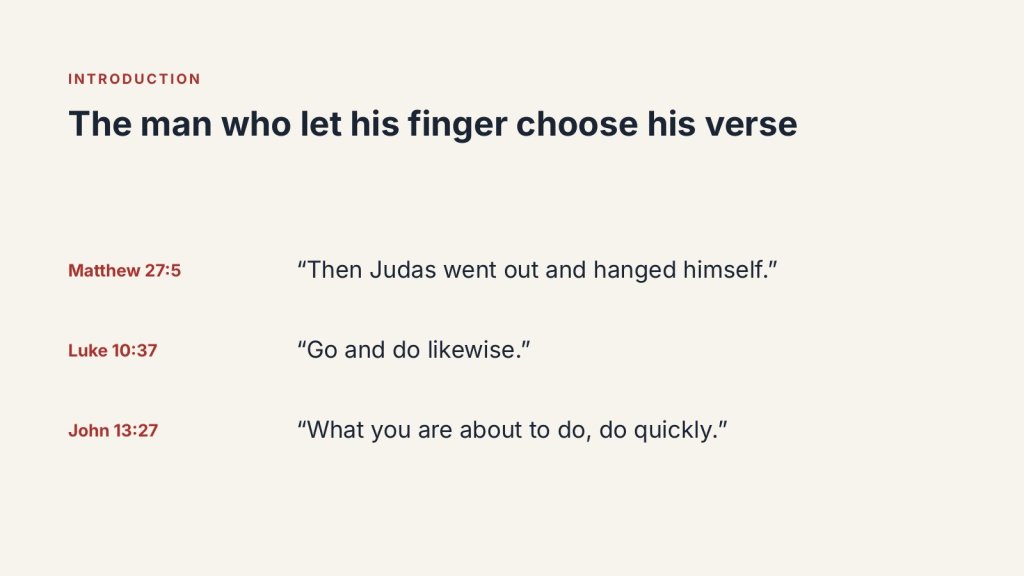
There was a man who sought God’s will by opening his Bible at random and obeying the first verse his finger landed on. He was going through a hard season with his family, so he prayed, opened, and pointed.
- (Matthew 27:5) “Then Judas went out and hanged himself.”
- Puzzled, he called a do-over and flipped again. (Luke 10:37) “Go and do likewise.”
- Flustered, he gave it one last try. (John 13:27) “What you are about to do, do quickly.”
Every verse he read was true. Every conclusion he drew was deadly.
Everybody interprets the Bible. The only question is whether we interpret it well. The man in the story believed every word. His problem was not faith; it was method. Sincerity does not protect you from misreading God. Training does.
In 2 Timothy 2:15, Paul charges a young evangelist to handle the word like a craftsman: “Do your best to present yourself to God as one approved, a worker who does not need to be ashamed and who correctly handles the word of truth.” Not a hobbyist. Not a talker. A workman.
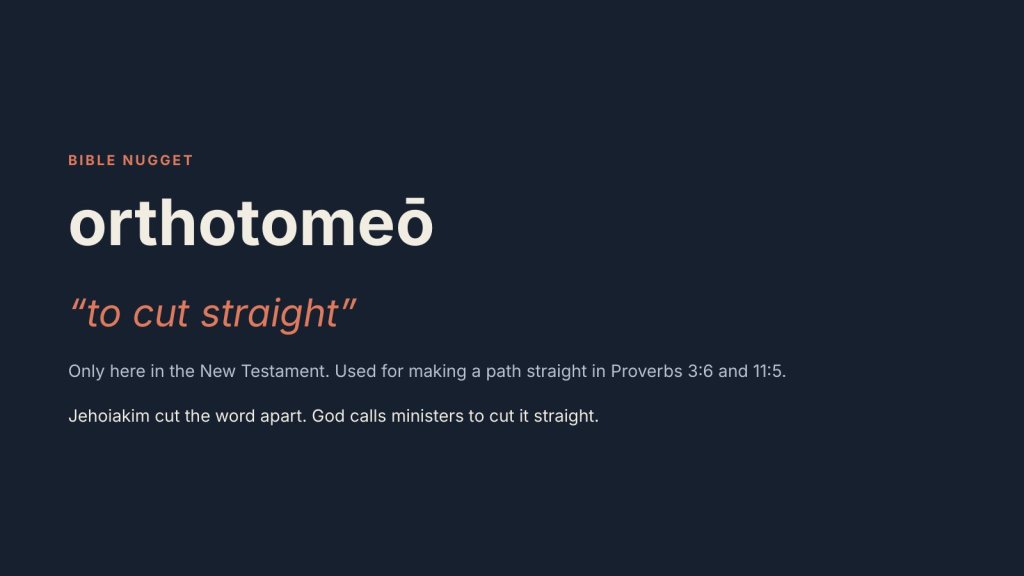
Bible Nugget: “Correctly handles” is one Greek word: orthotomeō, “to cut straight.”
- It appears only here in the New Testament.
- The Greek Old Testament uses it in Proverbs 3:6 and 11:5 for God making a path straight.
- Picture a road crew cutting a straight road through rough country, so others can travel it safely.
- Some older commentators (Pulpit Commentary) suggest Paul the tentmaker had his own trade in mind: cut the pieces straight or nothing fits together.
- Remember Jehoiakim? He took a knife to the word and cut it apart. God calls ministers to take the word and cut it straight.
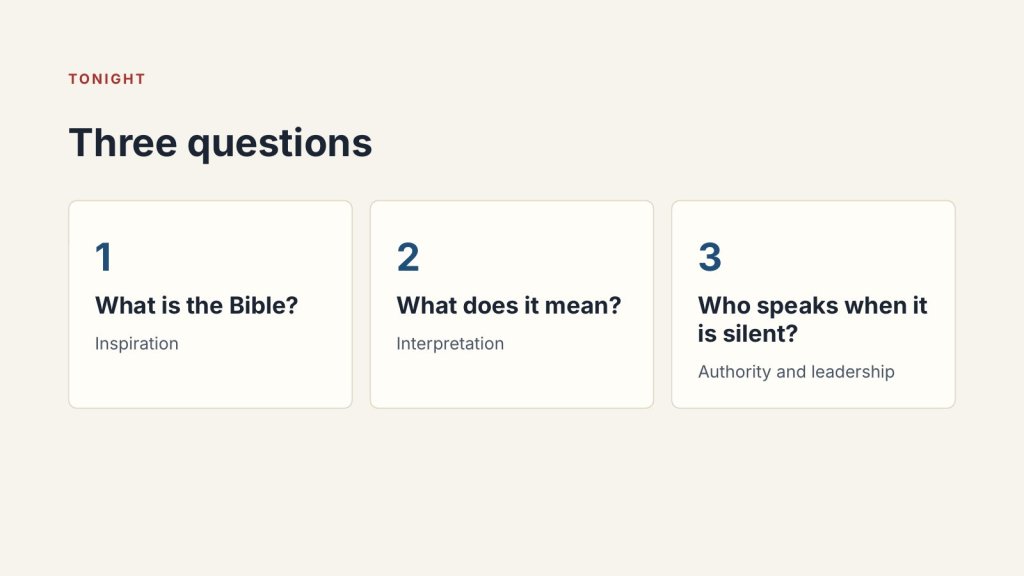
In our last class we studied how God gave us the Bible. In this one we study how to read it, and who speaks for it. Three questions guide us:
- What is the Bible? (inspiration)
- What does it mean? (interpretation)
- Who speaks when it is silent? (authority and leadership)
Bible Nugget: Jesus was the first great hermeneutics teacher (Luke 24:27). On the road to Emmaus, “he explained to them what was said in all the Scriptures concerning himself.” “Explained” is diermēneuō. Our word hermeneutics comes from the same family: the art and science of interpretation. If Jesus took two discouraged disciples through a Bible study, we can take our study seriously.
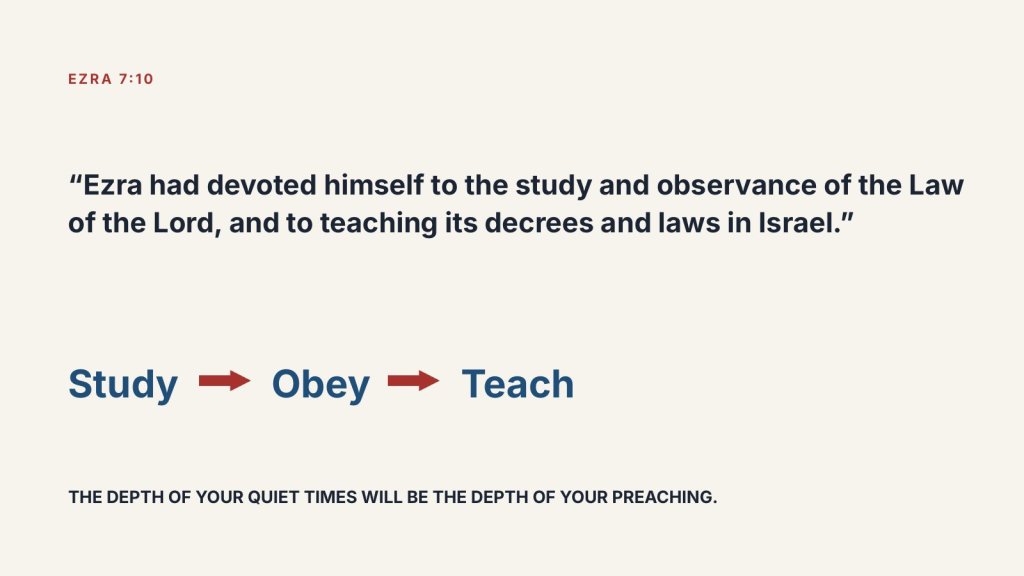
Ezra 7:10 is the theme verse for every minister’s study life: “Ezra had devoted himself to the study and observance of the Law of the Lord, and to teaching its decrees and laws in Israel.” Study, then obey, then teach. The order is the point.
The depth of your quiet times will be the depth of your preaching.
I. Your View of the Book Shapes How You Read It (2 Timothy 3:16-17; 2 Peter 1:20-21)
How you believe the Bible came to be will decide how you study it. Last class we covered how the books were written, gathered, and recognized. Now we ask what that means for the way we open them.
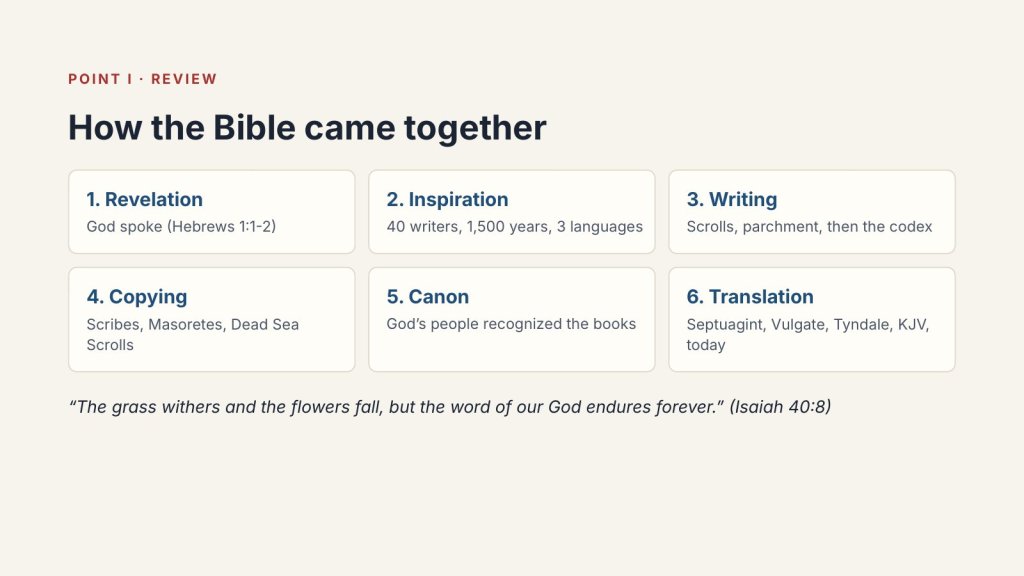
Here is a quick review of how the Bible came together, from God to your hands:
- Revelation: God spoke. He spoke through the prophets at many times and in many ways, and last of all through his Son (Hebrews 1:1-2).
- Inspiration: God breathed out his word through about 40 human writers over roughly 1,500 years, in Hebrew, Aramaic, and Greek.
- Writing: on papyrus scrolls, then parchment, and by the second century the church was using the codex, the first book with pages.
- Copying: scribes copied by hand with great care. The Masoretes counted letters to protect the Hebrew text, and the Dead Sea Scrolls showed how faithfully Isaiah had been copied over a thousand years.
- Canon: God’s people recognized which books God had breathed out. (More on this in a moment.)
- Translation: the Greek Septuagint (about 250 BC), Jerome’s Latin Vulgate (about AD 400), Wycliffe’s English (1380s), Tyndale’s New Testament (1526), the King James (1611), and the modern translations we use today.
Every link in that chain is God keeping his promise: “The grass withers and the flowers fall, but the word of our God endures forever” (Isaiah 40:8).
Bible Nugget: “All Scripture is God-breathed” (2 Timothy 3:16). The word is theopneustos: breathed out by God. B. B. Warfield made the point a century ago: Scripture is not a human book God breathed into. It is a word God breathed out.
The prophets spoke as they were “carried along by the Holy Spirit” (2 Peter 1:21). It is the same word Luke uses for a ship driven by the wind (Acts 27:15, 17). The men raised the sails. The Spirit supplied the wind.
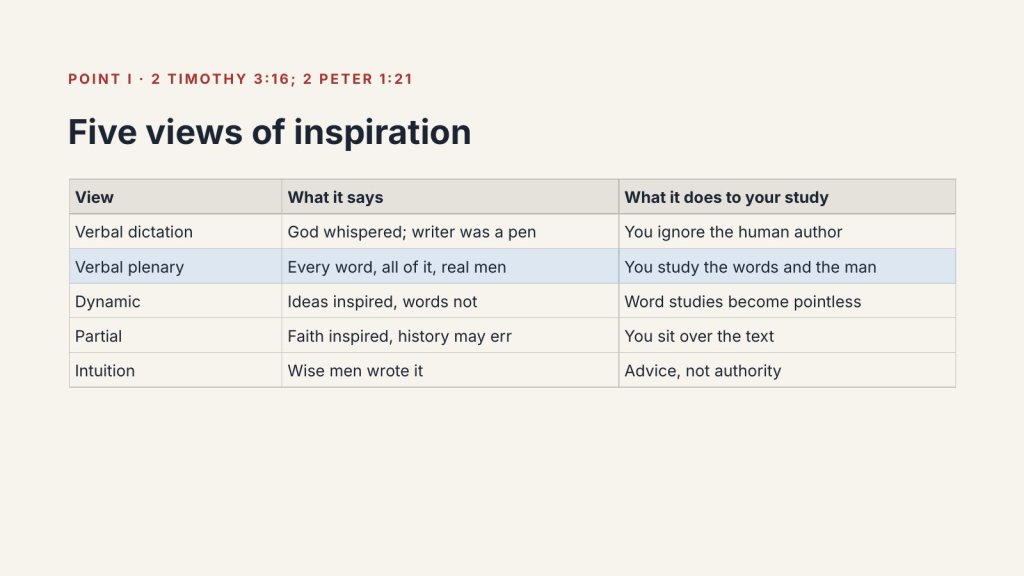
There are five views of inspiration, and each one does something to your Bible study:
- 1. Verbal dictation: God whispered every word and the writer was a pen. Result: the human author does not matter, so you ignore his background, style, and audience.
- 2. Verbal plenary: every word (verbal), all of Scripture (plenary), breathed out by God through real men whose backgrounds God prepared. Result: you study the words and you study the man.
- 3. Dynamic (thought) inspiration: the ideas are inspired, the wording is not. Result: word studies become pointless, and the wording becomes negotiable.
- 4. Partial inspiration: faith and morals are inspired, history and science may be wrong. Result: the reader decides which parts are God’s. You now sit over the text instead of under it.
- 5. Intuition: the Bible is the writing of wise men. Result: the Bible becomes advice, not authority. We reject this.
The Bible itself shows real human authors.
- (Luke 1:1-4) Luke did research. He interviewed eyewitnesses and wrote an orderly account.
- (1 Corinthians 1:14-16) Paul cannot remember whether he baptized anyone else. God did not erase the man; he guarded the message.
- Every writer sounds like himself. John does not write like Paul, and Amos the shepherd does not write like Isaiah in the palace.
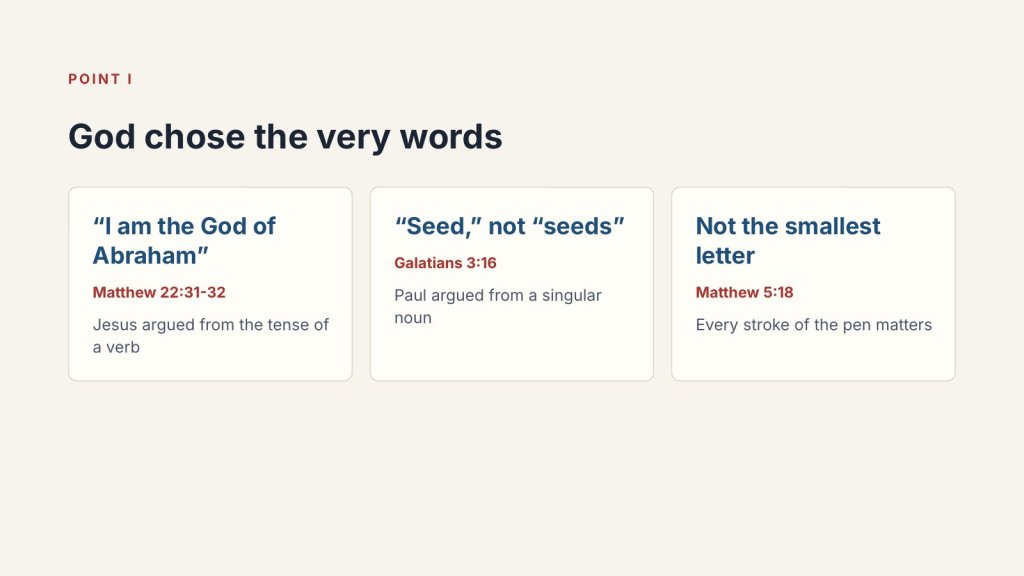
The Bible also shows that God chose the very words.
- (Matthew 22:31-32) Jesus wins an argument about the resurrection on the tense of a verb: “I am the God of Abraham,” not “I was.”
- (Galatians 3:16) Paul builds an argument on a singular noun: “seed,” not “seeds.”
- (Matthew 5:18) Not the smallest letter, not the least stroke of a pen, will disappear.
You cannot hold the dynamic view and preach like Jesus did. He trusted the words, not just the ideas.
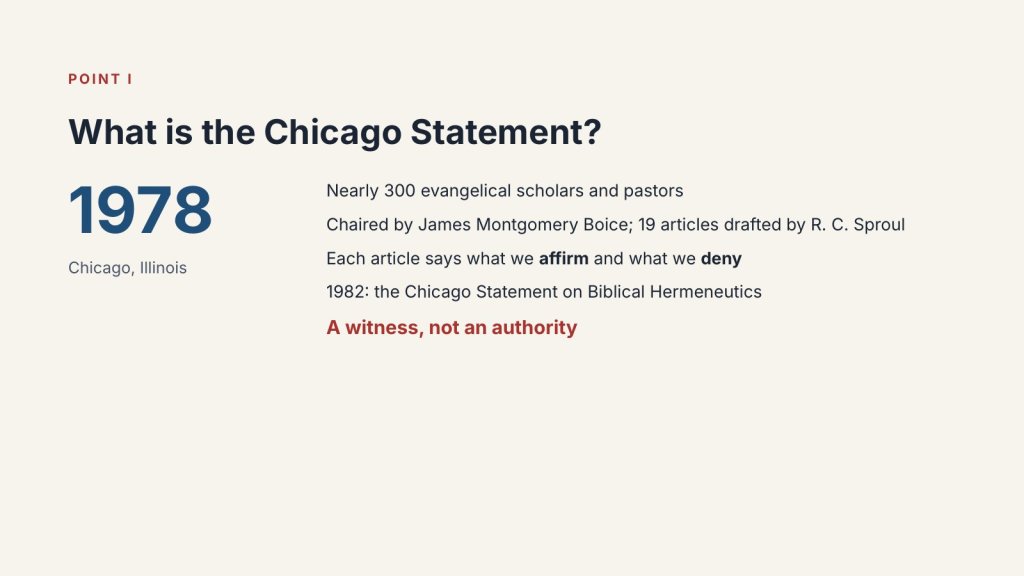
What is the Chicago Statement? I quote it several times in this lesson, so here is the background.
- In October 1978, nearly 300 evangelical scholars and pastors met at the Hyatt Regency O’Hare in Chicago.
- The meeting was called by the International Council on Biblical Inerrancy, chaired by James Montgomery Boice. Leaders included R. C. Sproul, J. I. Packer, Norman Geisler, and Francis Schaeffer.
- Why? In the 1970s, seminaries and denominations that once held the Bible to be without error were backing away from it. Harold Lindsell’s book The Battle for the Bible (1976) put the fight in the open.
- R. C. Sproul drafted the nineteen articles. Each one says what we affirm and what we deny. About four out of five who attended signed it.
- The council met again in 1982 and wrote the Chicago Statement on Biblical Hermeneutics, about how to interpret the Bible. A third statement in 1986 covered application. The council then disbanded.
- The drafters themselves said it should not be given the weight of a creed. That fits us well: we do not follow creeds, but we can learn from good brothers who stood for the Bible. Use it as a witness, not an authority.
The Chicago Statement on Biblical Inerrancy (1978), Article VIII, says it well:
“We affirm that God in His work of inspiration utilized the distinctive personalities and literary styles of the writers whom He had chosen and prepared. We deny that God, in causing these writers to use the very words that He chose, overrode their personalities.”
Theologians call this concursus: God and man both fully at work, with God as the primary author. Warfield compared it to a musician playing different instruments. Same musician, different sound, every note his.
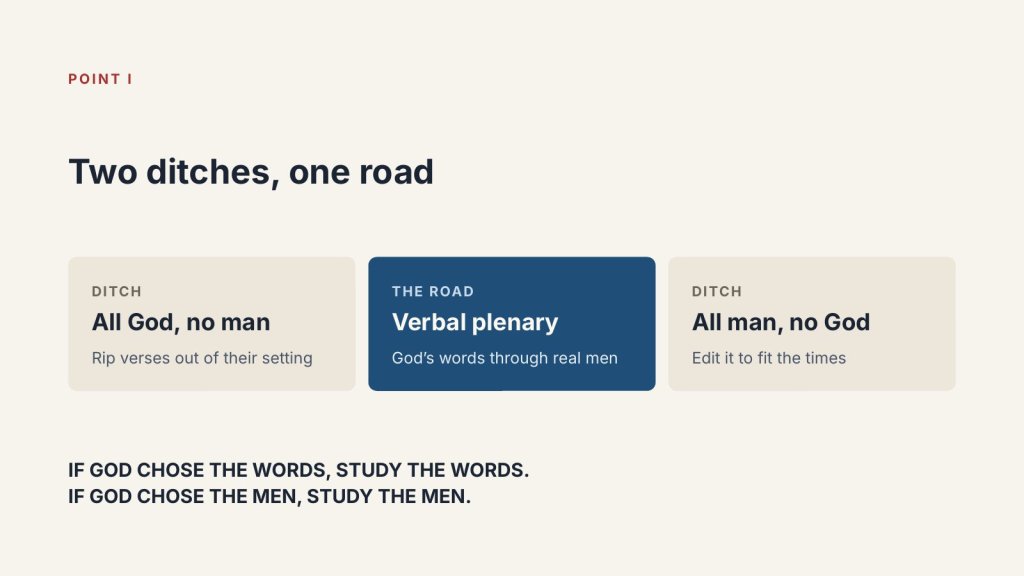
There are two ditches on either side of this road.
- Ditch one: all God, no man. You rip verses out of their setting because “it’s all God talking anyway.”
- Ditch two: all man, no God. You treat the Bible like any other old book and edit it to fit the times.
Verbal plenary inspiration keeps you on the road.
If God chose the words, study the words. If God chose the men, study the men.
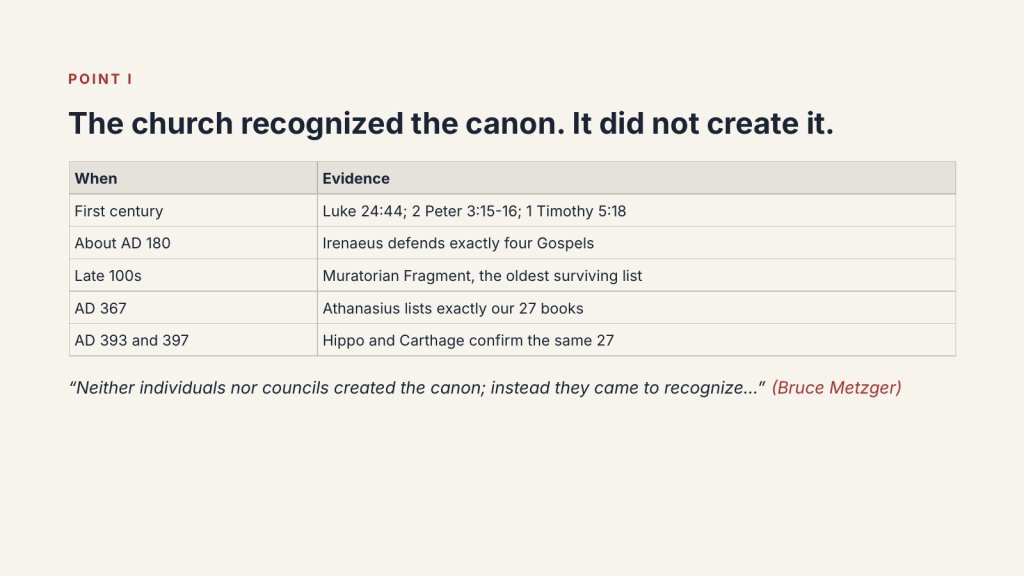
The church recognized the canon; it did not create it. “Canon” comes from a Greek word for a measuring rod. The canon is the measuring rod; the church is what gets measured. Chicago Article I says the Scriptures do not receive their authority from the church, tradition, or any human source.
The evidence starts inside the Bible itself.
- (Luke 24:44) Jesus affirmed the Old Testament as Israel already had it: the Law of Moses, the Prophets, and the Psalms.
- (Luke 11:51) “From the blood of Abel to the blood of Zechariah” runs from Genesis to Chronicles, the first and last books in the Hebrew order. Jesus recognized the whole collection.
- (2 Peter 3:15-16) Peter puts Paul’s letters alongside “the other Scriptures.” The apostles were already recognizing New Testament writings as Scripture.
- (1 Timothy 5:18) Paul quotes Deuteronomy 25:4 and Luke 10:7 side by side and calls both “Scripture.”
- (Colossians 4:16; 1 Thessalonians 5:27) The letters were read aloud and passed from church to church. Recognition began the day they arrived.
Then the early church kept recognizing what it had received.
- Around AD 180: Irenaeus defends exactly four Gospels, Matthew, Mark, Luke, and John, against the heretics’ add-ons.
- Late 100s: the Muratorian Fragment, the oldest surviving list, names most of our New Testament.
- AD 367: Athanasius, bishop of Alexandria, lists exactly our 27 books in his Easter letter.
- AD 393 and 397: councils at Hippo and Carthage confirmed the same 27. They did not vote books in; they put in writing what the churches had already been reading for generations.
The tests were simple. Was it written by an apostle or a close companion of one? Does it agree with the faith already delivered (Jude 3)? Was it received and used by the churches everywhere?
Bruce Metzger of Princeton Seminary, the leading canon scholar of the last century, put it this way:
“Neither individuals nor councils created the canon; instead they came to recognize” the authority those writings already had.
It is like Jesus’ sheep: “My sheep listen to my voice” (John 10:27). The church did not make the word God’s; it recognized his voice. Hold onto that. It will matter when we talk about leadership: the church stands under the word, never over it.
II. Read Out, Not Into (Genesis 3:1-5; Nehemiah 8:8)
The first Bible was one command (Genesis 2:16-17): “You are free to eat from any tree in the garden; but you must not eat from the tree of the knowledge of good and evil, for when you eat from it you will certainly die.” Short, clear, and loving. No commentary needed.
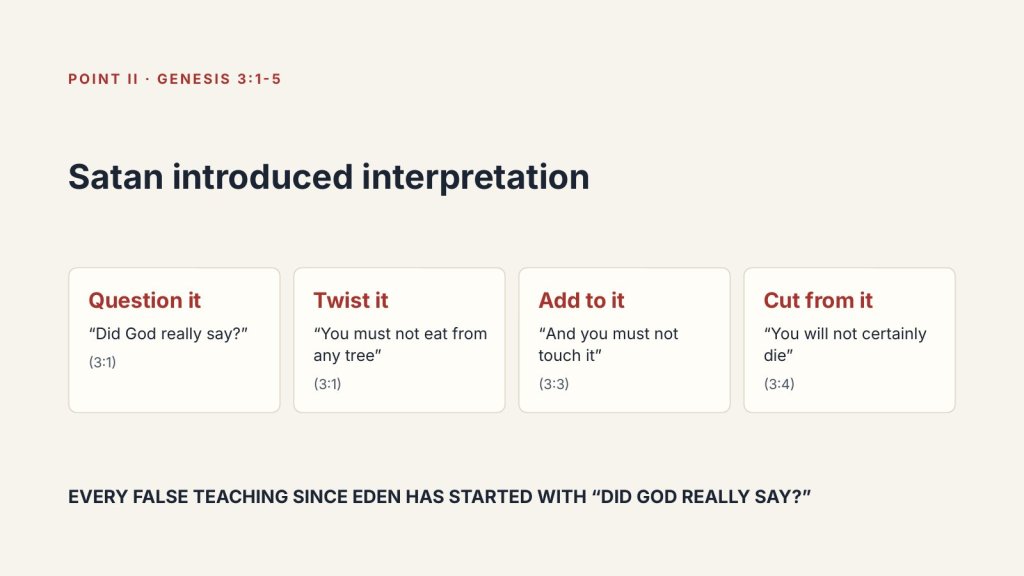
Satan introduced interpretation by questioning what God said (Genesis 3:1-5). His first words in the Bible are “Did God really say?” He did not deny God’s word at first. He reinterpreted it.
- He twisted it into “You must not eat from any tree in the garden.” God had said the opposite: eat from any tree but one.
- Eve then added to it: “and you must not touch it” (3:3). God never said that.
- Then Satan subtracted from it: “You will not certainly die” (3:4).
Question it, twist it, add to it, cut from it. The first sin started with a bad interpretation.
Bible Nugget: Satan has not changed his method; he just learned to quote Scripture. In the wilderness he quotes Psalm 91:11-12 to Jesus, ripped out of context (Matthew 4:6). Jesus answers, “It is also written” (Matthew 4:7). He corrects a misused verse with the rest of the Bible. That is hermeneutics. The devil uses one verse; Jesus uses the whole word.
Every false teaching since Eden has started with “Did God really say?”
Nehemiah 8:8 gives us the first picture of expository preaching in the Bible: “They read from the Book of the Law of God, making it clear and giving the meaning so that the people understood what was being read.” Read it. Explain it. Make sure they get it. That is still the job.
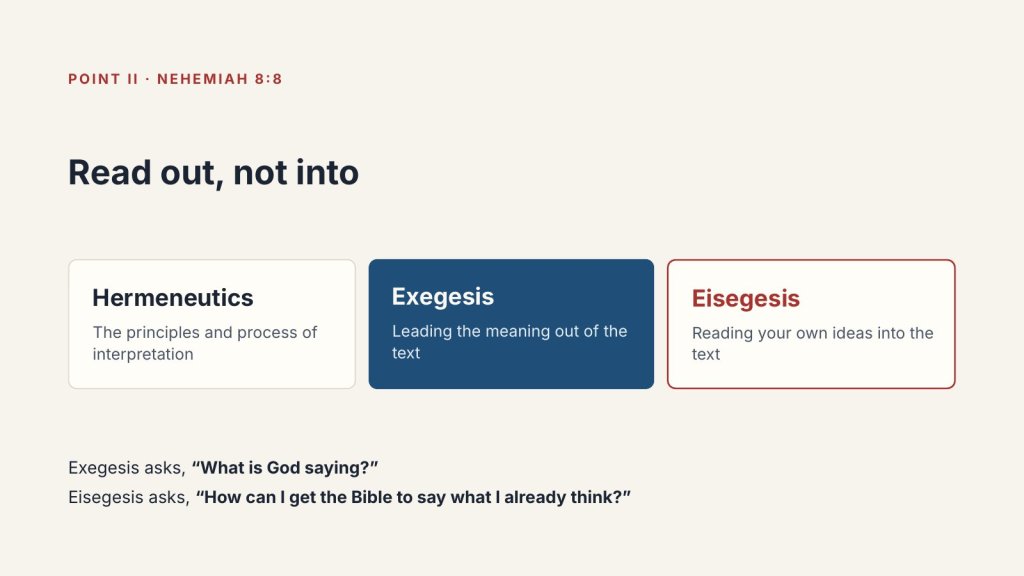
Three words every minister needs to own:
- Hermeneutics: the principles and process of interpretation.
- Exegesis: to lead the meaning out of the text.
- Eisegesis: to read your own ideas into the text.
Exegesis asks, “What is God saying?” Eisegesis asks, “How can I get the Bible to say what I already think?”
Eisegesis has done real damage.
- (Revelation 8:13) Some preachers have made the eagle flying in midair into the United States.
- (Philippians 4:13) We print it on football jerseys, but Paul wrote it about being content when he was hungry and in need (Philippians 4:11-12).
- In the 1700s and 1800s, slave owners preached that Africans were under “the curse of Ham.”
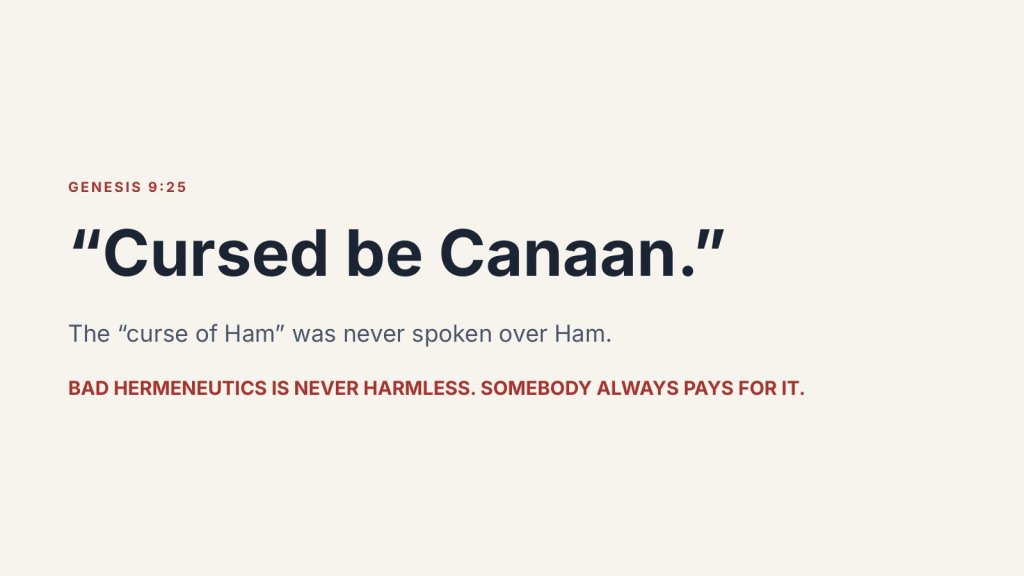
Bible Nugget: Read the text (Genesis 9:25). The curse was not even spoken over Ham. Noah says, “Cursed be Canaan.” Canaan, Ham’s son, was the father of the Canaanites, not of Africa. Men read their sin into a verse that never said what they needed it to say.
Bad hermeneutics is never harmless. Somebody always pays for it.
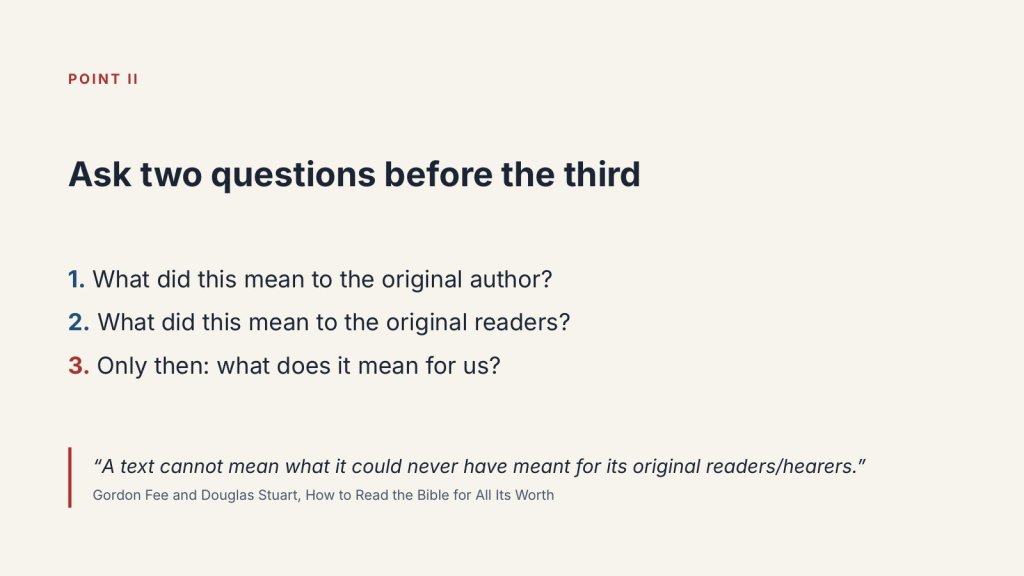
Ask two questions before you ever ask the third.
- 1. What did this mean to the original author?
- 2. What did this mean to the original readers?
- 3. Only then: what does it mean for us?
Gordon Fee and Douglas Stuart, in How to Read the Bible for All Its Worth, say it plainly:
“A text cannot mean what it could never have meant for its original readers/hearers.”
They also warn that interpretation which thrives on being new and unique usually comes from pride, a false idea of spirituality, or a bias we are protecting. If nobody in two thousand years saw what you just “discovered,” slow down.
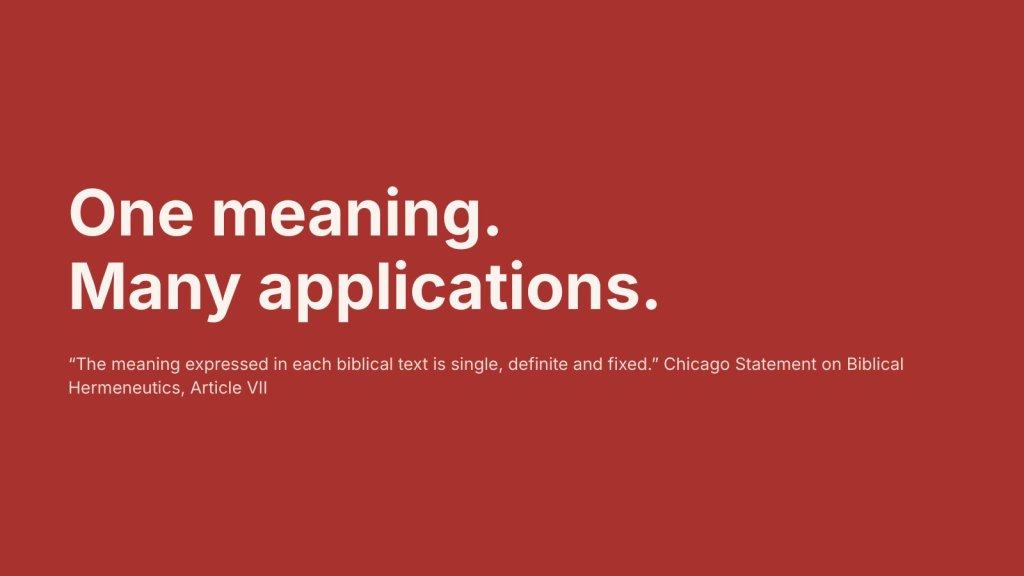
The Chicago Statement on Biblical Hermeneutics (1982), Article VII:
“We affirm that the meaning expressed in each biblical text is single, definite and fixed.”
It also denies that this single meaning eliminates the variety of its application.
One meaning. Many applications.
Most interpretation is sanctified common sense. Fee and Stuart call common sense the most important hermeneutical skill most believers already have. We spent years in English class learning to read a letter, a poem, and a news story differently. Use it.
Jesus’ own listeners kept missing figures of speech.
- (John 3:4) Nicodemus: can a man enter his mother’s womb a second time?
- (John 4:11) The Samaritan woman: you have nothing to draw with, and the well is deep.
- (John 6:52) The crowd: how can this man give us his flesh to eat?
They were not too spiritual. They were too literal in the wrong places.
Challenge: When you prepare a lesson, write the “then” sentence before you write the “now” sentence. If you cannot say what it meant to them, you are not ready to say what it means to us.
III. The Interpreter’s Toolbox: Six Kinds of Criticism (Acts 17:11)
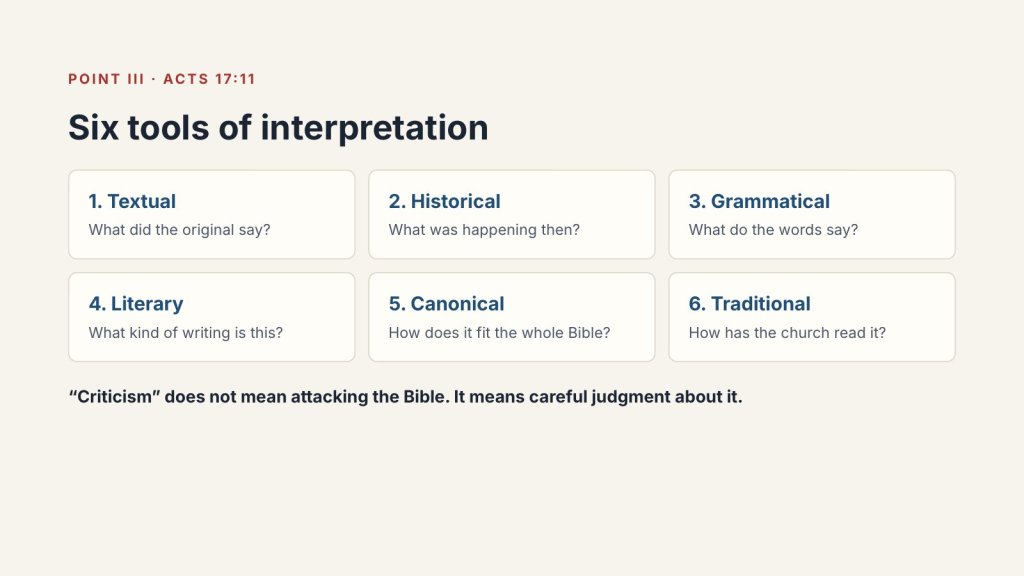
Bible Nugget: The Bereans were doing biblical criticism. They “examined the Scriptures every day to see if what Paul said was true” (Acts 17:11). “Examined” is anakrinō: to investigate, to judge carefully, like a court hearing evidence. In Bible study, “criticism” does not mean attacking the Bible. It means careful judgment about the Bible.
Know the difference between lower and higher criticism.
- Lower criticism asks: what exactly did the original text say?
- Higher criticism asks: who wrote it, when, from what sources, and how was it put together?
Asking those questions is not wrong. But since the 1800s, much of higher criticism started with the assumption that miracles and prophecy cannot happen, and then reached the conclusions it started with. The Chicago Statement on Hermeneutics (Article XVI) affirms using legitimate critical methods to establish the text and its meaning, and denies any method used to question the truth of what the writer said.
Eat the fish. Spit out the bones.
Bible Nugget: Grant Osborne called this process The Hermeneutical Spiral. It is not a circle that goes nowhere, but a spiral: text, context, text again, each pass bringing you closer to the author’s meaning. Here are the six tools that move you up the spiral.
1. Textual Criticism: What did the original manuscripts say?
- We have no original autographs, but we have about 5,800 Greek New Testament manuscripts, far more than any other ancient book.
- Comparing them lets scholars recover the original wording with remarkable confidence. Most differences are spelling and word order.
- Conservative textual scholars point out that no core doctrine rests on a disputed reading.
- This is why your Bible brackets Mark 16:9-20 and John 7:53-8:11 with a note. Know why before a student asks you.
- The KJV translators did faithful work with the manuscripts they had. Since 1611 we have found far older ones: Codex Sinaiticus, Codex Vaticanus, early papyri, and the Dead Sea Scrolls.
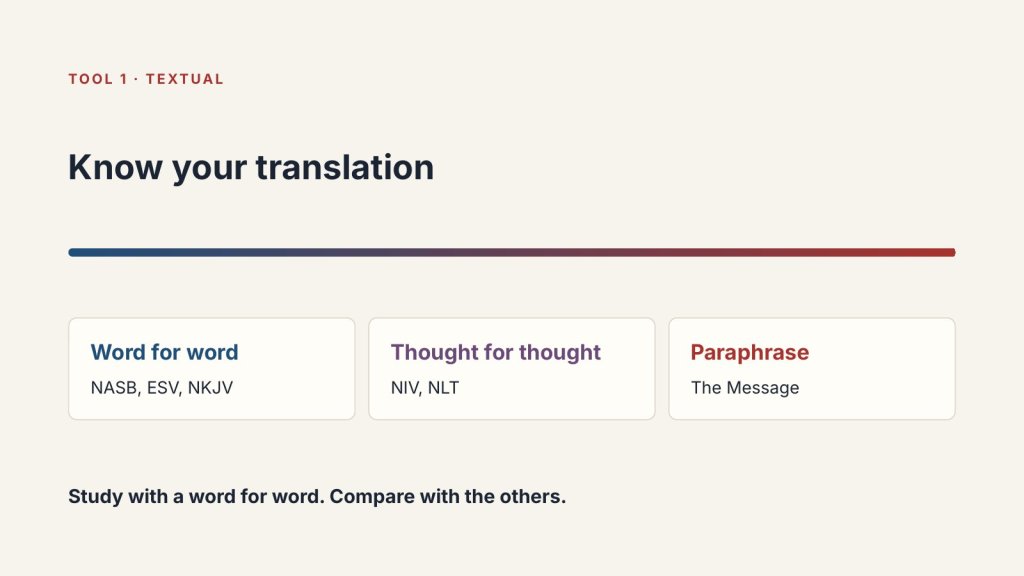
Know your translation: word for word (NASB, ESV, NKJV), thought for thought (NIV, NLT), paraphrase (The Message). Study with a word for word; compare with the others.
2. Historical and Cultural Criticism: What was happening when it was written?
- For the Old Testament, know the Ancient Near East and Israel’s culture. For the New Testament, know the Roman world and first century Judaism.
- (Revelation 3:15-16) Laodicea is widely taught to have piped its water in by aqueduct, so it arrived lukewarm, unlike the hot springs of Hierapolis or the cold water of Colossae. Lukewarm was not a feeling. It was useless.
- Slavery: critics read the Bible through the lens of 1800s race-based chattel slavery. But the Law made kidnapping a man to sell him a capital crime (Exodus 21:16), and Paul lists slave traders among the lawless (1 Timothy 1:10).
- Head coverings (1 Corinthians 11:2-16): without culture you either bind a veil on every woman or throw out the passage. With culture you find the principle and honor it.
3. Grammatical Criticism: What do the words and sentences actually say?
- This is where word studies live. Look up the word, then see how the same author uses it elsewhere.
- (Matthew 28:19-20) There is one command in the Great Commission: make disciples. Going, baptizing, and teaching describe how.
- Watch the grammar: a “therefore” always points back. An “if” sets a condition. A question can be sarcasm.
Bible Nugget: D. A. Carson’s Exegetical Fallacies should be on every minister’s shelf. He warns against the root fallacy: assuming a word always means what its root means. His famous example is that the gospel is the dunamis of God (Romans 1:16). Preachers love to say “dynamite.” But dynamite was invented in 1867. Paul never thought of an explosion. He meant God’s power to save. A word means what its author used it to mean in that sentence. Usage beats etymology.
4. Literary Criticism: What kind of writing is this?
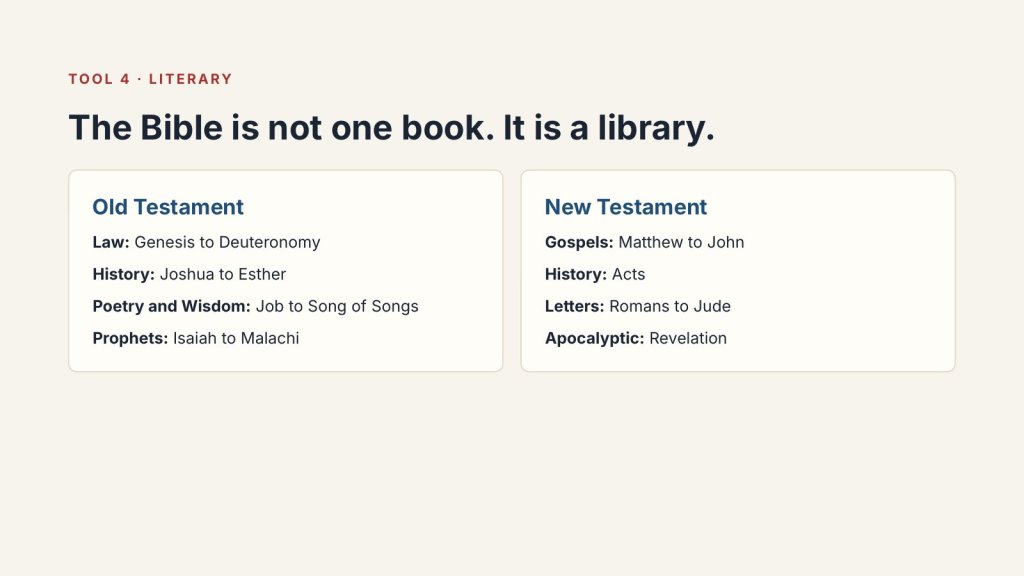
The Bible is not one book. It is a library. You do not read a cookbook the way you read a love letter.
- Old Testament: Law (Genesis to Deuteronomy), History (Joshua to Esther), Poetry and Wisdom (Job to Song of Songs), Prophets (Isaiah to Malachi).
- New Testament: Gospels, History (Acts), Letters (Romans to Jude), Apocalyptic Prophecy (Revelation).
- Proverbs are probabilities, not promises. Proverbs 22:6 is wise counsel, not a guarantee.
- Poetry uses images. (Psalm 91:4) God does not have feathers.
- Hyperbole exaggerates to make a point. (Matthew 5:29-30) Nobody reading this should be missing an eye.
- Apocalyptic speaks in symbols. Do not turn every beast in Revelation into this week’s headlines.
For balance, the Chicago Statement on Hermeneutics (Article XIII) values genre study but denies that genre can be used to turn history the Bible presents as fact into myth. Genesis and Acts are narrative, and narrative is history.
Narrative tells you what happened. It does not always tell you what to do.
- (Acts 1:26) They cast lots to choose an apostle. Are we commanded to?
- (Acts 2:45) They sold property. Is every disciple commanded to?
- (Matthew 27:5) Judas hanged himself. You see where this is going.
Narrative becomes our pattern when the rest of Scripture teaches it. The baptism of Acts 2:38 is taught again in Romans 6:3-4, Colossians 2:12, and 1 Peter 3:21.
5. Canonical Criticism: How does this passage fit the whole Bible?
- Scripture interprets Scripture. The Chicago Statement on Hermeneutics (Article XVII) calls the Bible its own best interpreter.
- Let the clear passages explain the unclear ones. Even Peter said Paul wrote some things hard to understand (2 Peter 3:16).
- (1 Corinthians 15:29) Baptism for the dead appears once and is never taught again. Do not build a practice on it.
Never build a doctrine on one verse the rest of the Bible never repeats.
Know where you are in the timeline of God’s covenants.
- (Luke 23:43) The thief on the cross was saved before Jesus died, while the old covenant still stood. A will takes effect only when the one who made it has died (Hebrews 9:16-17).
- (Ephesians 2:14-16; Colossians 2:16-17) The Sabbath was a sign given to Israel. The law was set aside in Christ’s flesh.
- (2 Timothy 3:16-17) When Paul wrote “all Scripture,” he was pointing Timothy to the Old Testament. Too many disciples do not know their Old Testament.
6. Traditional Criticism: How has the church understood this passage?
- Augustine, Luther, Calvin, the early church fathers, the Restoration preachers: they are not our authority, but they are wise company.
- Chicago Article II denies that creeds, councils, or declarations have authority equal to the Bible. History is a guardrail, not a steering wheel.
Tradition: Is the “morning star” of Isaiah 14:12 Satan or the king of Babylon? In context the taunt is aimed at the king of Babylon (Isaiah 14:4). The church has long also read it as a picture of Satan’s fall. That is possible, but hold it as tradition, not as the plain meaning of the text. Learn to say, “The text says this. Tradition adds this.” That honesty builds trust.
Challenge: Pick the one tool you have never really used and use it in your quiet times this week. Most of us live in tool three and skip the rest.
IV. Where the Bible Speaks and Where It Is Silent (Deuteronomy 29:29; 1 Corinthians 4:6)
God has not told us everything, but he has told us enough: “The secret things belong to the Lord our God, but the things revealed belong to us and to our children forever, that we may follow all the words of this law” (Deuteronomy 29:29).
“Do not go beyond what is written” (1 Corinthians 4:6). Paul says this so the church would stop taking pride in one leader over another. Going beyond Scripture always ends up exalting a man.
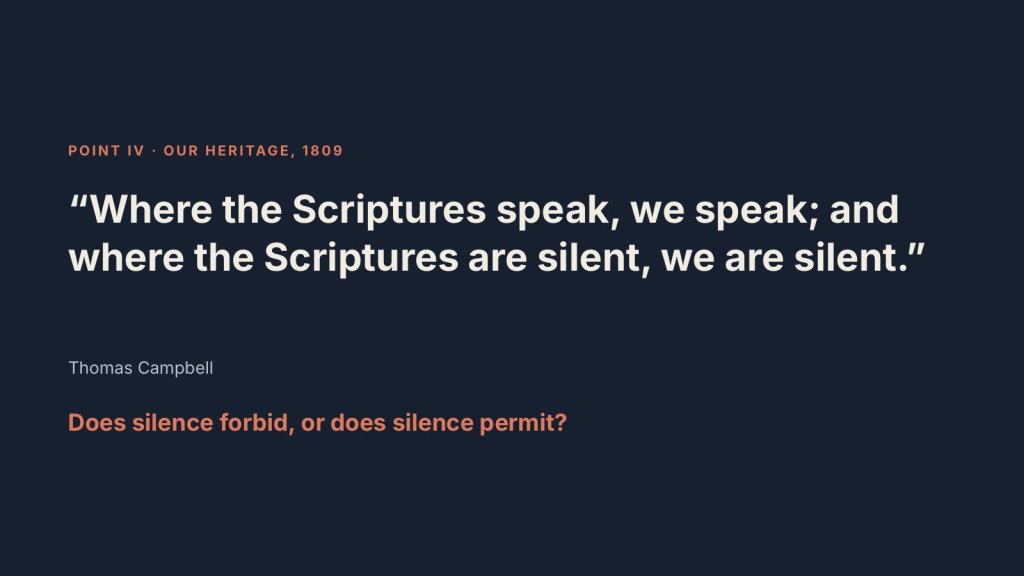
Our heritage gives us a famous rule. In 1809, Thomas Campbell wrote this for the Restoration Movement:
“Where the Scriptures speak, we speak; and where the Scriptures are silent, we are silent.”
It is a great rule. But the movement later split over what “silent” means.
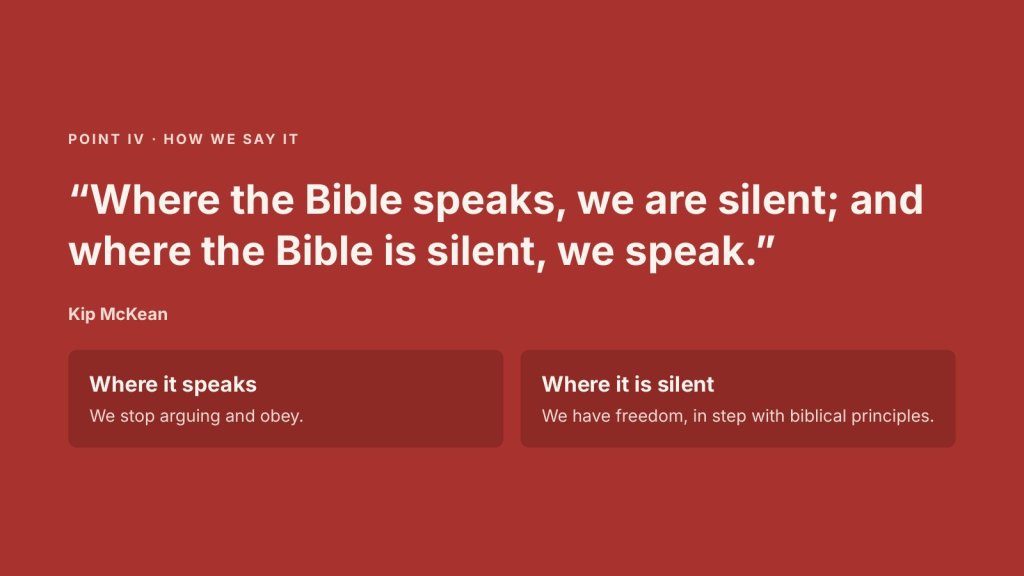
Does silence forbid, or does silence permit? Brothers broke fellowship over that question in the late 1800s.
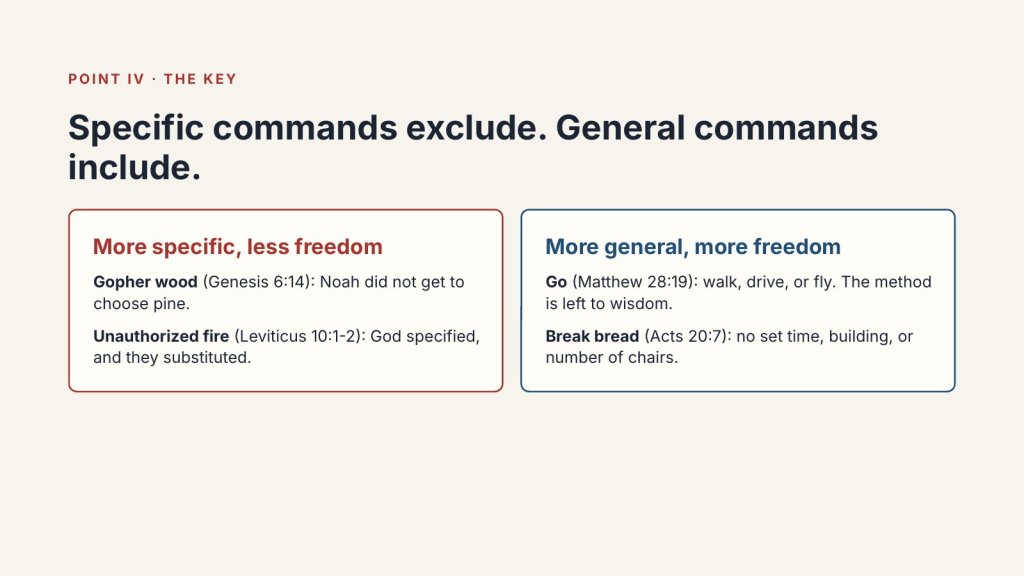
Here is the key: specific commands exclude, and general commands include. The more specific the command, the less freedom. The more general the command, the more freedom.
- (Genesis 6:14) God said cypress (gopher) wood. Noah did not get to choose pine.
- (Leviticus 10:1-2) Nadab and Abihu offered fire “contrary to his command.” God had specified, and they substituted.
- (Matthew 28:19) God said go. He did not say walk, drive, or fly. The method is left to wisdom. There is silence in the method, so we speak!
- (Acts 20:7) God shows us the church gathering to break bread. He does not tell us what time, what building, or how many chairs.
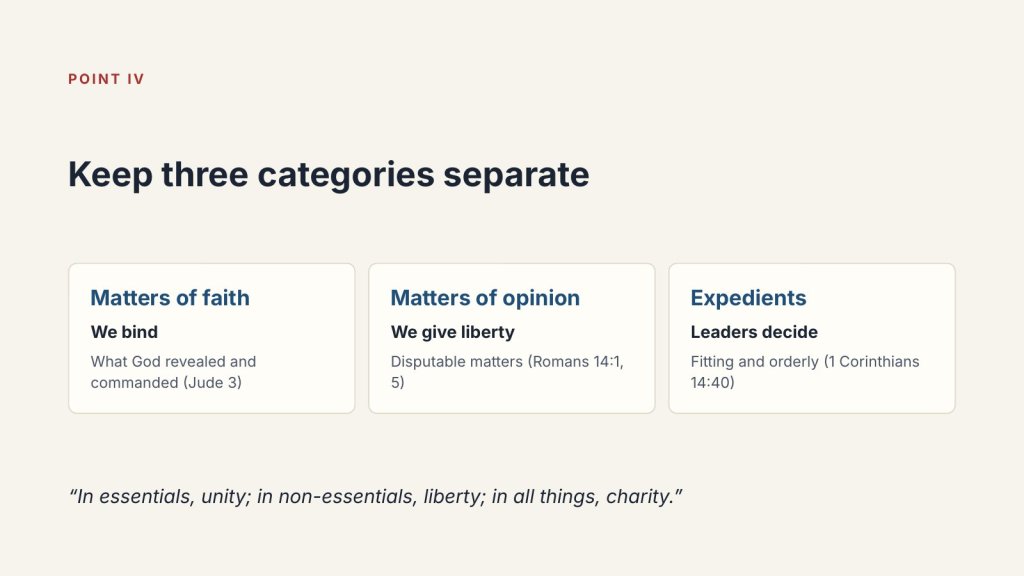
Three categories every minister must keep separate:
- Matters of faith: what God has revealed and commanded. We bind these (Jude 3).
- Matters of opinion: disputable matters God leaves to conscience. We give liberty (Romans 14:1, 5).
- Expedients: the best way to carry out what God commanded. Leaders decide these with wisdom, so that everything is done in a fitting and orderly way (1 Corinthians 14:40).
A seventeenth century line usually credited to Rupertus Meldenius sums it up:
“In essentials, unity; in non-essentials, liberty; in all things, charity.”
Unity where God has spoken. Liberty where he has not. Love everywhere.
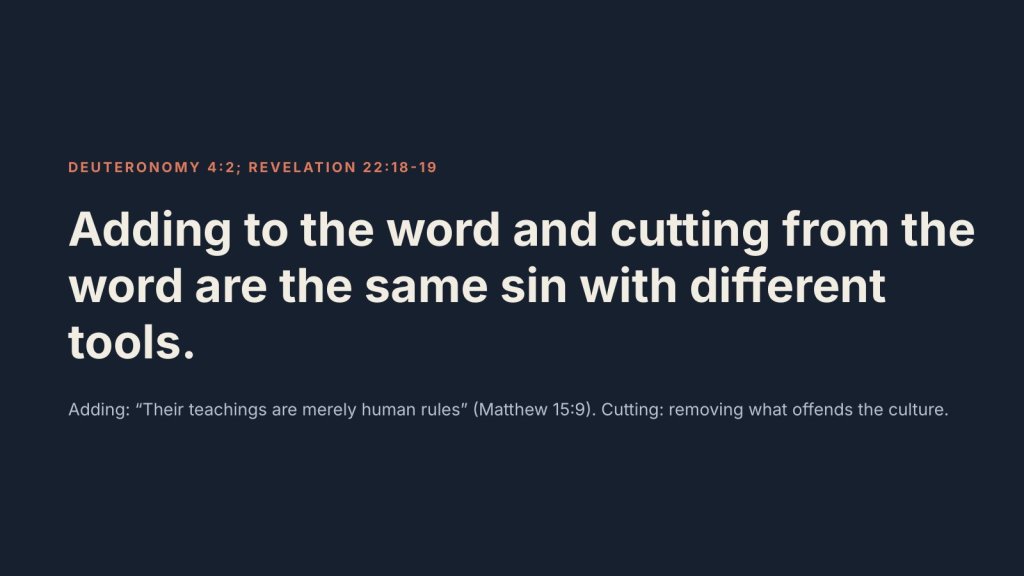
There are two ways to break the rule, and both are deadly.
- Adding: the Pharisees bound their traditions on people. “They worship me in vain; their teachings are merely human rules” (Matthew 15:9).
- Subtracting: the modern church cuts out what offends the culture.
God warns against both (Deuteronomy 4:2; Revelation 22:18-19).
Adding to the word and cutting from the word are the same sin with different tools.
V. Who Speaks When the Bible Is Silent? (Acts 15:28; Hebrews 13:17)
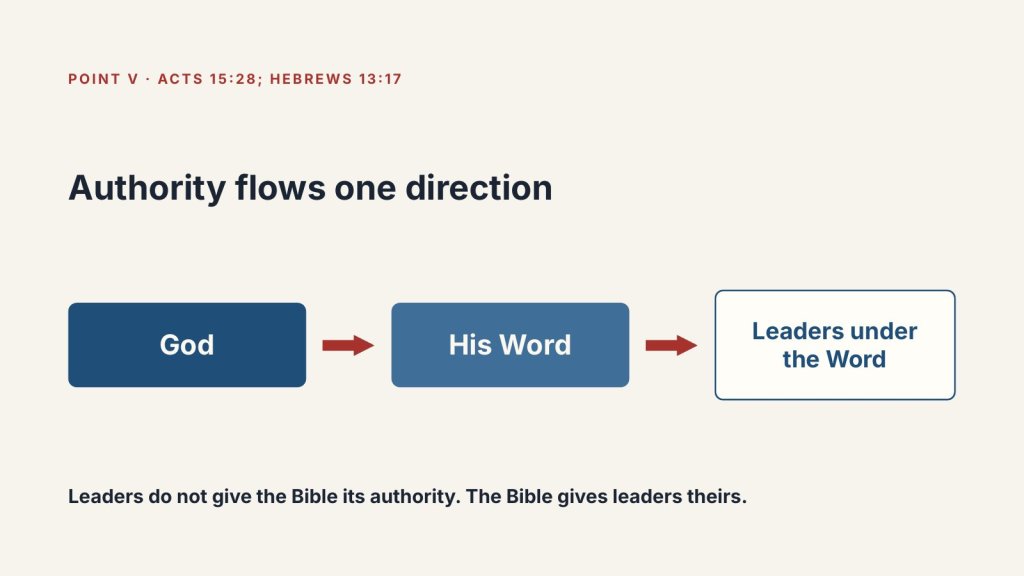
Authority flows in one direction: God, then his word, then leaders who stand under his word. Leaders do not give the Bible its authority. The Bible gives leaders theirs. Every bit of authority a leader has is borrowed, and borrowed authority must be used the way the owner intended.
“It seemed good to the Holy Spirit and to us” (Acts 15:28). Watch their process: a real question, an open discussion, testimony of what God was doing, and Scripture (Amos 9:11-12 quoted in Acts 15:16-18). Then came a decision, written down and delivered in person. The apostles’ authority was unique, but their process is a model: Scripture first, then sanctified judgment. And notice their heart: “We should not make it difficult for the Gentiles who are turning to God” (Acts 15:19).
Leaders are called to bring order where Scripture gives the goal but not the details.
- (Titus 1:5) Titus was left in Crete to “put in order what was left unfinished.”
- (1 Corinthians 14:33, 40) “Everything should be done in a fitting and orderly way.”
- (1 Corinthians 11:16) Paul appeals to the practice of the churches.
Bible Nugget: “Have confidence in your leaders and submit to their authority” (Hebrews 13:17). The word often translated “obey” is peithō: to be persuaded. Good leaders persuade from Scripture. Good disciples choose to be persuadable. Leaders “keep watch over you as those who must give an account.” That is weight, not privilege.
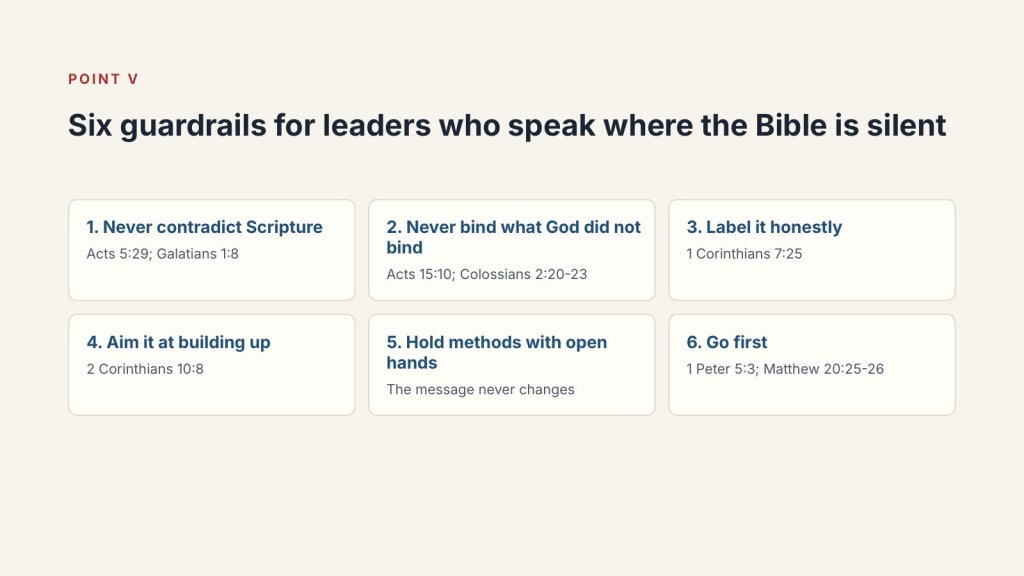
Six guardrails for leaders who speak where the Bible is silent:
- 1. Never contradict Scripture (Acts 5:29; Galatians 1:8).
- 2. Never bind as salvation what God did not bind (Acts 15:10; Colossians 2:20-23).
- 3. Label it honestly. “Thus says the Lord” is different from “This is our best judgment” (1 Corinthians 7:25).
- 4. Aim it at building up. Paul’s authority was “for building you up rather than tearing you down” (2 Corinthians 10:8).
- 5. Hold methods with open hands. The message never changes. Methods should.
- 6. Go first. Shepherds lead by example, not by lording it over people (1 Peter 5:3; Matthew 20:25-26).
Disciples have a responsibility too.
- Follow leaders in matters of judgment even when you would have done it differently.
- Disagree biblically, privately, and respectfully, and keep following while you talk it through.
- Do not confuse your preference with a conviction, and do not confuse a leader’s judgment with a command of God.
Where the Bible speaks, we are silent. Where the Bible is silent, leaders may speak, but they speak as shepherds, not as prophets.
Challenge: Write down three things you are teaching or directing in your ministry this week. Put each one in a category: command, principle, or our judgment.
VI. The Minister’s Study Life (1 Timothy 4:13-16; Hebrews 5:12-14)
Paul tells Timothy to devote himself to the word and watch his life and doctrine closely: “Be diligent in these matters; give yourself wholly to them, so that everyone may see your progress” (1 Timothy 4:15). People should be able to see your Bible study growing. If your schedule has no room for the word, your schedule is the problem.
Bible Nugget: Mature believers are “trained by constant use” (Hebrews 5:14). “Trained” is gymnazō, where we get gymnasium. You do not become a skilled interpreter by attending a class. You become one by repetition. You don’t pick up a sword and know how to fight. Someone trained me.
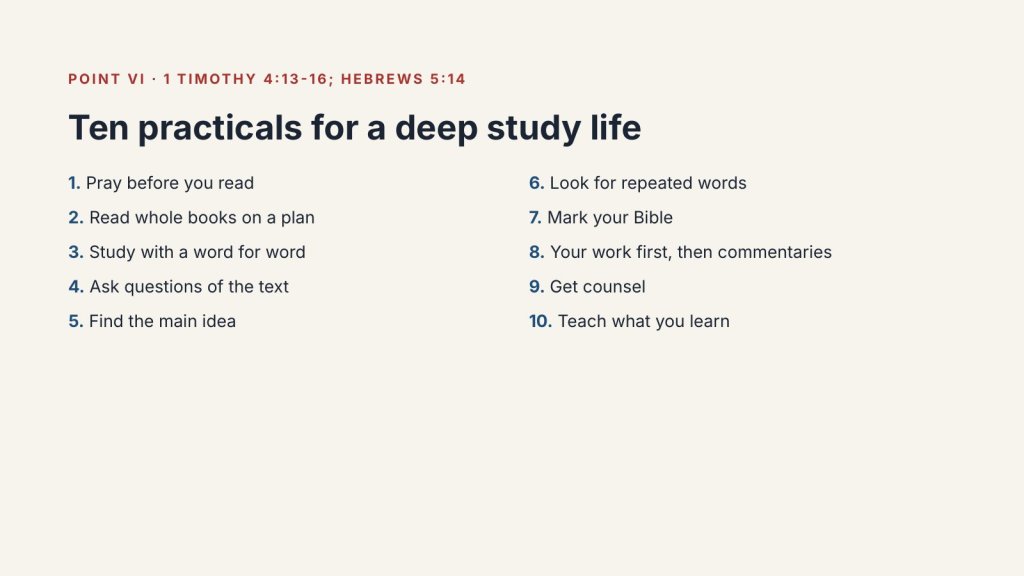
Ten practicals for a deep study life:
- 1. Pray before you read. “Open my eyes that I may see wonderful things in your law” (Psalm 119:18).
- 2. Read whole books, by thought units, on a plan. Do not graze verse by verse.
- 3. Use a word for word translation for study, and compare two or three others.
- 4. Ask questions of the text: Who wrote it? To whom? Why? What problem is he answering? Reading a letter is like hearing one side of a phone call.
- 5. Find the main idea of the passage, then where it fits in the big story of the Bible.
- 6. Look for repeated words and do word studies the right way.
- 7. Mark your Bible: red for commands, green for history, black for doctrine, blue for promises and prayers.
- 8. Do your own work first, then check conservative commentaries: Blue Letter Bible, Coffman on StudyLight, Bible Hub, the Pulpit Commentary, Halley’s Bible Handbook.
- 9. Get counsel. Talk through your study with your discipler and your evangelist (Romans 15:14; Ephesians 4:11-13).
- 10. Teach what you learn. You never know a passage until you have taught it (2 Timothy 2:2).
A note on AI tools: if you use them in your study, give them guardrails.
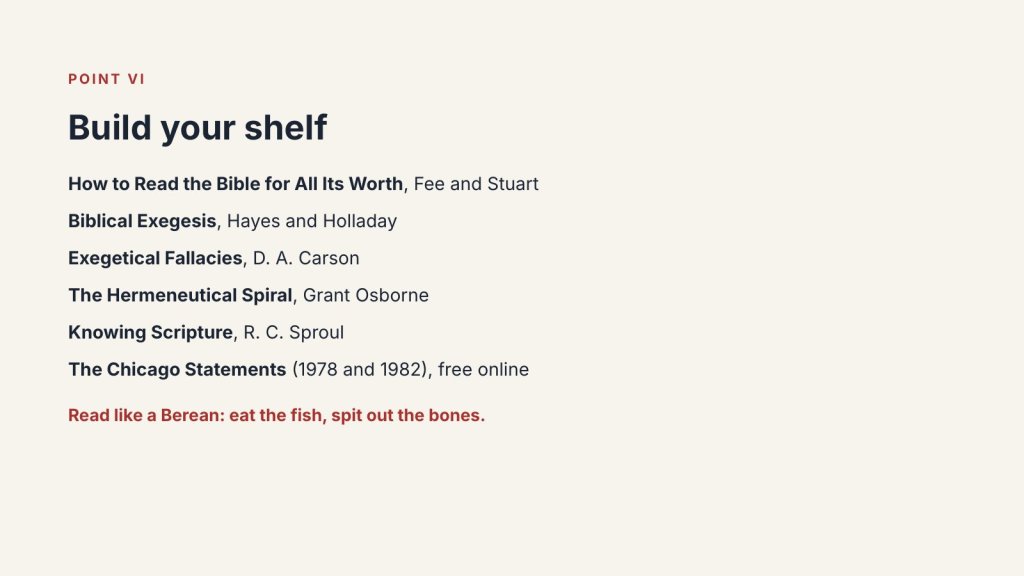
Build your shelf. Here is my recommended reading:
- Gordon Fee and Douglas Stuart, How to Read the Bible for All Its Worth
- John H. Hayes and Carl R. Holladay, Biblical Exegesis
- D. A. Carson, Exegetical Fallacies
- Grant Osborne, The Hermeneutical Spiral
- R. C. Sproul, Knowing Scripture
- The Chicago Statements on Biblical Inerrancy (1978) and Biblical Hermeneutics (1982), free online
Read every book like a Berean: eat the fish, spit out the bones.
Conclusion (2 Timothy 2:15)
Go back to the man with his finger on Judas. He loved the Bible. He just never learned to cut it straight. God is not asking for ministers who can quote verses. He is asking for workmen who handle them correctly.
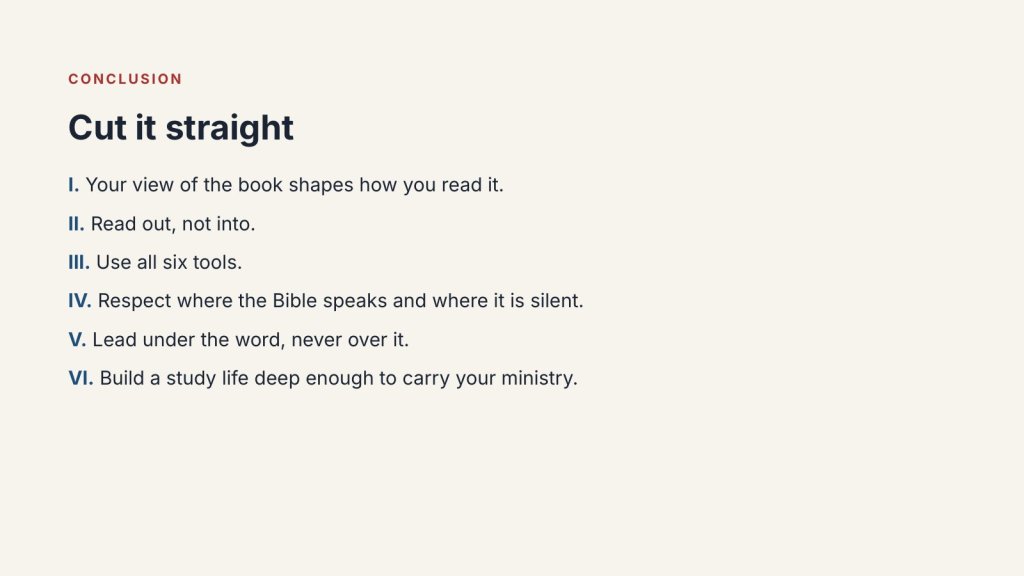
- I. Your view of the book shapes how you read it.
- II. Read out, not into.
- III. Use all six tools.
- IV. Respect where the Bible speaks and where it is silent.
- V. Lead under the word, never over it.
- VI. Build a study life deep enough to carry your ministry.

Your assignment: Take 1 Corinthians 15:29 and walk it through all six tools. On one page, write what it meant then, what it means now, and one place you realize you have been reading something into the Bible.


Leave a Reply